 WhatsApp
 sales@unpchemicals.com
 +86 16638830202
A Comprehensive Review of Demulsifiers in Crude Oil Production
What is a Demulsifier?
Demulsifiers are specialized chemical additives designed to separate emulsified water from crude oil. During crude oil extraction, gathering, and processing, stable water-in-oil (W/O) and oil-in-water (O/W) emulsions are inevitably formed due to the intense mixing of oil, water, and naturally occurring surfactants such as asphaltenes, resins, and naphthenic acids that accumulate at the oil-water interface, creating a rigid interfacial film that prevents the coalescence of dispersed water droplets and makes gravity separation extremely slow and inefficient. Demulsifiers, also known as emulsion breakers or de-emulsifiers, are surface-active compounds that counteract this stabilization by migrating to the oil-water interface, displacing the naturally occurring emulsifying agents, and disrupting the rigid interfacial film, thereby allowing the dispersed water droplets to collide, coalesce, and eventually settle out of the oil phase under the influence of gravity or other external forces. By improving dehydration efficiency, demulsifiers help crude oil meet pipeline and refinery specifications, protect downstream equipment from corrosion caused by dissolved salts and water, reduce energy consumption associated with heating and pumping, and ensure the smooth and economical production and transportation of crude oil throughout the entire upstream and midstream value chain.
The Chemistry of Emulsion Formation and Destabilization
The formation of stable crude oil emulsions is a complex physicochemical phenomenon governed by the interplay of interfacial tension, droplet size distribution, and the presence of naturally occurring surface-active species. When crude oil is produced from a reservoir, it typically coexists with formation water, and the turbulent flow through the reservoir rock, wellbore, chokes, valves, and pipelines provides sufficient shear energy to disperse one phase into the other in the form of microscopic droplets, giving rise predominantly to water-in-oil (W/O) emulsions in conventional systems, although oil-in-water (O/W) and even complex multiple emulsions can be encountered in heavy oil and high-water-cut scenarios. The stability of these emulsions is primarily attributed to the accumulation of asphaltenes, resins, waxes, and fine solid particles at the oil-water interface, which form a viscoelastic interfacial layer that acts as a physical barrier against droplet coalescence; asphaltenes, in particular, are highly surface-active due to their polyaromatic structure with polar functional groups, and they tend to aggregate at the interface, forming a rigid, cross-linked network that is difficult to disrupt.
The mechanism by which demulsifiers counteract this stabilization involves several sequential steps: first, the demulsifier must be sufficiently soluble in the continuous oil phase to diffuse through the bulk oil and reach the oil-water interface; second, it must adsorb onto the interface more rapidly and more strongly than the naturally occurring emulsifiers, thereby displacing them through a competitive adsorption process; third, once adsorbed, the demulsifier must reduce the interfacial tension and weaken the viscoelastic properties of the interfacial film, making it more susceptible to rupture upon droplet collision; and finally, the demulsifier may also promote flocculation by bridging between adjacent droplets or by altering the electrostatic charge on the droplet surfaces, thereby increasing the frequency and effectiveness of droplet collisions. The overall effectiveness of a demulsifier is therefore determined by a delicate balance of its molecular architecture, including its hydrophilic-lipophilic balance (HLB), relative solubility number (RSN), molecular weight, and the nature of its functional groups, all of which must be carefully matched to the specific characteristics of the crude oil emulsion being treated.
Methods of Promoting Oil-Water Separation
The destabilization and separation of crude oil emulsions can be achieved through a variety of physical and chemical methods, each operating on different principles and offering distinct advantages and limitations depending on the specific operational context. The first and most widely employed physical method is heating, which works by decreasing the viscosity of the crude oil, thereby increasing the mobility of dispersed water droplets and reducing the resistance to their movement through the continuous oil phase, while also increasing the density difference between oil and water to enhance the buoyant force driving water droplets toward the bottom of the separation vessel and accelerating the rate of droplet collisions, a phenomenon known as flocculation, by increasing the thermal energy and Brownian motion of the dispersed phase; however, excessive heating is energy-intensive and can lead to undesirable side effects such as the vaporization of light hydrocarbon fractions, increased corrosion rates, and the potential for thermal degradation of heat-sensitive crude oil components, so it is typically used in combination with other methods rather than as a standalone solution. The second method is centrifugation, which applies a powerful centrifugal force to accelerate the separation of phases based on their density difference and is particularly effective for the treatment of oily wastewater and for laboratory-scale bottle testing, although its high capital and operating costs generally limit its use to specialized industrial applications rather than large-scale crude oil processing.
The third method is simply the provision of sufficient residence time, which allows gravity to act on the emulsion over an extended period, as is the case in long flowlines, large settling tanks, and atmospheric storage vessels, where the slow but relentless force of gravity gradually causes water droplets to settle and coalesce at the bottom of the vessel; while this method requires no additional energy input beyond the initial pumping, it necessitates very large equipment footprints and long processing times, making it impractical for high-throughput operations and for emulsions that are particularly stable. The fourth method is the application of an electric field, typically high-voltage alternating current (AC), which induces dipolar charges on the dispersed water droplets, causing them to be attracted to one another and to align along the electric field lines, thereby dramatically increasing the collision frequency and coalescence rate between droplets; electrostatic treaters are widely used in crude oil desalting operations, where they can achieve very low water and salt contents in the treated oil, but they require a continuous oil phase with sufficient electrical conductivity and are generally less effective for very heavy or highly conductive crude oils. The fifth and arguably most versatile and cost-effective method is the use of chemical demulsifiers, which are emulsion-breaking additives that can be injected at various points in the production system, including downhole, at the wellhead, in the flowline, or at the inlet of the separation facility, and which work by chemically disrupting the stabilizing interfacial film and promoting the coalescence and settling of water droplets. In practice, most modern crude oil treatment facilities employ a combination of these methods, typically using chemical demulsifiers as the primary treatment agent supplemented by heating and/or electrostatic coalescence to achieve the desired separation efficiency and to meet the stringent water and salt content specifications required for pipeline transportation and refinery feedstock.
Chemical Classifications of Demulsifiers
Demulsifiers can be classified into several major chemical families based on their molecular structure, and each family exhibits distinct performance characteristics that make it more or less suitable for particular crude oil types and operating conditions. One of the most important and widely used families is the resin oxyalkylates, which are produced by the alkoxylation of phenolic or amino-formaldehyde resins with ethylene oxide (EO) and propylene oxide (PO), resulting in block or random copolymer structures that can be finely tuned to achieve the desired hydrophilic-lipophilic balance; resin oxyalkylates are known for their excellent water-dropping performance and their ability to produce a clear, sharp oil-water interface, and they are particularly effective for medium to heavy crude oils with high asphaltene content. Another major family is the polymerized polyols, which are typically based on polyoxyalkylene glycols or polyether polyols with high molecular weights and which function primarily as drying agents that reduce the residual water content in the treated oil to very low levels, although they may be somewhat slower in terms of initial water dropping compared to resin-based demulsifiers. Esterified phenolic polymers represent another important class, in which phenolic resins are modified through esterification reactions to introduce additional functional groups that enhance their interfacial activity and their ability to displace asphaltenes from the oil-water interface, and these compounds are often used as dehydrating agents in applications where rapid and complete water removal is critical. Alkoxyamines, produced by the alkoxylation of amine-based initiators such as ethylenediamine or polyethyleneimine, represent a versatile class of demulsifiers that exhibit both cationic and nonionic surface-active properties, making them effective for a wide range of crude oil types and particularly useful for applications requiring wetting effects and oil-in-water demulsification.
In addition to these primary chemical families, there are also proprietary blends that combine two or more of these chemistries in carefully optimized ratios to achieve synergistic performance benefits, such as the combination of a fast-acting water dropper with a slow-acting drying agent to achieve both rapid initial separation and low residual water content in the final treated oil. The relative solubility number (RSN) is a key parameter used to characterize and select demulsifiers, as it provides a quantitative measure of the compound's solubility in water relative to its solubility in oil, with lower RSN values indicating more oil-soluble (lipophilic) products and higher RSN values indicating more water-soluble (hydrophilic) products, and the optimal RSN for a given application depends on the crude oil's API gravity, asphaltene content, temperature, and the type of emulsion being treated.
Selection Criteria and Application Challenges
The selection of an appropriate demulsifier for a specific crude oil treatment application is a complex process that requires careful consideration of multiple interrelated factors, and it is rarely possible to predict the optimal product based solely on theoretical considerations or on the performance of a demulsifier in a different crude oil system. The first and most fundamental criterion is the nature and characteristics of the crude oil itself, including its API gravity, viscosity, asphaltene and resin content, wax content, total acid number (TAN), and the presence of any production chemicals such as corrosion inhibitors, scale inhibitors, or paraffin inhibitors that may interact with the demulsifier and either enhance or inhibit its performance; heavy crude oils with high asphaltene content typically require more powerful, oil-soluble demulsifiers with lower RSN values and higher molecular weights, while lighter crude oils may respond well to more water-soluble products with higher RSN values. The second critical factor is the type and stability of the emulsion, which is influenced by the water cut, the droplet size distribution, the pH and salinity of the produced water, and the degree of shear and mixing that the emulsion has experienced during production and transportation. The third factor is the operating conditions of the separation facility, including the treatment temperature, the available residence time in the separators and treaters, the use of electrostatic coalescence or other physical treatment methods, and the target specifications for basic sediment and water (BS&W) and salt content in the exported crude oil.
The fourth factor is the dosage and injection point of the demulsifier, which must be optimized to ensure that the chemical is well mixed with the emulsion and has sufficient time to diffuse to the interface and act before the crude oil reaches the separation equipment, and it is common practice to conduct bottle tests or field trials to determine the optimal dosage rate, which typically ranges from a few parts per million (ppm) to several hundred ppm depending on the severity of the emulsion. One of the most significant challenges in demulsifier application is the phenomenon of over-treating, in which excessive demulsifier dosage can actually stabilize the emulsion rather than break it, because the excess demulsifier molecules can form a new, densely packed interfacial film or can create reverse emulsions in which the oil becomes the dispersed phase in a continuous water phase, so it is essential to carefully monitor and control the dosage to avoid this counterproductive effect. Another challenge is the potential for demulsifiers to carry over into the produced water and cause environmental or processing issues, such as the formation of stable oil-in-water emulsions in the water treatment system, which may require the use of additional water clarification chemicals or reverse demulsifiers to mitigate. Despite these challenges, when properly selected and applied, chemical demulsifiers remain the most cost-effective and flexible method for achieving efficient crude oil dehydration and desalting, and they are an indispensable component of modern crude oil production and processing operations worldwide.
Comparative Analysis of Demulsification Methods
To provide a clearer understanding of the relative strengths and weaknesses of the various demulsification approaches discussed above, Table 1 presents a comparative summary of the five principal methods, organized according to their primary mechanism of action, their typical applications, their key advantages, and their principal limitations. This comparison underscores the fact that no single method is universally superior, and that the optimal approach for any given operation depends on a careful assessment of the crude oil properties, the emulsion characteristics, the available infrastructure, and the economic constraints of the project. In most industrial settings, a combination of methods is employed, with chemical demulsifiers serving as the primary treatment agent and physical methods such as heating and electrostatic coalescence providing supplementary enhancement to achieve the required separation performance.
Method | Primary Mechanism | Typical Application | Key Advantages | Principal Limitations |
Heating | Reduces oil viscosity; increases density difference; accelerates droplet flocculation | Treaters, heaters, upstream of separators | Simple, widely applicable, improves demulsifier performance | High energy cost; risk of light-end loss and corrosion |
Centrifugation | Applies centrifugal force to accelerate phase separation by density | Oily water treatment; laboratory bottle testing | Very fast separation; compact equipment | High capital and operating costs; limited scale-up |
Time / Gravity Settling | Allows gravity to act over extended residence time | Long flowlines; storage tanks; settling vessels | No energy input; passive and reliable | Very large footprint; slow; ineffective for stable emulsions |
Electric Field (AC) | Induces dipolar charges on water droplets; increases collision and coalescence | Electrostatic treaters; crude oil desalting | Very low residual water and salt; high throughput | Requires conductive continuous oil phase; less effective for heavy crude |
Chemical Demulsifiers | Displaces natural emulsifiers; disrupts interfacial film; promotes coalescence | Downhole, wellhead, flowline, separator inlet injection | Versatile, cost-effective, flexible injection points, tunable chemistry | Requires optimization; risk of over-treatment; potential water carryover |
Table 1. Comparative summary of principal crude oil demulsification methods.
UNPChemicals DEMET® Series: High-Performance Demulsifier Solutions
UNPChemicals (Luoyang Pacific United Petrochemical Co., Ltd.) offers a comprehensive portfolio of high-performance crude oil demulsifiers under the DEMET® brand, specially designed to break stable water-in-oil (W/O) and oil-in-water (O/W) emulsions encountered in crude oil production, gathering, and refining operations. The DEMET® series is engineered to deliver fast separation, lower treatment costs, and consistent compliance with pipeline and refinery specifications, making it an optimal solution for both conventional and heavy crude oil recovery applications. Based on the dehydration speed and the residual water content of the crude oil after treatment, the DEMET® product line is strategically divided into three functional categories: the “dryer type,” which is formulated to achieve exceptionally low residual water content in the treated oil; the “dropper type,” which is optimized for rapid and voluminous water separation at the initial stage of treatment; and the “desalter type,” which is specifically designed for crude oil desalting processes where the removal of dissolved salts and trace metals is of paramount importance. This categorization enables operators to select the most appropriate product based on their specific treatment objectives and crude oil characteristics, and many formulations can be blended or combined to address complex or challenging emulsion systems.
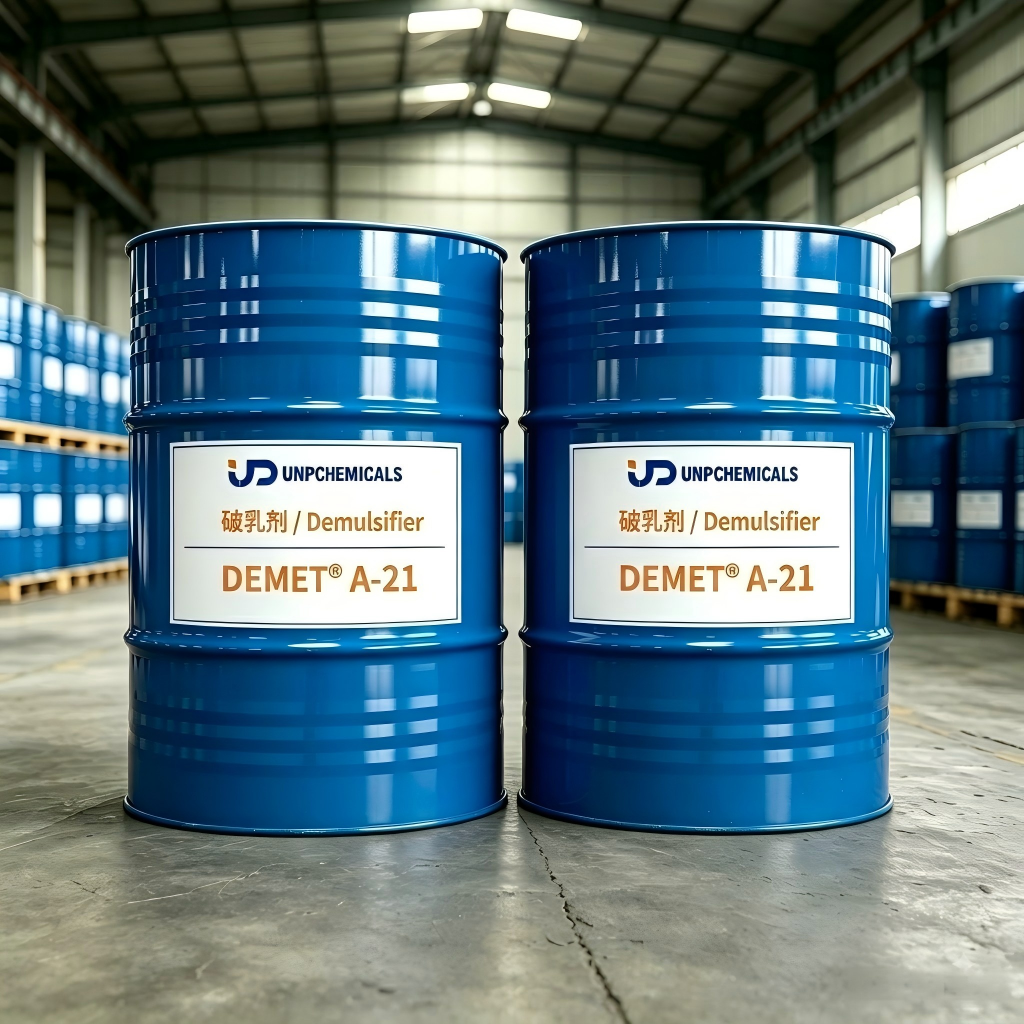
Among the featured products in the DEMET® portfolio, DEMET® A-21 is a liquid oxyalkylate category demulsifier utilized in industrial crude oil desalting processes, particularly in exploration and upstream applications, with a relative solubility number (RSN) ranging from 13.5 to 16.0 and a dark amber liquid appearance at 25°C. DEMET® C-168 is a resin oxyalkylate intermediate primarily utilized in oilfield production as a water dropper, while also serving as a dryer and interface control agent for a broad spectrum of API crudes worldwide, with an RSN of 19.5 to 22.0 and notable wetting characteristics that make it particularly effective for interfacial control. DEMET® I-9037 is a high-performance polymerized polyol demulsifier specifically designed for the rapid separation of water-in-oil emulsions, and it can be applied in continuous processing systems, downhole operations, and batch treatments, with an RSN of 7.0 to 9.5 making it highly oil-soluble and suitable for heavy crude oil applications. DEMET® M-9510 is a proprietary blend that displays exceptional water dropping, desalting, and oil brightening characteristics, and its unique chemistry enables this concentrate to be used as is or formulated with other bases for a wide variety of crude oils, with an RSN of 7.6 to 8.8. The broader DEMET® catalog encompasses over fifteen standard products spanning resin oxyalkylates, polymerized polyols, esterified phenolic polymers, alkoxyamines, polyoxyalkylene glycols, and proprietary blends, with RSN values ranging from 5.0 to 23.4, thereby providing comprehensive coverage of virtually all crude oil types and treatment conditions encountered in the global oil and gas industry.
The key benefits of UNPChemicals demulsifiers include the rapid reduction of water-in-oil levels, the provision of a clearer and sharper oil-water interface for easier separation, the effective removal of water to meet commercial crude oil specifications, strong performance in heavy oil applications, and the reduction of heating expenses through low-temperature treatment efficiency. Founded in 2014 and headquartered in Luoyang, China, UNPChemicals operates a modern and standardized fine chemical manufacturing plant spanning more than 120 acres, with an annual production capacity exceeding 10,000 tons of functional fine chemicals. The company's oilfield chemical solutions cover the entire process of oilfield production, including drilling and completion, production stimulation operations, oil and gas production and transportation, and refining, and the company is committed to providing efficient and environmentally friendly chemical solutions to the global oilfield industry, helping customers improve oil drilling and production efficiency, reduce operational costs, and protect the environment. With three state-owned and municipal lubricant additive R&D platforms and a strong track record in the development and manufacture of high-performance oilfield and industrial chemicals, UNPChemicals is well positioned to serve as a reliable partner for crude oil producers and refiners seeking optimized demulsification solutions tailored to their specific operational requirements.