 WhatsApp
 sales@unpchemicals.com
 +86 16638830202
Addressing Boundary-Friction Challenges in Modern Lubricant Formulation
Technical perspectives on organomolybdenum and ashless borate-ester friction-modifier chemistries
Friction loss creates persistent hidden challenges across automotive powertrains and industrial rotating equipment. Under boundary-lubrication conditions, even premium base oils cannot fully prevent metal-to-metal contact, triggering elevated energy consumption, component wear, higher operating temperature and shortened service intervals. As global OEM specifications keep tightening for fuel-economy performance alongside low-phosphorus, low-sulfur and low-ash (low-SAPS) requirements, lubricant formulators are facing growing pressure to select suitable friction-modifier chemistries for diverse operating scenarios. To address these industry-wide pain points, UNPChemicals has rolled out its complete portfolio of MSAIL organomolybdenum friction modifiers and FMET ashless nitrogen-containing borate-ester friction modifier, covering multiple chemical pathways for automotive, industrial, metal-working and grease applications.
What Are Lubricant Friction Modifiers
Friction modifiers are specialty chemical additives incorporated into engine oils, industrial lubricants, metal-working fluids and greases. Their core function is to build protective interfacial films over rubbing metal surfaces, lowering friction coefficient and mitigating abrasive wear. By restraining metal contact, these additives help extend component service life, cut energy waste and lift overall mechanical efficiency.
It is critical to note that friction modifiers do not eliminate friction completely. Analogous to paraffin inhibitors which modify wax crystal morphology instead of removing paraffin components from waxy crude oil, friction modifiers interfere with surface tribological behaviour at molecular level. They form protective boundary films, rather than altering the intrinsic properties of base stock. Friction modifiers fall into major groups: organic compounds, polymers, solid-particle additives and inorganic metallic additives such as organomolybdenum grades. Different categories deliver distinct performance for given base oils, hardware materials and service constraints.
The Hidden Cost of Poor Friction Control
Without properly selected friction-modifier packages, lubricated systems suffer cascading operational and financial consequences. Uncontrolled boundary friction accelerates component wear in engines, gearboxes, compressors and bearings. It pushes up power draw and energy expenditure, increases operating temperature, and may trigger unplanned equipment downtime. For automotive applications, insufficient friction reduction directly drags down fuel efficiency. In metal-working processes, high friction produces poor workpiece surface finish and speeds up tool degradation. Over time, repeated maintenance, component replacement and production interruptions substantially raise total operational expenditure. This makes friction-control chemistry one of the highest-priority considerations for modern lubricant development.
How UNPChemicals Friction Modifiers Work
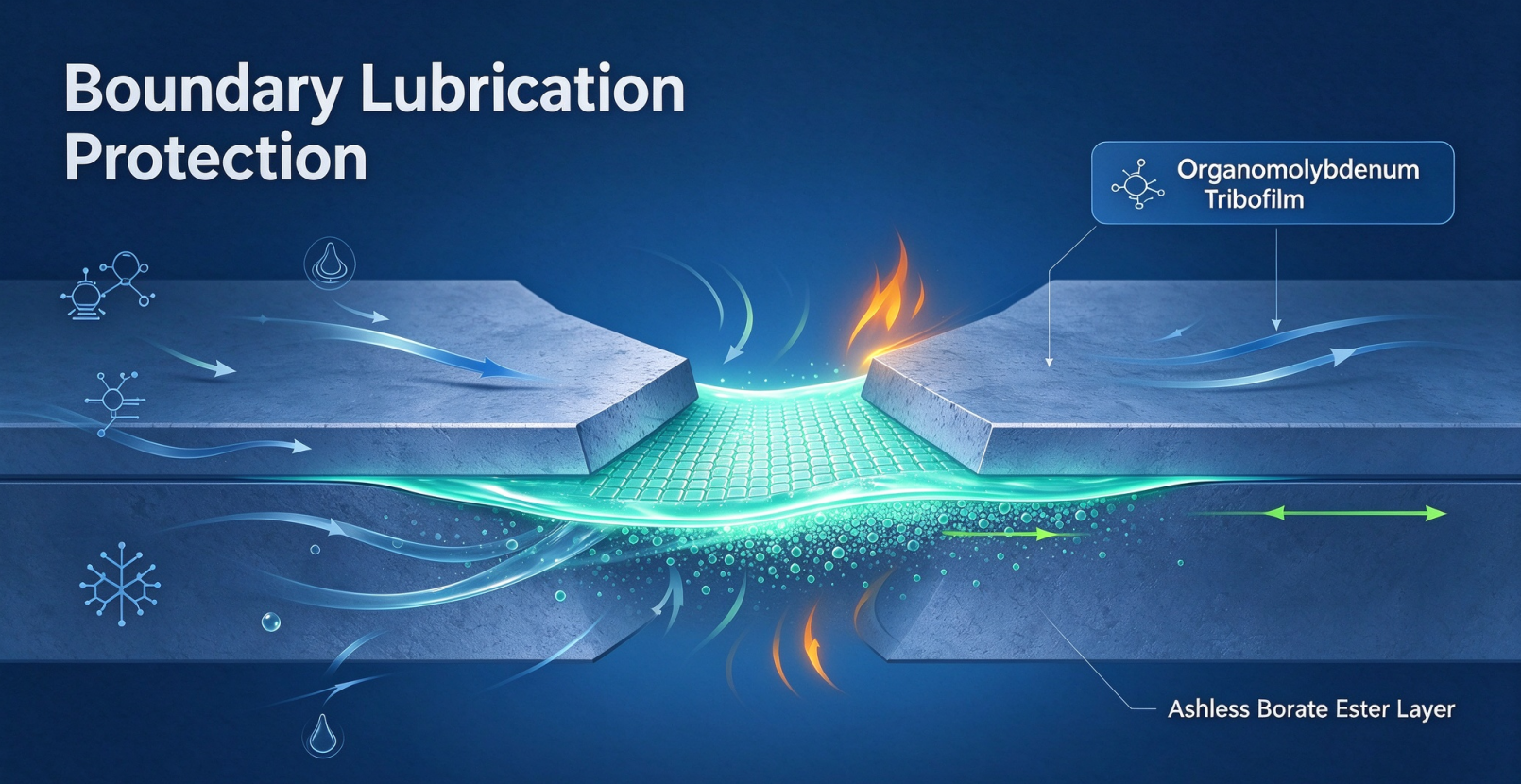
MSAIL organomolybdenum and FMET ashless borate-ester products operate via well-documented tribological mechanisms. Organomolybdenum additives decompose under boundary-friction conditions, depositing thin molybdenum-rich tribofilms on metal contact surfaces to suppress wear and shear stress. Ashless borate-ester FMET 2890 generates boron-containing protective surface layers, and delivers strong synergistic performance when blended with organomolybdenum components.
Instead of relying on a single universal mechanism, UNPChemicals offers differentiated technical routes: sulfur-phosphorus-containing MoDTP for heavy-duty extreme-pressure demand; phosphorus-free MoDTC for exhaust-after-treatment compatible oils; sulfur-and-phosphorus-free organomolybdenum complex for low-SAPS formulas; and ashless borate ester for metallic-ash-free formulation targets. Formulators may deploy these additives via single-component dosing or combined compounding schemes to match base-oil types and end-use requirements.
UNPChemicals MSAIL & FMET Full-Range Friction-Modifier Product Portfolio
MSAIL MoDTP (Molybdenum alkyl dithiophosphate, S-P containing)
· MSAIL 300L (CAS 72030-25-2): Equivalent to SAKURA LUBE 300 / MOLYVAN L; Mo 9.1 %, S 11.3 %, P 3.2 %. Multi-functional liquid additive delivering friction reduction, extreme-pressure, anti-wear and antioxidation properties.
· MSAIL 300LB (CAS 68958-92-9): Equivalent to RC3580; Mo 8.0 %, S 12.0 %, P 6.0 %. Suited for heavy-load lubricant systems.
Both grades find broad use for internal-combustion engine oils, industrial lubricants, neat-oil metalworking fluids and greases.
MSAIL MoDTC (Molybdenum alkyl dithiocarbamate, phosphorus-free)
· MSAIL 525A (CAS 253873-83-5): Equivalent to SAKURA LUBE 525; Mo 10.0 %, phosphorus-free.
· MSAIL 525B (CAS 71342-89-7): Equivalent to MOLYVAN 3000, long-chain alkyl MoDTC; Mo 10.0 %, phosphorus-free.
Phosphorus-free liquid organomolybdenum products with excellent friction-reduction, anti-wear and antioxidation capacity, ideal for catalyst-friendly modern engine-oil formulations.
MSAIL 8550 Sulfur-Phosphorus-Free Organomolybdenum Complex
MSAIL 8550 (CAS 445409-27-8), equivalent to MOLYVAN 855, Mo 7.9 %. Environment-friendly S/P-free organomolybdenum complex with outstanding friction-reduction performance and antioxidation synergy when combined with sulfur-bearing additives. Designed for low-SAPS lubricant systems.
FMET 2890 Ashless Nitrogen-Containing Borate Ester
FMET 2890, equivalent to VANLUBE 289; boron 1 %, nitrogen 2.4 %, sulfur-phosphorus-free ashless additive. It features remarkable synergistic friction-lowering effects combined with organomolybdenum products, together with good anti-wear and corrosion-inhibition behaviour. Applicable for ashless-targeted lubricant formulas.
Key Properties of High-Performance Friction Modifiers
UNPChemicals defines four core benchmarks for qualified friction-modifier additives:
1. High efficiency at low treat rates: Deliver stable friction-reduction and anti-wear performance under economical dosage, even across varying base-oil compositions.
2. Broad formulation compatibility: Maintain performance when mixed with detergents, dispersants, antioxidants, anti-wear agents and other typical lubricant additives; avoid antagonistic side-reactions. Products perform reliably in mineral, hydro-cracked and synthetic PAO base oils.
3. Superior thermal and chemical stability: Resist thermal decomposition under high operating temperature within engines and industrial equipment, preserving tribological performance over extended service cycles.
4. Convenient handling & storage: All MSAIL and FMET 2890 are liquid-form additives, easy for pumping, metering and blending under regular plant operating conditions, with acceptable low-temperature storage characteristics.
Application Scope & Product-Selection Guidance
Friction modifiers from UNPChemicals serve four major industry segments:
1. Automotive: Passenger-car & commercial-vehicle engine oils, transmission fluids, gear oils for fuel-efficiency improvement and wear protection.
2. Industrial: Lubricants for gearboxes, turbines, compressors and hydraulic systems to cut energy consumption and extend maintenance intervals.
3. Metalworking: Neat-oil cutting and forming fluids to optimise workpiece surface finish and reduce tool wear.
4. Greases: Bearing and gear greases to minimise friction within mechanical assemblies.
When selecting grades, formulators need to evaluate base-oil compatibility, operating temperature-pressure conditions, contact-surface materials and environmental-regulatory constraints.
· Choose MoDTP MSAIL 300L / 300LB for heavy-duty systems requiring robust extreme-pressure performance.
· Choose MoDTC MSAIL 525A / 525B for phosphorus-free, catalyst-safe engine-oil packages.
· Choose MSAIL 8550 for low-SAPS, sulfur-phosphorus-restricted formulations.
· Choose FMET 2890 for ashless formulas or compound synergism together with organomolybdenum series.
Summary
As lubricant specifications keep evolving toward higher energy-saving efficiency, stricter emission standards and low-SAPS limits, one-size-fits-all friction-modifier solutions can no longer satisfy diverse market requirements. UNPChemicals MSAIL organomolybdenum and FMET ashless borate-ester friction-modifier portfolio provides flexible molecular building blocks for lubricant manufacturers. By adopting properly matched grades, formulators can effectively reduce friction coefficient, enhance anti-wear and antioxidation performance, extend equipment service life and lower end-user total operating costs.
For technical datasheets, formulation recommendations or customised grade support for your specific lubricant projects, please contact the UNPChemicals technical-sales team.