 WhatsApp
 sales@unpchemicals.com
 +86 16638830202
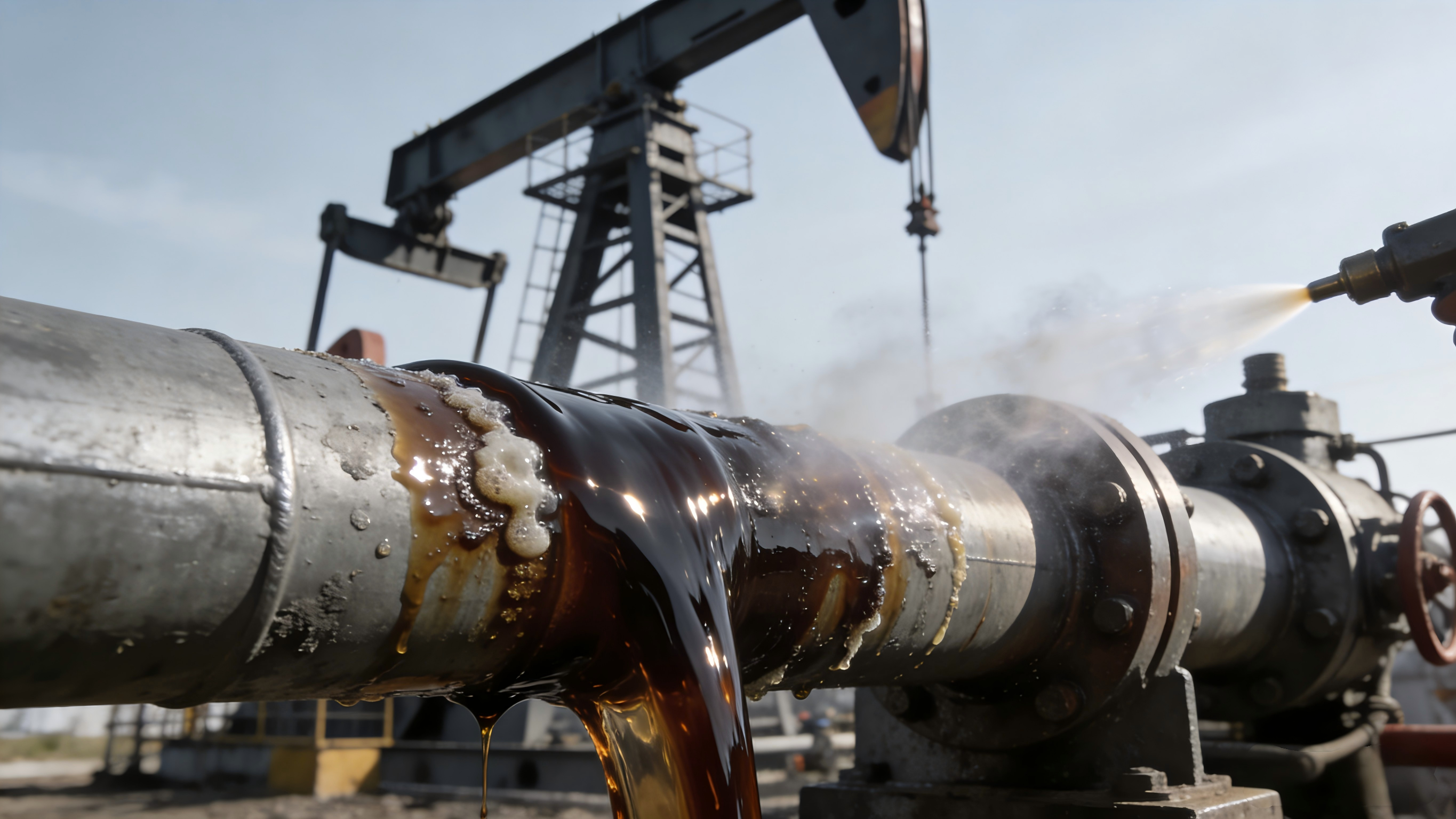
Application and Technical Analysis of Petroleum Wax Inhibitors
What is a wax inhibitor?
A wax inhibitor is a special chemical agent used in oil production to prevent paraffin from precipitating, crystallizing, and depositing on the inner walls of oil wells, pipelines, and equipment. It works by changing the structure of wax crystals, improving the low-temperature fluidity of crude oil, or modifying the surface properties of metal pipes, so that wax cannot stick and accumulate, thereby keeping oil wells and pipelines unobstructed and ensuring stable production.
Causes and Hazards of Oil Well Wax Deposition
Main Types and Action Mechanisms of Petroleum Wax Inhibitors
At present, the mature petroleum wax inhibitors used in industry are mainly divided into three types: polycyclic aromatic hydrocarbon type, surfactant type and polymer type. Different types of wax inhibitors have their own unique component composition and action mechanisms, and all can cooperate with the natural resin and asphaltene in crude oil to improve the overall wax inhibition effect. The core effective components of polycyclic aromatic hydrocarbon type wax inhibitors are polycyclic aromatic hydrocarbons and their derivatives, among which polycyclic aromatic hydrocarbons refer to aromatic hydrocarbons formed by two or more benzene rings sharing two adjacent carbon atoms, with naphthalene, anthracene and phenanthrene as typical representatives, and derivatives such as methylnaphthalene and naphthol also having the same wax inhibition effect. The polycyclic aromatic hydrocarbons used in practical applications are all mixed polycyclic aromatic hydrocarbons, mainly extracted from coal tar. For example, the product cut from the 232-388℃ fraction of coal tar has an aromatic hydrocarbon mass fraction of at least 0.90, among which the mass fraction of mixed hydrocarbyl C1-C2 naphthalene is at least 0.50, which is a high-efficiency polycyclic aromatic hydrocarbon type wax inhibitor. The core action mechanism of this type of wax inhibitor is to participate in the formation of wax crystal nuclei and twist the crystal nucleus structure, which fundamentally hinders the continuous growth of wax crystals. At the same time, the resin in crude oil is soluble in oil and can participate in the formation of crystal nuclei in oil, playing the same wax inhibition role as polycyclic aromatic hydrocarbons. Asphaltene is insoluble in oil and exists as solid particles dispersed in oil to become the crystal nuclei of wax. A large number of dispersed crystal nuclei will hinder the growth and enlargement of wax crystals, making tiny wax crystals be carried away with the oil flow in a suspended state. Any type of crude oil contains a certain amount of resin and asphaltene, which are the basic wax inhibitors of crude oil itself, and other artificial wax inhibitors can give full play to their wax inhibition effect only with the cooperation of the two. Surfactant type wax inhibitors achieve wax inhibition by adsorbing on the surface of wax crystals or wax-deposited solid surfaces, and are mainly divided into oil-soluble and water-soluble types. Among them, the HLB value of oil-soluble surfactants needs to be less than 7, with petroleum sulfonates and polyoxyethylene alkyl alcohol ethers as commonly used types. Their action mechanism is to adsorb on the surface of wax crystals, turning the originally non-polar wax crystal surface into a polar surface, reducing the adsorption force between wax molecules and hindering the further deposition of wax molecules. Water-soluble surfactants are represented by polyoxyethylene sorbitan fatty acid esters, sodium alkylbenzene sulfonates and polyoxyethylene alkyl alcohol ethers, etc. They adsorb on the wax-deposited surfaces such as oil pipes, sucker rods and pipelines, making these solid surfaces polar and adsorbing a water film. Utilizing the characteristic that wax is insoluble in water, they prevent wax from depositing on solid surfaces. Moreover, water-soluble surfactants do not need to be added additionally and can be generated by the reaction of waxy oil with corresponding chemical reactants. For example, treating the surface of oil pipes with SO3-containing liquid and NaOH solution can make the sulfonatable substances in wax undergo sulfonation reaction first, and then generate surfactants through alkali neutralization. These surfactants will adsorb on the surface of oil pipes to form a water-wet surface, achieving the purpose of wax inhibition. Polymer type wax inhibitors are a class of polymers with excellent wax inhibition effect. The non-polar segments on their chain links and the non-polar parts on the polar chains can form eutectics with wax, while the polar segments will twist the crystal form of wax crystals, hindering the continuous growth of wax crystals to form a network structure, thus realizing wax inhibition. Polyacrylates are commonly used polymer type wax inhibitors, and the carbon number of their branched chain R is usually in the range of C14-C26. The specific carbon number depends on the peak alkane carbon number of wax in crude oil. When the average carbon number of the paraffin-like branched chain of the polymer is close to the peak alkane carbon number of wax in crude oil, it is most conducive to the precipitation of wax on it and can produce the best wax inhibition effect, which also makes the polymer type wax inhibitor have the characteristic of adaptive adjustment according to the characteristics of crude oil.