 WhatsApp
 sales@unpchemicals.com
 +86 16638830202

The Application of Paraffin Inhibitors in Waxy Crude Oil Production
Winter is the season that exposes every weakness in a crude oil production system, and for waxy crudes it is also the season when paraffin deposition turns into a costly, recurring battle against blocked tubing, frozen flowlines, seized sucker rods and sharply reduced production rates; yet the entire struggle can be avoided at its very source with a well-designed paraffin inhibitor, and this article explains what these chemicals are, why and how wax deposition occurs, the damage it silently causes, the mechanism by which inhibitors control it, and finally the complete PCMET® series of paraffin inhibitor products developed by UNPChemicals to keep oil flowing smoothly through even the harshest winters.
What Are Paraffin Inhibitors?
Paraffin inhibitors are a class of specialty oilfield chemicals specifically formulated to prevent, delay or modify the crystallization and deposition of paraffin wax in crude oil, refined products and the production and transportation systems that handle them, and in doing so they preserve the low-temperature fluidity of the oil and eliminate most of the operational disruptions caused by wax buildup. Paraffin itself is by no means a simple, single compound but rather a highly complex mixture of straight-chain normal alkanes ranging roughly from C18 to C64, together with branched alkanes and naphthenic hydrocarbons that share a chemically stable, relatively high-melting nature; it is precisely this broad and heterogeneous molecular distribution that makes wax one of the most stubborn challenges in the petroleum industry, since different crudes contain different wax compositions and therefore respond differently to temperature, pressure and chemical treatment.
It is important to understand that a paraffin inhibitor does not eliminate the wax that is inherently present in the crude, because that wax is a natural component of the oil and cannot simply be removed on a practical scale; instead, the inhibitor interferes with the physical process through which dissolved wax molecules assemble into large, adherent crystals, keeping the wax suspended in the oil as fine, flowable particles that travel harmlessly along with the production stream. Paraffin inhibitors can be applied both as continuous chemical treatments injected into wellbores, flowlines and pipelines and as periodic batch treatments, and in real field practice they are frequently combined with complementary measures such as thermal management, pipe insulation, hot-oiling and routine pigging so as to form a comprehensive, multi-layered wax-control strategy tailored to the specific characteristics of each well and each crude.
Why Does Wax Deposition Occur in Crude Oil?
Deep underground, the combination of high reservoir temperature and high pressure keeps virtually all of the wax fully dissolved in the crude oil, so that the oil flows freely through the porous rock, up the wellbore and into the surface facilities without any visible solid material; however, the moment the fluids begin their journey toward the surface the temperature and pressure start to drop continuously, light components such as methane and other volatile hydrocarbons progressively flash out of the liquid phase, and the dissolving power of the remaining liquid toward the heavier paraffinic molecules decreases sharply, until the solubility limit of the wax is exceeded and the excess wax begins to come out of solution.
As the oil cools below a critical point known as the wax appearance temperature, or WAT, the dissolved wax molecules start to nucleate and grow into needle-shaped, plate-shaped or blocky crystals, and, as illustrated in Figure 1, the quantity of precipitated wax rises progressively as the temperature continues to fall, which means that the lower the ambient temperature and the longer the exposure, the more wax will be deposited on every cold surface that the oil comes into contact with; this is why the problem becomes dramatically worse in winter, when wellheads, surface lines, storage tanks and long-distance pipelines all operate far below the WAT and provide ideal conditions for rapid, widespread wax accumulation.
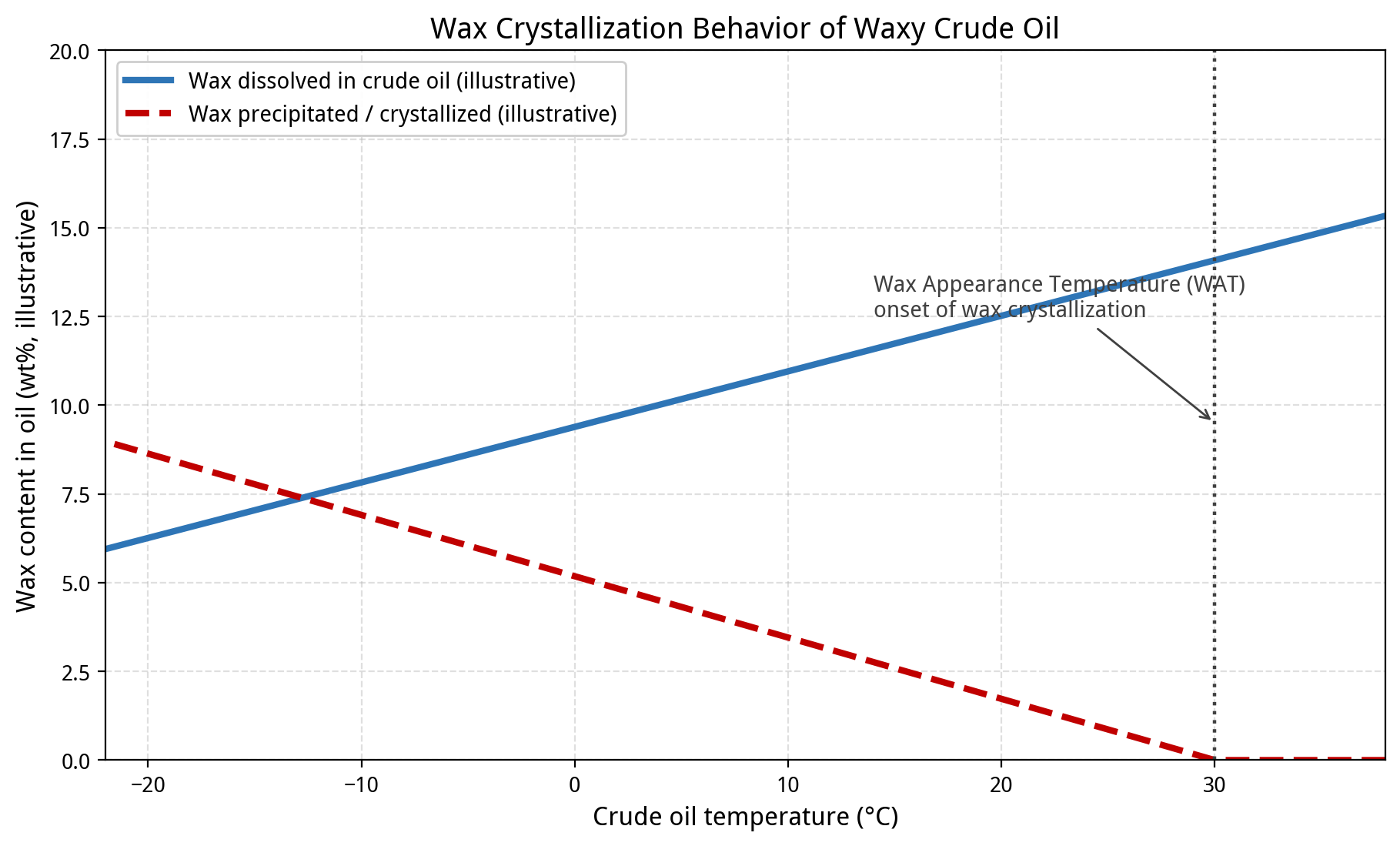
Figure 1 Schematic illustration of wax crystallization behavior in waxy crude oil (illustrative trend).
The Hidden Cost of Wax Deposition
The crystals that form during cooling are characterized by exceptionally strong adhesion, and they readily attach themselves to the internal walls of tubing, sucker rods, wellhead equipment, flowlines, separators and storage tanks, gradually building up into hard, insulating layers that narrow the effective flow area, increase the pressure drop along the system and ultimately plug the production and transportation network altogether, with the most severe cases leaving the well completely shut in and requiring expensive intervention to restore operation. The financial and operational consequences of wax deposition are far-reaching, because the gradual buildup leads to reduced production rates, higher pumping loads and energy consumption, accelerated wear and even mechanical damage to pumps, rods and other downhole equipment, frequent shutdowns for cleaning, and the recurring costs of hot-oiling, solvent washes, pigging runs and the manpower and downtime associated with each of these remedial operations.
Beyond the direct costs of remediation, wax deposition also damages the reliability of the entire production system, because a single plugged flowline or a frozen wellhead during the coldest weeks of the year can interrupt an entire field's output, delay downstream commitments, and force operators to divert resources away from more productive work, and it is this combination of rising operating cost, falling production efficiency and growing equipment damage that makes wax control one of the highest-priority issues in waxy crude operations and justifies the investment in effective chemical solutions.
How Paraffin Inhibitors Work
Paraffin inhibitors operate through a well-understood mechanism of interference at the molecular level, in which the polymeric molecules of a high-quality inhibitor share structural segments that closely resemble the paraffin chains themselves, so that when the oil cools and the first wax molecules begin to align and crystallize, the polymer chains co-crystallize with the forming wax nuclei and become trapped inside the growing crystals, where they disrupt the orderly packing of the crystal lattice, bend and deform the crystal faces, and prevent the wax from growing into the large, hard and strongly adherent plates and needles that cause blockages. As a direct result of this crystal-modification effect, the wax is instead released as a large number of small, rounded and weakly adhesive crystals that remain dispersed in the oil and travel harmlessly with the flow, and because these fine crystals present a far smaller surface area and a far weaker tendency to stick to steel, the rate of deposition on pipe walls and equipment drops dramatically even though the total amount of wax in the crude remains essentially unchanged.
In addition to this primary crystal-modification function, many modern paraffin inhibitors act as surface-active agents that adsorb onto the pipe walls and reduce the adhesion between the wax and the metal surface, and some formulations go one step further by lowering the pour point of the crude through modification of the gel structure that forms at low temperature; this dual function of pour point depression and wax inhibition is precisely what the PCMET® series delivers, so that the treated crude not only produces less deposit but also remains fluid and pumpable at significantly lower temperatures, as summarized in Figure 2.
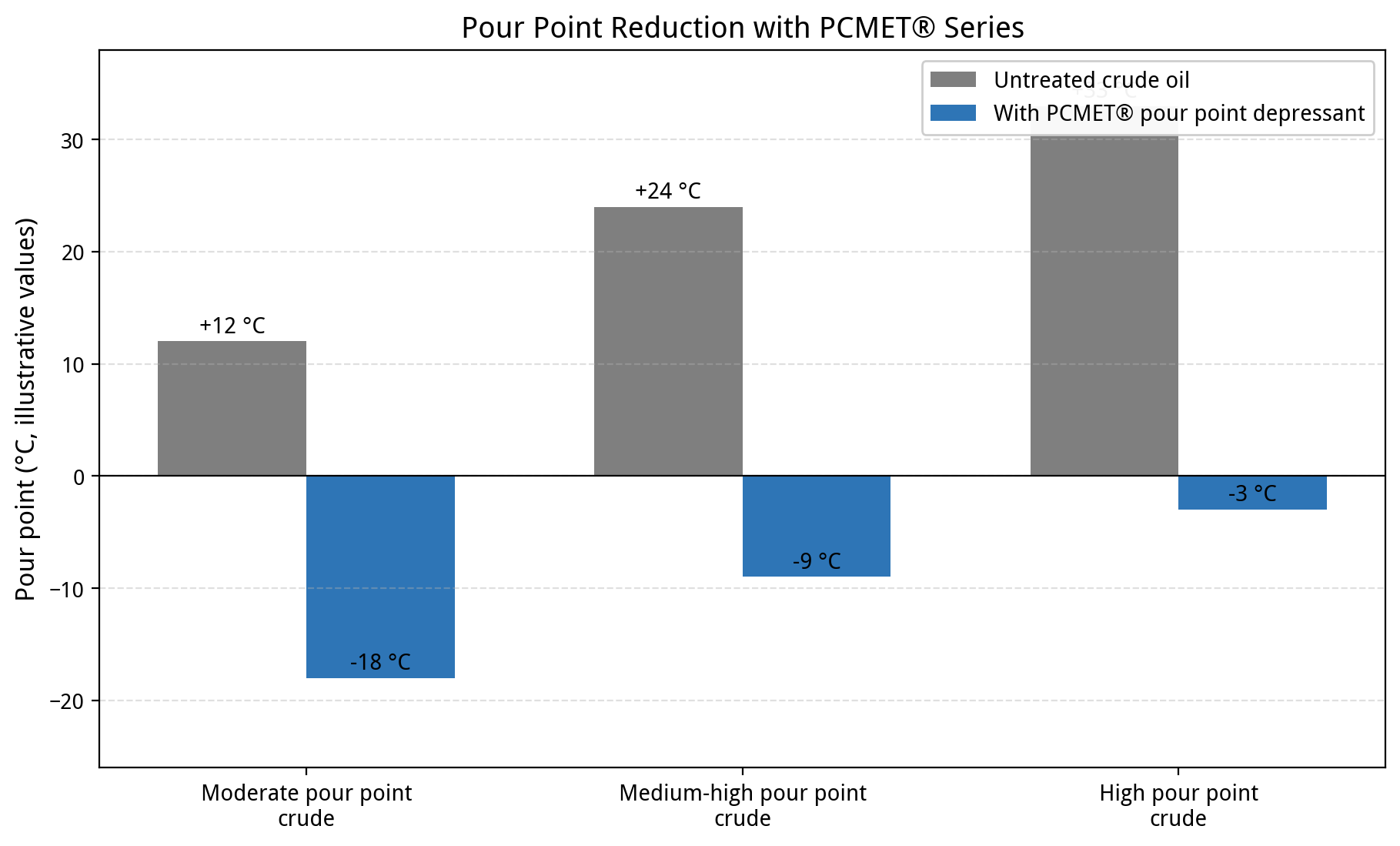
Figure 2 Illustrative comparison of pour point before and after treatment with the PCMET® series (illustrative values).
Key Properties of a High-Performance Paraffin Inhibitor
A paraffin inhibitor that is expected to deliver reliable, long-term protection under real field conditions must combine several essential properties, and the first of these is high efficacy at low dosage, because the chemical must be able to suppress wax crystallization and depress the pour point effectively even when it is injected at economically attractive treat rates in crudes that may differ widely in wax content, asphaltene content and low-temperature behavior. The second essential property is broad compatibility, since the inhibitor must perform reliably in the presence of the many other production chemicals that are typically present in the system, including demulsifiers, corrosion inhibitors, scale inhibitors and biocides, without losing its activity or causing undesirable interactions, and it must also remain stable and effective across the wide range of crude compositions and the demanding operating conditions that are encountered from one field to another.
The third essential property is thermal and chemical stability, because the product must withstand the elevated temperatures of the wellbore and the prolonged contact with brines, gases and other aggressive species without degrading, and the fourth is convenient handling and good low-temperature behavior of the product itself, so that it can be pumped, dosed and stored without excessive heating or special equipment even in cold climates; finally, a high-performance inhibitor must be cost-effective over the full life cycle, meaning that its purchase price, dosage requirement, logistics and the operating savings it generates must together deliver a clear and measurable return on investment, and it is against these demanding criteria that the PCMET® series has been engineered and validated.
UNPChemicals PCMET® Series Paraffin Inhibitor Products
To address the challenges described in the previous sections, UNPChemicals, also known as Luoyang Pacific Union Petrochemical Co., Ltd., has developed the PCMET® series of high-performance pour point depressants and paraffin inhibitors, a complete product family specifically engineered to solve the pour point and cold-flow problems caused by paraffin in both crude oil and finished petroleum products, and to do so from the very root of the problem rather than by merely treating its symptoms. The products in the PCMET® series are built on advanced poly-α-olefin graft copolymer chemistry, and the molecular architecture of each grade has been carefully tuned through ester modification and imide modification so that a suitable product can be selected to match virtually any crude-oil characteristic and any pour-point level encountered in the field, from light and medium crudes with moderate pour points to highly waxy crudes with very high pour points.
Thecomplete PCMET® product family is summarized in Table 1, which lists the different grades together with their chemical descriptions and the pour-point levels of crude oil for which each grade is intended, and this systematic lineup allows operators to choose the most appropriate product for their specific crude and operating conditions. By inhibiting wax crystallization at its source and improving the low-temperature fluidity of the crude, the PCMET® series fundamentally reduces the incidence of pipeline plugging and equipment seizure, and, thanks to its excellent compatibility and stability across a wide range of crude compositions and demanding operating conditions, it effectively raises production efficiency, lowers production costs and extends the service life of the equipment, delivering exactly the trouble-free winter extraction that every oilfield operator aspires to achieve.
Table 1 PCMET® series product lineup and applications.
Product | Chemistry | Application |
PCMET 420 | Poly-α-olefin graft copolymer / ester modified | Moderate pour point crude |
PCMET 820 | Poly-α-olefin graft copolymer / ester modified | High pour point crude |
PCMET 818 | Poly-α-olefin graft copolymer / imide modified | Medium-high pour point crude |
PCMET 42182 | Poly-α-olefin graft copolymer / imide modified | Moderate pour point crude |
PCMET 82182 | Poly-α-olefin graft copolymer / imide modified | High pour point crude |
PCMET 4282 | Poly-α-olefin graft copolymer / imide modified | Medium-high pour point crude |
PCMET 8282 | Poly-α-olefin graft copolymer / imide modified | High pour point crude |
For further information about the PCMET® series or assistance with product selection for your specific crude, please contact the technical team of UNPChemicals.