 WhatsApp
 sales@unpchemicals.com
 +86 16638830202
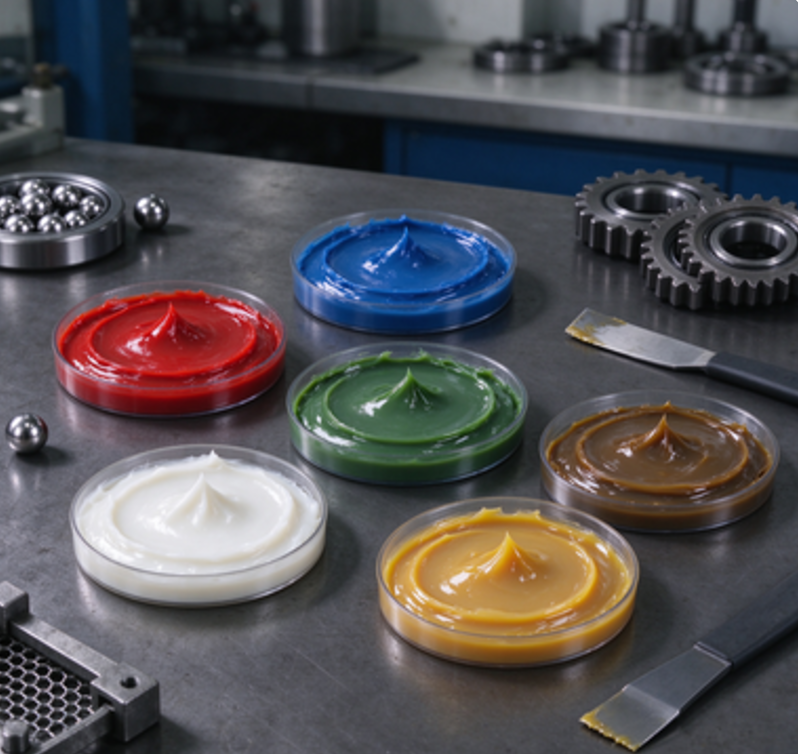
Industrial grease serves as the “blood” for mechanical equipment maintenance. It is different from the commonly referred to “butter”, which mostly refers to low-grade calcium-based grease. Industrial greases feature vastly diverse formulations, leading to substantial variations in performance indicators such as temperature resistance range, load-carrying capacity and water resistance.
II. Classification of Lubricating Greases
1. Classification by Thickener Type
(1) Lithium-based Grease Known as the “universal industrial grease”, lithium-based lubricating grease is the dominant product in China’s grease market and occupies a major market share, with wide adoption across a full spectrum of industrial sectors. General-purpose lithium grease operates within a temperature range of -20℃ to 120℃, complying with the temperature specifications stipulated in the national standard GB/T 7324—2010 for general lithium lubricating greases. Complex lithium grease can function from -30℃ up to 180℃. It delivers outstanding water resistance and mechanical stability, making it suitable for medium-to-high speed, high-temperature and humid working environments such as motor bearings, water pumps and fans. The No.3 grade lithium grease with high consistency can also meet the lubrication requirements of heavy-duty equipment including large and medium-sized motors.
(2) Calcium-based Grease This is the traditional “grease butter”. Calcium soap hydrate will undergo hydrolysis and lose its consistency at approximately 100℃, resulting in poor heat resistance. Different grades of calcium grease have a maximum operating temperature ranging from 55℃ to 70℃, and the general service temperature should not exceed 60℃. Beyond this threshold, calcium grease tends to soften, bleed and run off easily. Subject to product grades, it fits medium and low-speed applications with rotating speed below 3000 r/min under corresponding loads. In daily scenarios, it can be applied to low-speed, room-temperature and light-duty components, such as household door locks and bicycle chains.
(3) Complex Soap-based Grease It excels at high-temperature resistance and heavy-load performance, ideal for severe operating conditions including high-temperature furnace bearings and heavy-duty gearboxes.
(4) Polyurea Grease Boasting strong oxidation resistance and extended service life, polyurea grease is widely specified for high-end industries such as wind power and new energy electric vehicles.
2. Classification by Performance Characteristics
(1) Extreme Pressure (EP) Grease Formulated with extreme pressure additives, this grease can withstand high impact loads, and is the preferred choice for heavy-duty gears, crushers and other heavy-load machinery.
(2) High-temperature Grease Temperature resistance varies with formulation. Conventional grades can endure temperatures above 150℃, while custom-engineered specialty products can sustain 200℃~300℃ or even higher temperatures. Complex lithium high-temperature grease is used for bearings inside high-temperature ovens, whereas polyurea high-temperature grease is applied to kiln cars to satisfy high-temperature lubrication demands in such harsh working conditions.
(3) Food-grade Grease Certified to NSF H1 standard, this is a globally recognized safety compliance standard for lubricants that may have incidental food contact. The certification mandates all ingredients to conform to relevant requirements of US FDA 21 CFR. The standard specifies that even if technically unavoidable accidental leakage and contamination occur, the product remains safe when the concentration in food is ≤10 ppm. Furthermore, food-grade grease shall be colorless, odorless and tasteless, without altering the flavor or appearance of food products. A full-formula toxicological assessment must be completed to verify zero health hazards. Safe and non-toxic, it can be deployed on food and medical manufacturing equipment with no risks even upon incidental contact with foodstuffs.
(4) Specialty Lubricating Grease Developed for extreme environments such as vacuum, intense radiation and ultra-low temperature. These premium greases are relatively costly yet irreplaceable for niche critical applications.
III. Guidelines for Grease Selection
1. Confirm operating temperature: Ordinary lithium-based grease is sufficient for room-temperature service. For high-temperature applications (above 150℃), complex lithium grease or fully synthetic high-temperature grease must be selected. For low-temperature conditions (below -30℃), dedicated low-temperature grease is required.
2. Check rotating speed and load: Low-viscosity grease is recommended for high-speed and light-duty working conditions. For low-speed and heavy-duty service, select grease compounded with extreme pressure additives.
3. Verify service environment: For applications exposed to water spray or humid atmosphere, choose grease with superior water resistance (e.g., complex calcium sulfonate grease). For dusty environments, select grease with strong adhesion property. Food and medical processing equipment must use NSF H1 certified grease products.
4. Check material compatibility: Where equipment incorporates plastic gears or rubber seals, select grease compatible with these materials to prevent corrosion, cracking and premature component failure.
IV. Color Coding of Lubricating Grease
Grease color serves as a universal identification marker in the lubrication industry, allowing field maintenance personnel to quickly distinguish products designed for different use cases at a glance:
1. Red: Delivers excellent high-temperature performance and high load-bearing capacity, mostly applied to heavy-duty bearing assemblies on construction machinery.
2. Blue: Features water resistance and anti-rust properties, suitable for water pumps, marine equipment and outdoor machinery.
3. Green: Offers outstanding anti-oxidation performance, matched to various agricultural machinery and farm equipment.
4. White: Food-grade, safe and non-toxic, exclusively used for food processing machinery.
5. Yellowish-brown: Universal grease for general mechanical equipment, the most commonly encountered type in workshops.
V. Precautions for Lubricating Grease Application
1. Establish equipment lubrication files: Document grease filling time, grease consumption and grease condition. This practice enables prediction of regreasing intervals in advance and mitigates the risk of unplanned equipment shutdowns.
2. Avoid arbitrary mixing of greases with different formulations: Mixing incompatible greases may trigger chemical reactions, changing physical properties and impairing lubrication performance. When switching to a different grease grade, thoroughly remove the residual old grease before refilling with new grease.
3. Enforce personal safety protection: Certain lubricating greases may irritate human eyes. Safety goggles must be worn during all handling operations.
VI. Common Grease Types, Performance and Application Scenarios (Mechanical Workshop / Sheet Metal Fabrication / Machine Tools)
Type | Temperature Range | Characteristics | Typical Applications |
General-purpose lithium grease | -20 to 120 °C | Cost-effective, water-resistant, mechanically stable; suitable for normal loads | Ordinary motor bearings, conveyor rollers, sheet-metal equipment bearings, standard machine-tool accessories |
Complex lithium grease | -30 to 180 °C | High dropping point, resistant to high temperature, excellent extreme-pressure (EP) performance | Spindle bearings of gantry machining centers, heavy-duty gears, high-temperature conveyors |
Polyurea grease | -40 to 200 °C | Long service life, high-temperature resistance, good high-speed stability, oxidation-resistant | High-speed motors, high-speed machine-tool spindles, continuously operating equipment |
Calcium grease | -10 to 60 °C | Excellent water resistance, not high-temperature resistant, low price | Water pumps, low-speed bearings in humid environments; prone to loss above 60 °C |
Molybdenum disulfide EP lithium grease | -20 to 120 °C | Black, contains MoS₂ solid lubricant, impact-resistant for heavy loads | Pivot pins of heavy equipment, low-speed heavy-load sliding surfaces, articulation points of construction machinery |