 WhatsApp
 sales@unpchemicals.com
 +86 16638830202
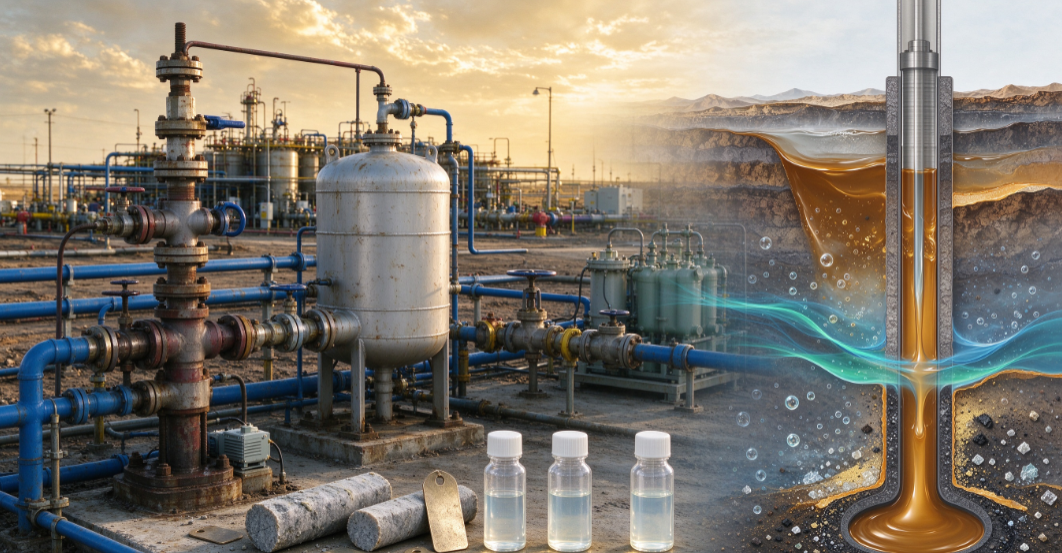
Industry-Wide Operational Challenges
Crude-oil and natural-gas extraction from deep subsurface formations represents a highly complex engineering activity. Operators are required to balance operational safety, production throughput, cost-control targets and local environmental regulatory constraints. Multiple variables including variable physicochemical properties of produced fluids, equipment design, material performance and on-site emergency management jointly determine overall production performance. Even with advances in engineering hardware and high-performance construction materials, field-operation difficulties such as oil-water emulsification, scale and organic-deposit accumulation, microbial reproduction and metallic corrosion persist. Without matched chemical-additive solutions, facilities face declined production efficiency, higher maintenance expenditure and environmental-compliance risks. Formulators rely on diversified specialty additives to mitigate these common production-site bottlenecks.
Core Principles & Fundamental Classification
Oil-production additives are specialty oil-field chemical components tailored to modify physicochemical properties of well-produced multi-phase fluids. Analogous to paraffin inhibitors modifying wax-crystal morphology without removing paraffin from crude oil: oil-production additives do not change the intrinsic bulk composition of crude oil and associated produced water. Instead, they function at molecular and interfacial levels to break emulsions, suppress deposition, restrain microbial activity and mitigate electrochemical corrosion.
They fall into seven primary application groups: - Demulsifiers: Interfacial-active agents for breaking stable oil-water emulsions. - Water clarifiers: Functional components for removing dispersed oil contaminants from produced-water streams. - Corrosion inhibitors: Surface-adsorbing agents mitigating metal electrochemical degradation. - Biocides: Microbe-suppressing additives to control bacterial growth within process fluids. - Paraffin inhibitors: Crystal-modifying chemicals preventing wax-deposition on pipe walls. - Asphaltene inhibitors: Stabilizing agents restraining asphaltene flocculation and precipitation. - Scale inhibitors: Sequestration-type additives inhibiting inorganic mineral-scale formation.
Performance-Driven Working Mechanisms
Different additive categories realize performance improvement through distinct molecular pathways: - Demulsifiers & Water Clarifiers: Adjust oil-water interfacial-film characteristics, destabilize persistent emulsions and separate dispersed oil droplets, achieving efficient phase separation and qualified produced-water quality. - Corrosion Inhibitors: Adsorb onto metallic equipment inner surfaces to build protective barrier films, blocking corrosive media from contacting substrate metal and slowing electrochemical corrosion. - Biocides: Suppress reproduction of harmful microorganisms in production fluids, preventing microbial-induced degradation, fouling and microbiologically-influenced corrosion. - Paraffin & Asphaltene Inhibitors: Interfere with crystal-aggregation and aggregation behaviour of paraffin wax and asphaltene molecules, avoiding solid-deposit blockage inside pipelines and process facilities. - Scale Inhibitors: Chelate metal ions or distort mineral-crystal growth patterns, suppressing inorganic-scale precipitation within production-circuit equipment.
Consequences of Improper Additive Selection
Inadequate or mismatched additive selection brings multiple operational risks. Ineffective demulsification leads to poor oil-water separation efficiency and oily-water discharge issues. Insufficient inhibition allows wax, asphaltene or inorganic scale to deposit, narrowing pipeline flow paths and raising flow resistance. Poor corrosion-control shortens service life of production hardware and increases unplanned downtime. Uncontrolled microbial proliferation triggers fouling and localized corrosion. All above-mentioned problems reduce production efficiency, lift maintenance costs and may cause non-compliance against local environmental regulations.
Commercial Additive Portfolio Overview
UNPChemicals supplies a comprehensive portfolio of oil-production-oriented specialty chemicals: - Demulsifiers, water clarifiers, corrosion inhibitors, biocides - Paraffin inhibitors, asphaltene inhibitors, scale inhibitors
All product grades undergo dedicated development and rigorous testing to resolve typical field-operational challenges for oil-gas production engineers and service contractors.
Critical Performance Metrics for Qualified Additives
Following the unified evaluation framework across UNPChemicals technical review series, high-quality oil-production additives shall meet four core performance metrics:
1. High efficiency at low treat rates: Deliver target demulsification, inhibition or sterilization performance under economically feasible dosage levels.
2. Broad formulation compatibility: Exhibit good compatibility when mixed together in multi-additive packages, avoiding antagonistic interactions and undesired phase changes in complex produced-fluid systems.
3. Robust environmental stability: Retain functional performance under variable field temperature, salinity and complex multi-phase produced-fluid conditions.
4. Practical industrial processability: Feature suitable physical properties for on-site metering, pumping and continuous injection within production-facility workflows.
Application Domains & Formulation Selection Guidelines
These additive systems serve multiple crude-oil-and-gas-production segments:
1. Well-head and gathering-station processing: Oil-water separation, produced-water purification, emulsion resolution for multi-phase well-stream fluids.
2. Surface pipeline and production-facility protection: Mitigation of wax, asphaltene, scale deposition and metallic corrosion along gathering pipelines and process units.
3. Produced-water management: Microbial control, water clarification to satisfy operational and environmental-discharge requirements.
Formulators need to evaluate crude-oil property, produced-water salinity, operating temperature and local environmental-protection regulations before grade selection: - Apply demulsifier together with water clarifier when primary targets are emulsion breaking and produced-water treatment. - Deploy paraffin / asphaltene / scale inhibitor packages for facilities threatened by organic-or-inorganic deposition blockage. - Combine corrosion inhibitor and biocide for integrated equipment-protection against chemical- and microbiologically-driven corrosion risks.
Concluding Remarks
Stable oil-gas production relies not merely on well-construction and mechanical-equipment capability, but also on rational application of multi-functional production-additive packages. Properly selected demulsifiers, clarifiers, corrosion-control, biocidal and deposition-inhibition additives resolve emulsion, fouling, corrosion and scaling challenges within complex produced-fluid systems, supporting safe, efficient and environmentally-sustainable oil-and-gas exploitation.
Contact UNPChemicals technical-sales team for datasheets, formulation recommendations and custom-grade support for your specific oil-production projects.