 WhatsApp
 sales@unpchemicals.com
 +86 16638830202
Industry-Wide Operational Challenges
Industrial mechanical equipment under diverse working conditions encounters combined stresses of varying temperature, rotational speed, heavy impact load, humidity, dust and special sanitary requirements. Base oil alone cannot maintain stable semi-solid lubricating state inside bearing, gear and friction pairs. Improper grease selection brings many adverse consequences: high-temperature softening and grease loss, insufficient load-bearing capacity under heavy impact, water-wash-out failure in humid environment, material incompatibility with rubber or plastic components, and food-safety risks for food-processing machinery. Without properly matched grease thickener systems and functional additive packages, operators face accelerated component wear, unexpected equipment downtime and potential compliance violations. Formulators and maintenance engineers need systematic grease classification and selection standards to resolve these on-site lubrication bottlenecks.
What Are Grease Additives
Grease additives are specialty chemical compounds designed to modify and enhance the performance of semi-solid grease lubricants. Analogous to paraffin inhibitors that alter wax-crystal morphology rather than removing paraffin from crude oil: grease additives do not change the fundamental base-oil-plus-thickener structure of greases. Instead, they interact within the thickener-base-oil matrix to deliver targeted tribological, antioxidative and anti-corrosion functions.
Typical grease-additive categories include anti-wear (AW) additives, extreme-pressure (EP) additives, rust & corrosion inhibitors, antioxidants and viscosity-modifying components. Each class fulfils distinct roles within the heterogeneous semi-solid grease system.
Core Principles & Fundamental Classification
Lubricating greases are semi-solid lubricants composed of base oil, thickeners and functional additives. Analogous to paraffin inhibitors modifying wax-crystal morphology without removing paraffin from crude oil: grease thickeners do not change the intrinsic tribological properties of base oil. Instead, they build three-dimensional network structures to immobilize base-oil molecules, converting liquid base oil into semi-solid grease and endowing the system with mechanical stability, temperature resistance and anti-bleeding performance.
According to thickener types and performance characteristics, industrial greases are divided into multiple major groups: - Lithium-based & complex-lithium greases: General-purpose and high-temperature multi-scene soap-thickened greases for mainstream industrial applications. - Calcium-based greases: Low-cost traditional soap-type greases with limited high-temperature tolerance. - Complex-soap-based greases: High-temperature and heavy-load oriented grease grades for harsh working conditions. - Polyurea greases: Non-soap thickened greases featured by excellent oxidation resistance and long service life for high-end industries. - Performance-oriented special grades: Extreme-pressure grease, high-temperature grease, NSF H1 food-grade grease and extreme-environment specialty greases.
Performance-Driven Working Mechanisms
Different thickener systems and functional additive packages realize performance improvement through distinct molecular and micro-structural pathways: - Lithium-based thickener systems: Lithium soap forms stable fibrous network structures, trapping base oil to achieve balanced mechanical stability and water resistance. Complex-lithium thickener further elevates dropping-point and high-temperature adaptability for medium-high-temperature working conditions. - Calcium-based thickener systems: Hydrated calcium soap network provides good water resistance, yet the hydration structure decomposes at elevated temperature, leading to softening and oil bleeding, which restricts its maximum service temperature. - Complex-soap & Polyurea thickener systems: Complex-soap structures improve high-temperature and heavy-load tolerance; polyurea forms heat-stable non-soap network, delivering outstanding anti-oxidation property and extended service cycle for continuous-running high-speed equipment. - Functional additive systems: Extreme-pressure additives form tribochemical protective films under heavy impact loads; food-grade compliant additives satisfy incidental food-contact safety requirements; solid-lubricant fillers such as molybdenum disulfide enhance boundary-lubrication performance for low-speed heavy-load friction pairs.
Consequences of Improper Additive Selection & Grease Mis-application
Incorrect grease grade selection or cross-mixing of incompatible greases brings multiple operational risks. Mismatched temperature resistance causes grease softening, bleeding and loss of lubrication. Insufficient extreme-pressure performance triggers severe wear and seizure for heavy-load friction pairs. Poor water-resistance grades are easily washed away under humid or water-spray conditions. Incompatibility with rubber-plastic materials induces swelling, cracking and premature sealing-component failure. Mixing different-formula greases destroys thickener network structure and degrades overall physical-chemical performance. Using non-certified grease on food-processing equipment introduces food-safety hazards. All these problems increase component-replacement frequency and unplanned equipment-downtime losses.
Commercial Additive & Grease Portfolio Overview
Representative industrial grease product families based on different thickener systems and additive formulations: - General-purpose lithium-based grease: -20 ℃-120 ℃, cost-effective for conventional industrial equipment bearings and conveying rollers. - Complex-lithium grease: -30 ℃-180 ℃, high dropping-point, excellent extreme-pressure performance for high-temperature heavy-duty machinery. - Polyurea grease: -40 ℃-200 ℃, oxidation-resistant long-life grade for high-speed motors and continuous-operation equipment. - Calcium-based grease: -10 ℃-60 ℃, good water-resistance, low-cost for low-speed light-duty components. - Molybdenum-disulfide EP lithium grease: Containing solid-lubricant molybdenum disulfide for heavy-load impact-resistance scenarios. - NSF H1 food-grade grease: Colorless-odorless, toxicologically-evaluated formulation for food-and-medical manufacturing equipment.
Critical Performance Metrics for Qualified Industrial Greases
Following the unified evaluation framework across UNPChemicals technical review series, high-quality industrial greases shall meet four core performance metrics:
1. High efficiency at low treat-rates for additives: Functional additives achieve extreme-pressure, anti-oxidation or anti-rust performance without destroying the thickener network structure of grease.
2. Broad formulation & material compatibility: Good compatibility between thickeners and additives; compatible with common rubber-seal and plastic-gear materials, avoiding swelling or cracking failure.
3. Robust environmental stability: Maintain stable semi-solid state and lubricating capacity under target temperature, humidity, dust and load working conditions.
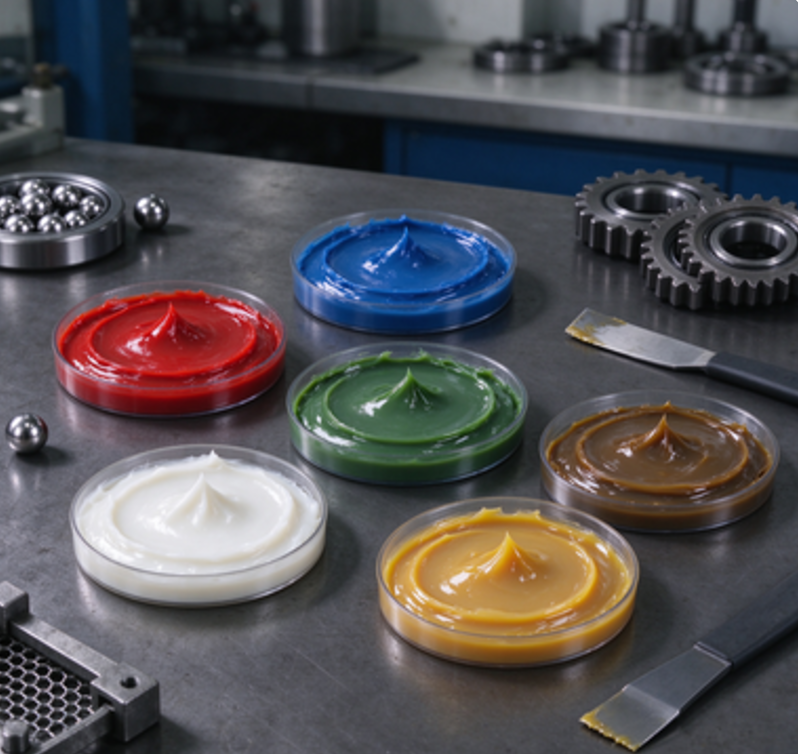
4. Practical industrial processability & identifiability: Stable physical properties for filling and re-greasing operations; distinguishable color-coding helps field maintenance personnel for rapid identification.
Application Domains & Formulation Selection Guidelines
These grease systems serve multiple industrial segments:
1. General mechanical-workshop equipment: Machine-tool bearings, conveying rollers, sheet-metal-processing equipment, common motor bearings.
2. Heavy-duty & high-temperature equipment: Heavy-duty gears, furnace bearings, high-temperature conveyors and construction-machinery hinge points.
3. New-energy and high-end manufacturing: High-speed motors, wind-power equipment and electric-vehicle related bearing components.
4. Food-and-medical production lines: Machinery parts with potential incidental food-contact requiring NSF H1 compliance.
Formulators and maintenance engineers need to evaluate operating temperature, rotational speed, load magnitude, ambient environment and contact-material properties before final grease selection: - Choose general-purpose lithium-based grease for room-temperature, conventional-load general-industrial equipment. - Deploy complex-lithium or polyurea grease for high-temperature or long-term continuous-operation working conditions. - Adopt extreme-pressure-grade grease including molybdenum-disulfide modified products for low-speed heavy-load and impact-load friction pairs. - Select water-resistant grease grades under water-spray and humid conditions; apply NSF H1 certified food-grade grease for food-processing production lines. - Avoid arbitrary mixing of different-formula greases; thoroughly remove residual old grease before switching grease grades.
UNPChemicals EPSAIL® Full-Range Grease-Additive Portfolio
· EPSAIL T351 (CAS 68412-26-0): Molybdenum dibutyl dithiocarbamate (Power-type MoDTC). Solid organomolybdenum EP-AW additive, delivers excellent anti-oxidation and anti-wear performance for greases and lubricants, partial or complete replacement option for molybdenum disulfide.
· EPSAIL 8088: Inorganic extreme-pressure agent, biodegradable sulfur-phosphorus-containing additive. Optimised as EP/AW component for lubricating greases for mining, construction and heavy-duty machinery.
· EPSAIL 8290 (CAS 72676-55-2): Thiadiazole dimer multi-functional additive. Exhibits outstanding EP, anti-wear and antioxidative performance when dispersed in greases. Widely adopted for steel-plant and heavy-load-equipment greases; also usable as rubber vulcanisation accelerator.
Concluding Remarks
Reliable equipment lubrication performance depends not only on base-oil performance but also on rational matching of thickener structures and functional-additive packages. Appropriately selected industrial greases build stable semi-solid lubricating systems, adapt to diversified temperature-load-environment conditions, reduce friction-pair wear and lower unplanned-downtime risks for mechanical facilities. Color-coding identification and standardized operating specifications further assist on-site maintenance to realize safe and efficient equipment-asset management.
Contact UNPChemicals technical-sales team for datasheets, formulation recommendations and custom-grade support for your specific industrial-grease projects.