 WhatsApp
 sales@unpchemicals.com
 +86 16638830202
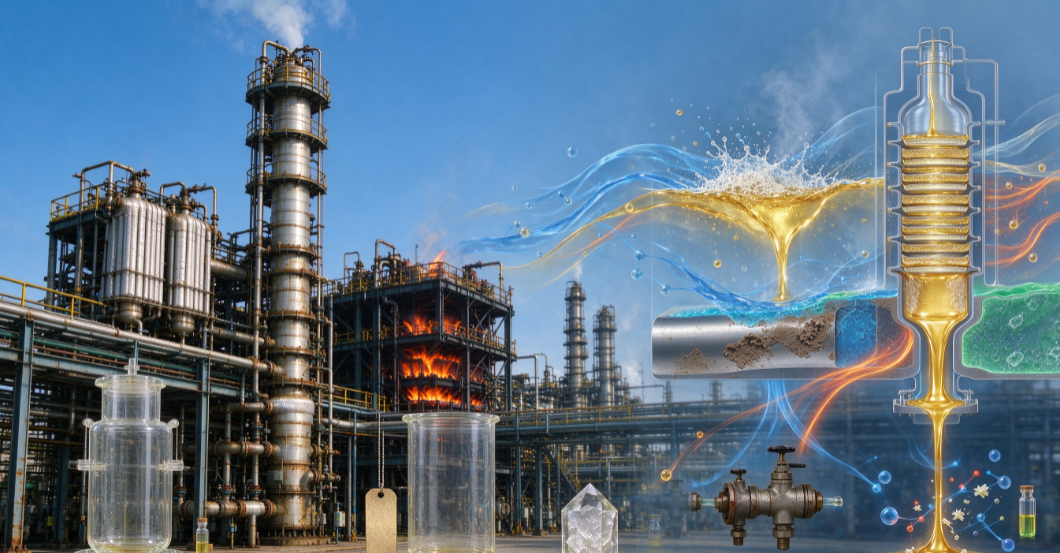
Industry-Wide Operational Challenges
Converting crude oil into qualified finished fuels and petrochemical feedstocks constitutes a highly sophisticated industrial activity. Refineries must guarantee operational safety for distillation, hydrotreating, catalytic cracking and other core units, while pursuing stable throughput, optimized product yields and reasonable cost control. Simultaneously, facilities need to comply with tightening environmental regulations and strict fuel-quality specifications. Processing heavy, high-sulfur crude further amplifies operational difficulties. Even with optimized process engineering, advanced alloy materials and complete online monitoring-early-warning systems, refineries still face persistent problems including foam accumulation, equipment fouling, metallic corrosion, oxidative degradation, undesired cold-flow properties and static-electric hazards. Without purpose-built specialty additive packages, plants suffer reduced unit efficiency, increased maintenance costs and risks of non-compliance. Formulators require targeted refinery-grade additives to tackle these practical process bottlenecks.
Core Principles & Fundamental Classification
Refinery additives are specialty chemical components designed to modify physicochemical behaviours of multi-component refinery process streams. Analogous to paraffin inhibitors modifying wax-crystal morphology without removing paraffin from crude oil: refinery additives do not alter the fundamental hydrocarbon composition of crude feedstock and finished-product streams. Instead, they function at molecular and interfacial levels to suppress foaming, mitigate fouling, retard corrosion, inhibit oxidation, adjust low-temperature fluid properties and improve process-stream safety performance.
They fall into nine primary application groups: - Antifoam agents: Interfacial modifiers for suppressing foam generation within process units. - Antifoulants: Deposit-inhibiting components mitigating thermal-fouling on heat-transfer surfaces. - Corrosion inhibitors: Surface-adsorbing agents mitigating electrochemical metal degradation. - Antioxidants: Radical-scavenging substances restraining oxidative deterioration of hydrocarbon streams. - Metal deactivators: Chelating components to neutralize catalytic negative effects of trace metal ions. - Pour-point depressants (PPD): Crystal-modifying additives improving low-temperature fluidity of oil products. - Lubricity additives: Boundary-film formers to enhance lubricating performance of finished fuels. - Antistatic agents: Conductivity regulators eliminating static-electric risks in hydrocarbon products. - Crude-desalting demulsifiers: Surfactants to break oil-water emulsions during crude-oil desalting pretreatment.
Performance-Driven Working Mechanisms
Different additive categories realize performance improvement through distinct molecular pathways: - Antifoam agents: Spread across gas-liquid interfaces, disrupt foam-film integrity and restrain persistent foam accumulation that would disturb separation-unit operation. - Antifoulants: Interfere with polymerization, coking and particle-aggregation processes, reducing sediment deposition on heat-exchanger and tower-internals surfaces to preserve heat-transfer efficiency. - Corrosion inhibitors: Adsorb onto metal surfaces to build protective barrier films, isolating equipment substrates from acidic and corrosive process media. - Antioxidants & Metal Deactivators: Antioxidants capture free radicals to interrupt hydrocarbon oxidation chain reactions; metal deactivators chelate trace metal ions to eliminate their catalytic promotion of oxidation and fouling. - Pour-point depressants: Interact with wax-crystal growth patterns, altering crystal morphology and preventing interlocking networks that cause product solidification under low-temperature conditions. - Lubricity additives: Adsorb onto metal contact surfaces and form low-shear boundary films, compensating insufficient lubricating properties of low-sulfur refined fuels. - Antistatic agents: Raise electrical conductivity of hydrocarbon products to dissipate static charge accumulation and reduce explosion-ignition hazards. - Crude-desalting demulsifiers: Adjust oil-water interfacial tension, destabilize stable emulsions and facilitate separation of brine impurities in crude-oil pre-treatment sections.
Consequences of Improper Additive Selection
Inadequate or mismatched additive selection brings multiple operational risks. Uncontrolled foaming disturbs tower separation efficiency and triggers product carry-over. Insufficient antifoulant dosage accelerates heat-exchanger fouling, reduces heat-transfer capacity and raises energy consumption. Poor corrosion protection accelerates equipment degradation and increases unplanned shutdown risk. Lack of antioxidants leads to hydrocarbon oxidation, gum formation and degraded finished-product quality. Improper pour-point depressant dosing fails to meet cold-flow specifications, while insufficient antistatic treatment introduces static-ignition safety threats. Defective desalting demulsifiers result in excessive residual salt in crude feedstock, bringing downstream corrosion and catalyst-poisoning risks. All these issues reduce economic returns and may cause violations against fuel-quality and environmental regulatory requirements.
Commercial Additive Portfolio Overview
UNPChemicals develops comprehensive high-efficiency refinery-specialty-chemical portfolio: - Antifoam agents, antifoulants, corrosion inhibitors - Antioxidants, metal deactivators - Pour-point depressants (PPD), lubricity additives, antistatic agents - Crude-desalting demulsifiers
All formulations undergo elaborate R&D cycles together with rigorous laboratory evaluation and on-site pilot testing to resolve daily technical challenges faced by refinery process engineers and chemical-service providers.
Critical Performance Metrics for Qualified Additives
Following the unified evaluation framework across UNPChemicals technical review series, high-quality refinery additives shall meet four core performance metrics:
1. High efficiency at low treat rates: Achieve target foam-suppression, fouling-mitigation or product-property-modification performance under economically feasible dosage.
2. Broad formulation compatibility: No antagonistic cross-reactions when multiple additives coexist within process streams; avoid adverse impacts on downstream catalyst performance and finished-fuel specifications.
3. Robust environmental stability: Retain core functionality across wide ranges of refinery operating temperature, pressure and variable crude-feedstock compositions.
4. Practical industrial processability: Suitable physical state for continuous metering and injection within large-scale refinery plant workflows.
Application Domains & Formulation Selection Guidelines
These additive systems serve multiple petroleum-refining segments:
1. Crude pre-treatment units: Crude-oil desalting, applying demulsifiers to remove brine and salt impurities from incoming crude feedstock.
2. Distillation and heat-exchange networks: Deploy antifoam, antifoulant and corrosion-inhibitor packages to stabilize atmospheric- / vacuum-distillation-unit operation.
3. Hydrotreating & catalytic-cracking units: Adopt antioxidants, metal deactivators and antifoulants to mitigate fouling and suppress undesirable side-reactions.
4. Finished-fuel blending facilities: Use pour-point depressants, lubricity additives and antistatic agents to adjust final-product properties and satisfy fuel-quality standards.
Formulators need to evaluate crude-feedstock type, unit operating conditions, downstream-process constraints and local fuel-quality regulations before grade selection: - Select crude-desalting demulsifiers for pretreatment sections to improve brine separation efficiency. - Combine antifoam, antifoulant and corrosion-inhibitor grades for distillation-circuit protection when processing heavy high-sulfur crude. - Deploy antioxidant together with metal deactivator to restrain oxidation and fouling for high-temperature process streams. - Apply pour-point depressant, lubricity additive and antistatic agent during finished-product blending to achieve required fuel specifications.
Concluding Remarks
Reliable refinery production relies not only on process-unit hardware and process-engineering optimization but also on rationally compounded specialty-additive packages. Properly selected refinery additives deliver interfacial regulation, fouling-mitigation, corrosion-control and product-property-tuning capabilities, supporting stable plant operation, maximizing product yields and helping refineries satisfy stringent fuel-quality and environmental-protection requirements.
Contact UNPChemicals technical-sales team for datasheets, formulation recommendations and custom-grade support for your specific refinery projects.