WhatsApp
 sales@unpchemicals.com
 +86 16638830202

What Is Wax Inhibitor
Classification of Mainstream Wax Inhibitor Chemistries for Crude Oil
Inhibitor type | Core working mechanism | Typical paraffin carbon range | Common dosage range | Main limitation |
Solvent type | Wax dissolution and swelling | C20–C40 | 1000–5000 ppm | High cost, poor continuous inhibition |
Polymeric comb copolymer | Co-crystallization and crystal distortion | C28–C52 | 50–500 ppm | Strong crude oil selectivity |
Surfactant type | Surface adsorption and dispersion | C22–C42 | 200–800 ppm | Easy failure under high salinity |
Nano-composite type | Heterogeneous nucleation and synergistic modification | C26–C50 | 30–200 ppm | Dispersion stability risk |
Bio-based type | Interfacial interference | C20–C38 | 300–1200 ppm | Weak high-temperature stability |
Multi-Scale Mechanisms of Wax Inhibition during Crude Oil Cooling
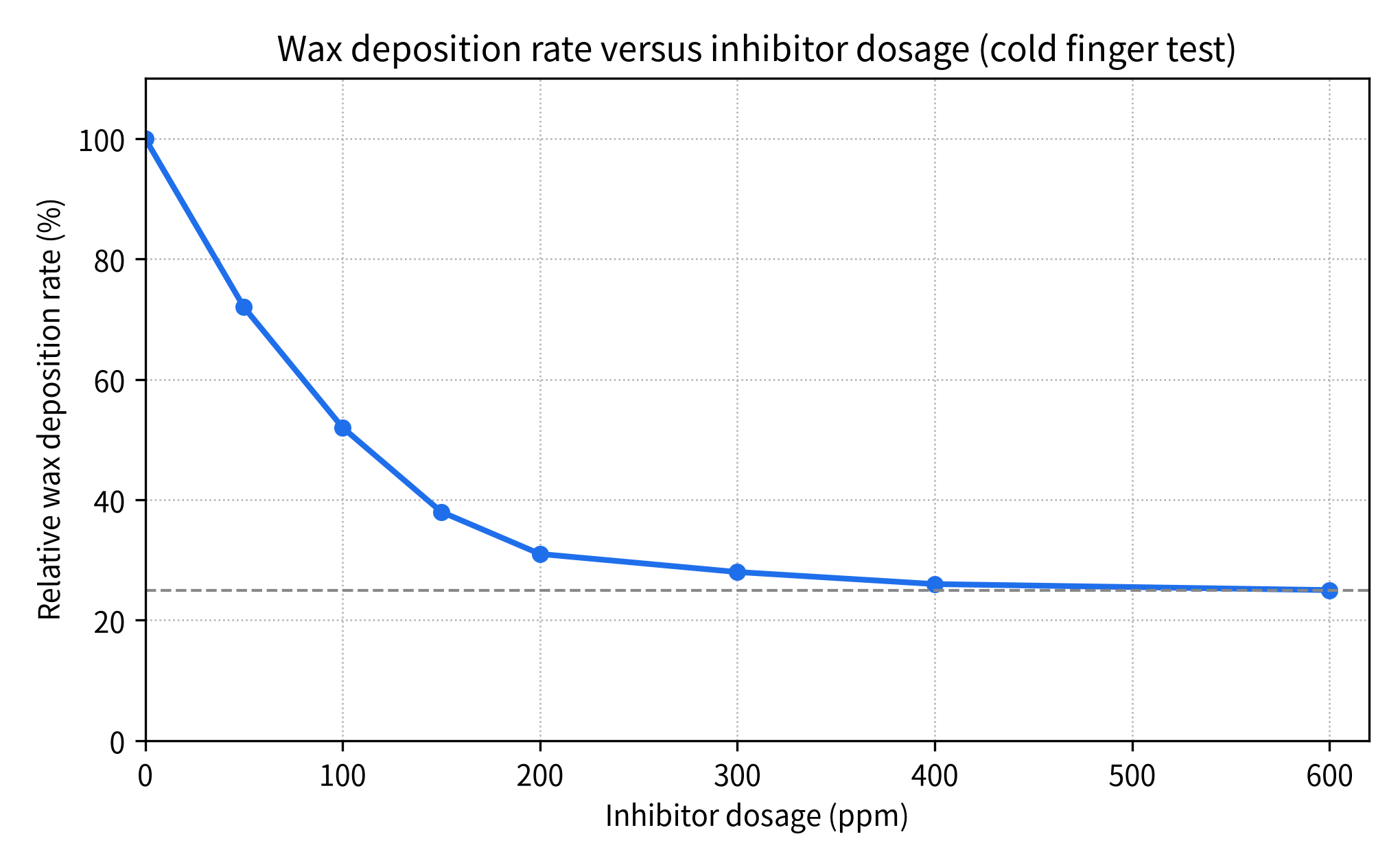
The inhibition process of high-performance polymeric wax inhibitors runs through three sequential stages of paraffin phase change, namely homogeneous nucleation of wax molecules, anisotropic crystal growth and mutual aggregation of wax crystals to form continuous solid network, and the long alkyl side chains on inhibitor molecular backbone can be embedded into the crystal lattice of precipitated n-paraffin through co-crystallization effect, while the polar functional segments such as ester groups and imide groups stretch outward to destroy the regular stacking sequence of paraffin chains, change the original lamellar and plate-like crystal morphology into fine discrete irregular particles, prevent adjacent wax crystals from interlocking and constructing rigid network, and some amphiphilic segments can adsorb preferentially on the inner wall of carbon steel pipelines to form a low-adhesion interfacial film, reducing the adhesion force between wax microcrystals and metal surfaces so that most tiny wax particles can be carried away by crude oil flow instead of accumulating into thick wax deposit layers, and the combined effect of these multiple mechanisms will directly lower the wax appearance temperature, reduce the yield value and low-temperature apparent viscosity of waxy crude, and cut the wax deposition rate under constant temperature difference and shear environment in cold finger simulation experiments.