WhatsApp
 sales@unpchemicals.com
 +86 16638830202
What Is Wax Inhibitor
Interactions between Wax Inhibitor and Complex Crude Oil Colloidal System
Crude sample | Initial WAT (℃) | Initial pour point (℃) | WAT after dosing (℃) | Pour point after dosing (℃) | Viscosity reduction rate at 10℃ |
Sample A (low asphaltene) | 36 | 27 | 29 | 18 | 72.3% |
Sample B (medium asphaltene) | 39 | 30 | 34 | 23 | 51.6% |
Sample C (high asphaltene) | 41 | 33 | 38 | 29 | 26.8% |
Rheological Evolution Characteristics of Wax Inhibitor Treated Crude Oil under Cooling and Shear
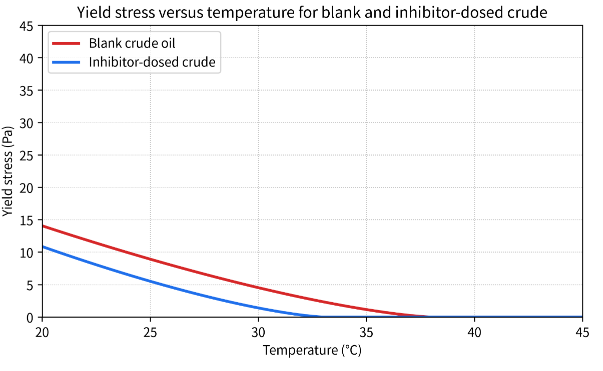
The addition of wax inhibitor changes not only the static crystallization behavior of paraffin but also the dynamic rheological response of crude oil under continuous shear in pipelines, and for untreated waxy crude oil, once the fluid temperature drops below wax appearance temperature, the number of wax crystals rises rapidly with continuous cooling, and these crystals connect with each other to form a space network structure, which makes crude oil transform from Newtonian fluid to non-Newtonian fluid with obvious yield stress, and the apparent viscosity rises sharply; after adding suitable polymer wax inhibitor, the co-crystallized distorted wax crystals lose the ability to form continuous network, the yield stress of crude oil is greatly reduced, and the crude oil still maintains approximate Newtonian flow characteristics within a certain temperature range below original wax appearance temperature, and shear condition also brings dual effects, moderate shear can help disperse modified wax microcrystals and improve inhibitor uniformity, while excessive high shear may break the molecular conformation of some polymer inhibitors and reduce their crystal modification capacity, and Figure 2 displays the yield stress temperature scanning curves of crude oil blank sample and inhibitor-treated sample, intuitively showing that the inhibitor significantly delays the emergence of crude yield stress and reduces the magnitude of yield stress at the same subcooling temperature.