 WhatsApp
 sales@unpchemicals.com
 +86 16638830202
The Protective Chemistry of Corrosion Inhibitors
What Is a Corrosion Inhibitor?
A corrosion inhibitor is a chemical substance that, when present in the environment of a metallic surface in a sufficiently small concentration, measurably reduces the rate at which that surface corrodes, and it achieves this without being consumed by the very electrochemical reaction it suppresses, which is precisely what separates it from a sacrificial anode, an impressed current system, or a coating that physically seals the metal away from its surroundings. In practical terms an inhibitor is a molecule, or more often a carefully formulated mixture of molecules, that travels with the corrosive fluid itself, reaches the metal through the very medium that is trying to destroy it, and then assembles at the metal–fluid boundary in a way that interrupts or dramatically slows the corrosion circuit, so that a few tens of parts per million of chemistry can keep carbon steel assets worth millions of dollars operating safely for years of continuous service. Because the inhibitor works at the molecular interface between the metal and the electrolyte rather than by adding a separate physical barrier, it is uniquely suited to protecting the internal surfaces of pipelines, production tubing, storage tanks, heat exchangers, cooling circuits and process vessels, places where no paint film can be applied, no lining can be installed, and no external current can be made to reach every hidden corner of a complex geometry.
The economic importance of this single family of chemicals is difficult to overstate, because corrosion itself is one of the most expensive engineering problems that modern industry has ever had to manage, and the most widely quoted global assessment, the International Measures of Prevention, Application and Economics of Corrosion Technologies study published by NACE International in 2016, estimated the worldwide cost of corrosion at approximately US$2.5 trillion every year, a sum equivalent to roughly 3.4 percent of global gross domestic product, while the same study pointed out that between 15 and 35 percent of that enormous bill could be saved simply by applying existing and well-understood corrosion control technologies, among which chemical inhibition is one of the most flexible and immediately deployable. A corrosion inhibitor therefore occupies a very particular position in the hierarchy of protective measures, because it is comparatively inexpensive, it can be introduced into a live operating asset without shutting that asset down, it follows the flowing fluid into the most inaccessible regions of a system, and it can be withdrawn, adjusted or replaced the moment the corrosion threat itself changes, which hands the production chemist a continuously tunable lever that no permanent coating or metallurgical upgrade can ever match. This article explains how these remarkable molecules actually perform their protective work, which chemical families dominate the market and why, how the physical properties of a finished product decide whether it will succeed in a given field, how the right chemistry is matched to the right corrosion threat, and finally how all of this knowledge is consolidated into a coherent, commercially available product line such as the CIMET series supplied by UNPChemicals.
The Electrochemical Roots of Corrosion and Where Inhibitors Intervene
To understand what an inhibitor does it is first necessary to understand the process it interrupts, and the fundamental truth that governs all aqueous corrosion is that metal destruction is an electrochemical phenomenon rather than a purely chemical one, meaning that the attack always involves two inseparable half-reactions that must proceed at exactly the same rate in two distinct regions of the same surface. At the anodic site the metal itself surrenders electrons and dissolves into the electrolyte, and for carbon steel this is the familiar oxidation of iron in which a neutral iron atom loses two electrons to become a positively charged ferrous ion that passes into solution, while at the cathodic site those same electrons are consumed by a reduction reaction, which in an acidic environment is the reduction of hydrogen ions to hydrogen gas and in a neutral or aerated environment is the reduction of dissolved oxygen to hydroxyl ions, and it is the continuous circulation of electrons through the metal, balanced by the migration of ions through the electrolyte, that constitutes the corrosion cell that progressively eats away the equipment. Figure 1 below illustrates this cell in its simplest form, showing the electrolyte layer above a carbon steel substrate, the anodic oxidation on the left, the cathodic reduction on the right, and the flow of electrons through the metal that ties the two together.
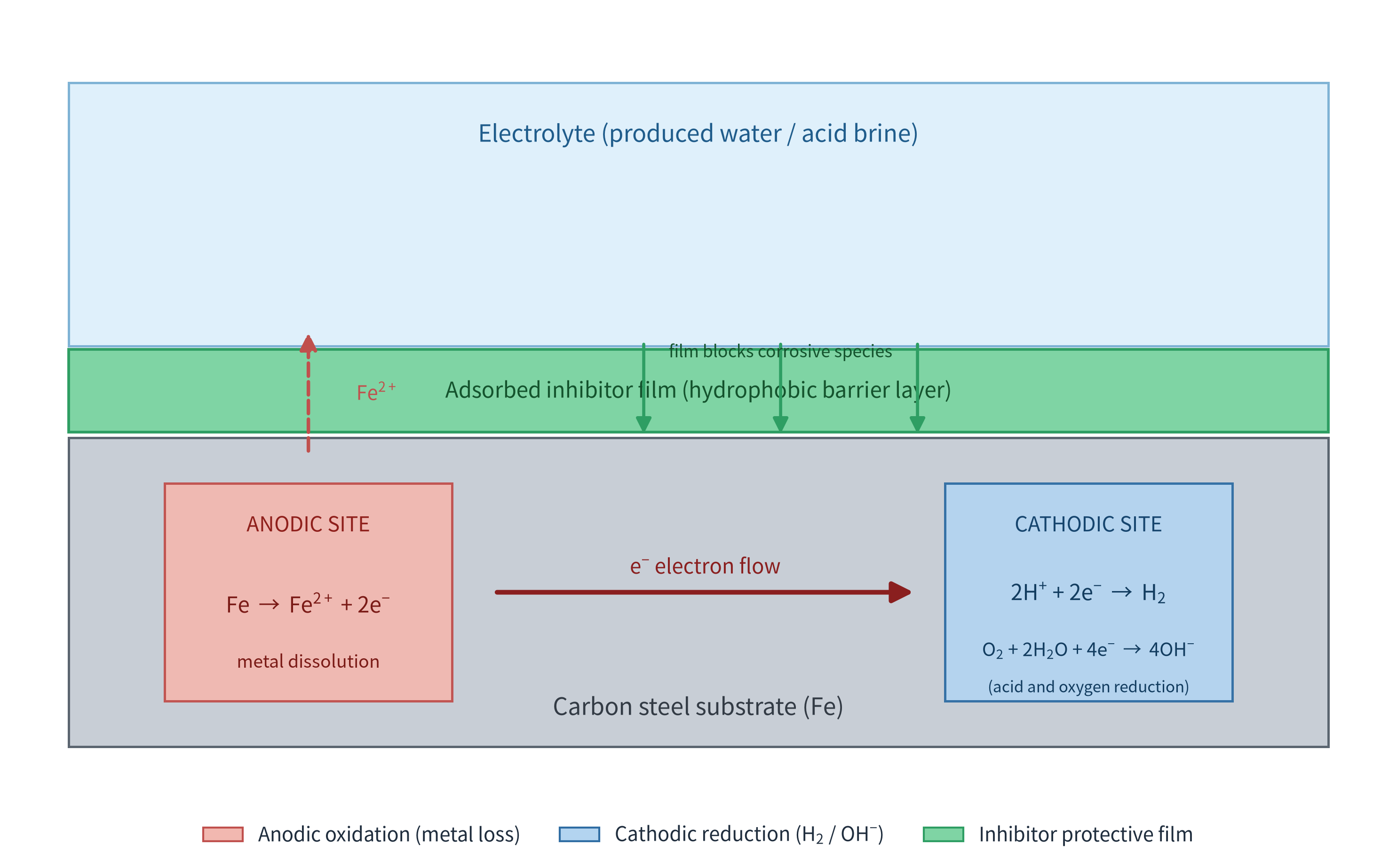
Figure 1. The electrochemical corrosion cell on a carbon steel surface, showing anodic dissolution, cathodic reduction and the protective film formed by an organic inhibitor.
The driving force for this entire circuit is the difference in electrochemical potential that develops between the anodic and cathodic regions, and such potential differences arise naturally from impurities in the metal, from weld zones, from differences in oxygen concentration across a surface, from deposits and scale that shield parts of the metal from the environment, and from the sheer statistical variation of the surface itself, which is why corrosion rarely proceeds uniformly and instead favours localized attack such as pitting, crevice corrosion and stress corrosion cracking that can perforate a pipe wall or fracture a component long before the average metal loss has become obvious. An inhibitor attacks this problem at its source, because the molecules are designed to lodge themselves at the metal–electrolyte interface and to interfere with one or more of the steps in the corrosion circuit, and depending on where they act they are classified as anodic inhibitors that suppress metal dissolution, cathodic inhibitors that suppress the reduction reaction, mixed inhibitors that slow both half-reactions simultaneously, and film-forming inhibitors that create a thin protective layer that physically separates the metal from the corrosive environment and raises the energy barrier that the charge transfer reaction must overcome. The most important class for the oil and gas industry is the film-forming organic type, whose long molecules adsorb onto the metal surface with their polar heads anchored to the metal and their hydrophobic tails pointing outward into the fluid, and the resulting monomolecular or near-monomolecular film, shown schematically in Figure 1 as the green barrier layer, is what blocks the approach of corrosive species, increases the electrical resistance of the interface, and converts a fast-dissolving surface into one whose corrosion rate drops by orders of magnitude.
The Principal Chemical Families of Inhibitor Molecules
Almost all of the high-performance organic inhibitors that dominate the oilfield market share the same architectural logic, which is a molecule that contains at least one strongly polar functional group, carrying atoms such as nitrogen, oxygen or sulphur that possess lone pairs of electrons, and at least one long hydrophobic hydrocarbon chain that is repelled by water and attracted to oil, and it is this two-ended structure, often called an amphiphilic or surfactant-like structure, that allows the molecule to adsorb firmly onto the positively or negatively charged metal surface through its polar head while simultaneously turning its non-polar tail outward to form a water-repellent blanket over the metal. The nitrogen-based family is by far the most commercially important, and within it the imidazolines occupy a special place, because these five-membered ring compounds, typically produced by reacting a fatty acid with a polyamine such as diethylenetriamine, combine outstanding adsorption on steel with strong protection in both sweet and sour environments, and the presence of a second nitrogen atom and an easily functionalised side chain means that the chemist can tune the molecule further, for example by ethoxylation, to adjust its water solubility, its dispersibility and its partitioning behaviour in multiphase fluids. The product data examined in this article show exactly this chemistry at work, with CIMET CI-209 being a straight tall oil imidazoline, CIMET TOI-7 and CIMET TOI-9 being tall oil imidazoline derivatives carrying seven and nine moles of ethylene oxide respectively, CIMET O and CIMET TOH being hydroxyethyl imidazolines, CIMET TO being a blended tall oil imidazoline, and CIMET TOI-A being a water-soluble salt form of an oleic imidazoline combined with a polyacrylate component.
Alongside the imidazolines sit the quaternary ammonium compounds, which carry a permanent positive charge on a nitrogen atom regardless of the pH of the environment, and this permanent cationic character makes them excellent film formers on the negatively charged steel surface as well as conferring useful biocidal side effects, while the product CIMET 515 in the series is a polyquaternary ammonium salt whose very high charge density and 50 percent active content make it a powerful and economical choice specifically for carbon dioxide dominated sweet systems. Further along the portfolio one finds the phosphate esters, represented in the data by PCMET PE1650, which are outstanding for the control of dissolved oxygen corrosion because the phosphate group can both adsorb onto the metal and participate in a mild anodic passivation that suppresses the oxygen-driven attack, and one also finds the fatty amine ethers, represented by CIMET TAE, which combine the film-forming power of a long-chain amine with ether linkages that improve solubility and wetting in hydrocarbon service. Finally there are the proprietary blends such as CIMET Cl-28 and CIMET Cl-31, whose exact compositions are guarded as trade secrets but which are formulated specifically to protect steel from the ferocious attack of mineral acids, namely hydrochloric acid in one case and sulphuric acid in the other, and the very existence of such specialised products illustrates the central principle of the whole field, which is that corrosion inhibitor chemistry is not a single formula but a whole toolbox of molecular architectures, each engineered for a particular threat, a particular temperature, a particular fluid and a particular set of operating conditions.
How Solubility and Physical Form Shape Real World Performance
An inhibitor that cannot reach the metal surface is of no value whatsoever, no matter how perfect its molecular architecture, and for this reason the solubility and dispersibility of a product in the carrier fluid, and in the production fluid it must protect, are just as decisive for field success as the chemistry of the active molecule itself. The finished products supplied by UNPChemicals are therefore characterised, as shown in the solubility matrix of Figure 2, against four media that represent the whole range of realistic delivery and service conditions, namely isopropanol, a polar solvent commonly used as a co-solvent in inhibitor formulations, kerosene, which represents the hydrocarbon or oil phase through which oil-soluble inhibitors are carried, water, which represents the aqueous phase of produced fluids, injection brines and cooling systems, and aromatic 150, a heavier aromatic solvent that is often used where better solvency and a higher flash point are required.
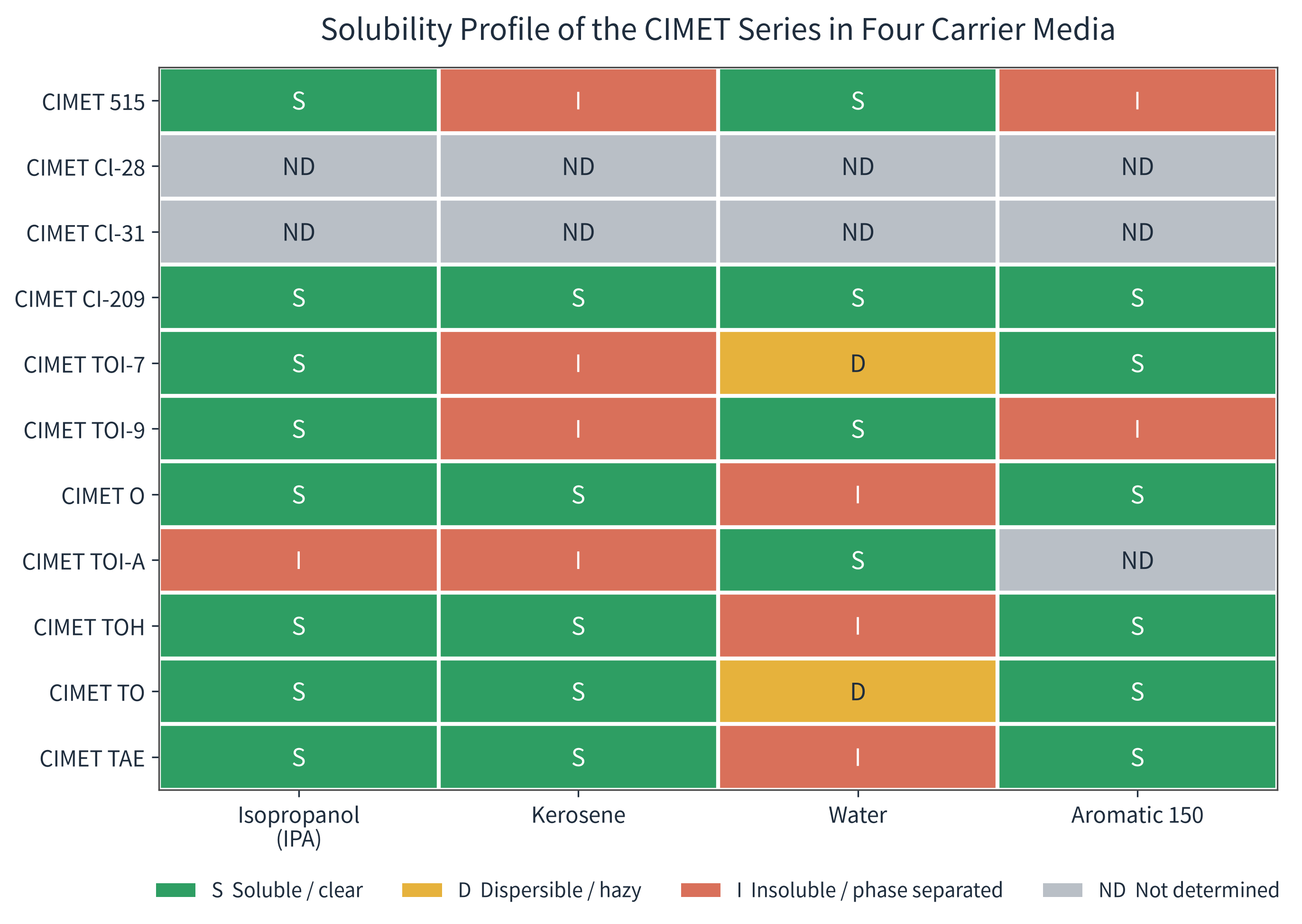
Figure 2. Solubility and dispersibility profile of the CIMET series in four carrier media (S soluble, D dispersible, I insoluble, ND not determined).
The matrix of Figure 2, which faithfully reproduces the supplier's own product data, tells a rich story about how the series has been engineered to cover the full spectrum of field conditions, and the most striking observation is that CIMET CI-209, the straight tall oil imidazoline, is soluble and clear in all four media, which makes it the most versatile and forgiving member of the family, equally at home in oil-continuous and water-continuous systems, while the ethoxylated derivatives show a deliberate shift in behaviour, with CIMET TOI-7 becoming dispersible rather than fully soluble in water as its ethylene oxide content gives it just enough hydrophilicity to work in mixed or water-wet systems, and CIMET TOI-9 going a step further to full water solubility, although at the cost of losing solubility in kerosene, which illustrates the classic trade-off that every formulator must manage between water compatibility on one hand and oil-phase delivery on the other. The hydroxyethyl imidazolines CIMET O and CIMET TOH, together with the fatty amine ether CIMET TAE, all display the opposite preference, being fully soluble in the hydrocarbon and aromatic solvents but insoluble in water, which tells the user immediately that these products are best deployed where the continuous phase is oil, while CIMET TOI-A, the water-soluble salt form, is the only member that is insoluble in the hydrocarbon media, signalling its intended role in high-water-cut and fully aqueous systems where an oil-soluble molecule would never reach the metal surface. The physical form of the products is equally informative, because every single member of the series is supplied as a liquid, which is essential for easy injection and metering, and the pour points, mostly below zero degrees Celsius with values such as minus 12 for CIMET 515 and CIMET Cl-28, below minus 15 for CIMET CI-209 and CIMET O, and below minus 10 for CIMET TOI-A and CIMET TOH, guarantee that the products remain pumpable in cold climates, although the phosphate ester PCMET PE1650 with its pour point of 12 degrees Celsius is the notable exception and will require heating or dilution with a solvent in winter conditions, while the active content figures ranging from 50 percent for the polyquaternary salt up to 100 percent for most of the imidazoline products govern the dose economics of each treatment.
Selecting the Right Inhibitor Chemistry for the Corrosion Threat
The entire art of corrosion inhibition can be condensed into a single sentence, which is that the chemistry must be matched to the mechanism of attack, and the product range described above maps almost one-to-one onto the principal corrosion threats that the oil and gas industry actually faces, with carbon dioxide sweet corrosion, which is caused by carbonic acid formed when carbon dioxide dissolves in water, being handled by the polyquaternary product CIMET 515, while the much more complex mixed threat of carbon dioxide together with hydrogen sulphide, the so-called sour environment in which sulphide films and hydrogen embrittlement complicate the picture, is the home territory of the eight-member imidazoline family stretching from CIMET CI-209 through the ethoxylated, hydroxyethyl, blended and salt derivatives to the amine ether CIMET TAE, and mineral acid attack, which occurs during acidising and pickling operations when concentrated hydrochloric or sulphuric acid is deliberately pumped into the well, demands the specialised proprietary formulations CIMET Cl-28 and CIMET Cl-31 respectively, while oxygen corrosion in water injection and aerobic service is countered by the phosphate ester PCMET PE1650. The reason such a spread of products is necessary is that the same steel surface, the same fluid, and even the same well can present several different corrosion mechanisms at different times, and a molecule that performs brilliantly against carbon dioxide may be helpless against oxygen, just as a product that is perfect for a continuous water-wet pipeline may fail completely in a batch-treated gas well where the fluid is predominantly condensate.
Beyond the identity of the aggressive species, the selection process must weigh the temperature and pressure of the system, the flow regime and turbulence that can strip away protective films, the water cut and the salinity of the brine, the partial pressure of the acid gases, the presence of solids and biological activity, and the compatibility of the inhibitor with every other chemical that is injected into the same stream, from demulsifiers and scale inhibitors to biocides and hydrate inhibitors, and in practice this selection is never made from a brochure alone but through a disciplined sequence that starts with identifying the corrosion mechanism from well data and standard references, moves through laboratory screening using methods such as the wheel test, the rotating cylinder electrode, linear polarisation resistance and electrochemical impedance spectroscopy, often under autoclave conditions that reproduce the downhole temperature and pressure, and concludes with a carefully monitored field trial in which corrosion coupons and real-time probes confirm that the chosen product achieves its target protection rate in the true operating environment. It is precisely because this process demands both a deep understanding of corrosion science and a broad, well-characterised portfolio of molecules that operators value a supplier who can offer, as UNPChemicals does, a complete family of products supported by solubility data, active content specifications, pour point information and application guidance that allow the production chemist to make an informed and defensible choice rather than relying on trial and error in the field.
UNPChemicals and the CIMET Series of Corrosion Inhibitors
The CIMET series brought together in Table 1 is the embodiment of everything discussed in this article, because it is a deliberately engineered product line in which each grade occupies a defined position in the matrix of corrosion threat, fluid phase and physical property, rather than a random collection of unrelated chemicals, and Table 1 presents the complete technical characterisation of the series exactly as supplied by UNPChemicals, listing for every product its chemical description, its total active content, its physical appearance, its pour point, its solubility and dispersibility in the four carrier media, and the corrosion function for which it is intended. Reading the table as a whole one sees a rational portfolio in which the imidazoline chemistry, with all its ethoxylated, hydroxyethyl, blended and salt-form variations, provides the broad backbone of protection for the sweet and sour carbon dioxide and hydrogen sulphide systems that dominate oil and gas production, the polyquaternary CIMET 515 covers the sweet carbon dioxide niche with a water-soluble product, the proprietary CIMET Cl-28 and CIMET Cl-31 are reserved for the extreme duty of hydrochloric and sulphuric acid service, and the phosphate ester PCMET PE1650 extends the family into the very different problem of oxygen corrosion.
Product | Description | Active % | Pour point (°C) | Solubility (IPA / Kerosene / Water / Aromatic 150) | Function | Use |
CIMET 515 | Polyquaternary ammonium salt | 50 | -12 | S / I / S / I | CO2 corrosion inhibitor | — |
CIMET Cl-28 | Proprietary blend | ND | -12 | ND / ND / ND / ND | HCl acid corrosion inhibitor | Added to acid solutions |
CIMET Cl-31 | Proprietary blend | ND | <0 | ND / ND / ND / ND | H2SO4 corrosion inhibitor | Added to acid solutions |
CIMET CI-209 | Tall oil imidazoline | 100 | <-15 | S / S / S / S | CO2, H2S | Oil / water systems |
CIMET TOI-7 | Tall oil imidazoline (7 EO) | 100 | <0 | S / I / D / S | CO2, H2S | — |
CIMET TOI-9 | Tall oil imidazoline (9 EO) | 100 | <0 | S / I / S / I | CO2, H2S | — |
CIMET O | Oleic hydroxyethyl imidazoline | 100 | <-15 | S / S / I / S | CO2, H2S | — |
CIMET TOI-A | Oleic imidazoline polyacrylate salt | 75 | <-10 | I / I / S / ND | CO2, H2S | — |
CIMET TOH | Tall oil hydroxyethyl imidazoline | 100 | <-10 | S / S / I / S | CO2, H2S | — |
CIMET TO | Tall oil imidazoline (blend) | 100 | <0 | S / S / D / S | CO2, H2S | Oil / water systems |
CIMET TAE | Fatty amine ether | 100 | <0 | S / S / I / S | CO2, H2S | — |
PCMET PE1650 | Phosphate ester | 100 | 12 | S / S / D / S | Oxygen | Oil / water systems |
Table 1. Technical characterisation of the UNPChemicals CIMET series, with solubility expressed in the order IPA / kerosene / water / aromatic 150 (S soluble, D dispersible, I insoluble, ND not determined); all grades are supplied as liquids. The full solubility matrix is shown in Figure 2.
For the production chemist the practical reading of Table 1 is straightforward, because the combination of the solubility matrix and the pour point data immediately narrows the selection, so that a continuous injection application in a water-wet carbon dioxide well will naturally point towards the water-soluble members such as CIMET 515, CIMET TOI-9 or CIMET TOI-A, while a batch treatment in an oil-continuous or condensate system will favour the hydrocarbon-soluble film formers such as CIMET CI-209, CIMET O, CIMET TOH, CIMET TO or CIMET TAE, and an acidising campaign will call directly upon CIMET Cl-28 or CIMET Cl-31 depending on whether the stimulation acid is hydrochloric or sulphuric, and an aerated water injection system will be served by the phosphate ester PCMET PE1650. What ultimately distinguishes the CIMET series is not any single magic molecule but the completeness and the transparency of the offering, because UNPChemicals characterises each grade with the active content, the solubility behaviour, the physical form and the intended service that the selection process demands, and supports that characterisation with the technical expertise to recommend, dose and monitor the product in the field, which is exactly the combination of chemistry, data and service that turns the abstract science of corrosion inhibition into reliable, quantifiable protection for the operator's most valuable assets.