 WhatsApp
 sales@unpchemicals.com
 +86 16638830202
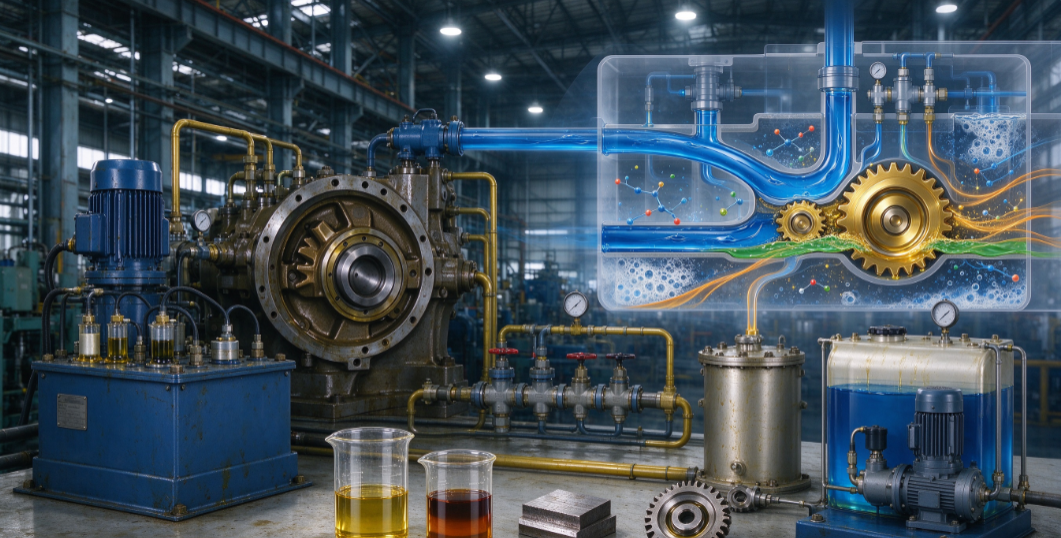
Industry-Wide Operational Challenges
Industrial machinery across manufacturing, power generation, mining and construction operates under variable conditions of heavy load, high temperature, speed fluctuation and contaminant ingress. Single-component base oils cannot independently satisfy comprehensive requirements including anti-wearprotection, oxidation stability, viscosity retention and contaminant dispersion. Without properly compounded additive-package solutions, operators face accelerated friction-pair wear, lubricant oxidative deterioration, sludge-varnish deposition, foam interference and higher frequency of oil change and equipment downtime. Formulators rely on pre-blended multi-functional additive packages to simplify formulation work and achieve balanced target performance for diverse industrial lubricant end-products.
Definition: Industrial Lubricant Additive Package
An industrial lubricant additive package is a pre-formulated blend of multiple functional chemical components designed to upgrade the performance of base oils and simplify lubricant formulation. Unlike single-function additives, which may address only wear, oxidation, or corrosion, an additive package integrates several complementary ingredients into one system. Its core purpose is to enable synergistic effects among anti-wear / extreme-pressure agents, antioxidants, corrosion inhibitors, detergents-dispersants, viscosity modifiers and foam suppressants, so that the finished lubricant can meet comprehensive industrial requirements without formulators having to develop every component separately.
Core Principles & Fundamental Classification
Industrial-lubricant additive packages are pre-formulated multi-component chemical blends for performance upgrading of base oils. Analogous to paraffin inhibitors modifying wax-crystal morphology without removing paraffin from crude oil: additive packages do not change the intrinsic base-oil hydrodynamic lubrication capability. Instead, multiple functional ingredients work synergistically at molecular and interfacial levels to realize wear-protection, oxidation suppression, contaminant control and viscosity-property adjustment.
They fall into two primary application groups according to end-use orientation: - Hydraulic-fluid additive packages: High-zinc, low-zinc and zinc-free grades for formulating performance-grade industrial hydraulic oils. - Industrial-gear-oil additive packages: Ashless and high-extreme-pressure compound grades for gear oils and compatible extreme-pressure greases.
Internal functional components inside these packages cover anti-wear / extreme-pressure agents, antioxidants, corrosion inhibitors, detergents-dispersants, viscosity modifiers and foam suppressants.
Performance-Driven Working Mechanisms
Different functional components within blended additive packages realize performance improvement through distinct molecular pathways: - Anti-wear & Extreme-Pressure Components: Form physical barrier films or generate tribochemical reaction layers on metal contact surfaces to avoid direct metal-to-metal contact and mitigate scoring and seizure under heavy-load conditions. - Antioxidant Components: Scavenge free radicals induced by heat, oxygen and mechanical shear, interrupting lubricant oxidative-chain-reactions and restraining sludge and varnish by-product generation. - Detergent-Dispersant Components: Possess amphiphilic molecular structures; polar moieties adsorb dirt, soot and fine metal particles, while non-polar segments keep contaminants stably suspended within oil phase to prevent surface deposition and filter blockage. - Viscosity Modifiers: Adjust molecular conformation responding to temperature variation, maintaining proper lubricant film thickness both at low-temperature startup and high-temperature continuous operation. - Corrosion Inhibitors & Foam Suppressants: Build protective adsorption layers isolating metal from corrosive media; suppress persistent gas-liquid foam to guarantee stable oil-system circulation.
Consequences of Improper Additive-Package Selection
Inadequate or mismatched additive-package selection brings multiple operational risks. Poor compatibility between additive-package and base oil triggers phase separation, sediment precipitation and overall performance decay. Insufficient anti-wear and extreme-pressure capacity leads to rapid wear and premature failure of gears, pump components and friction pairs. Inadequate oxidation stability accelerates lubricant aging and sludge-varnish accumulation, clogging filters and oil circuits. Packages failing to match industry-standard specifications cause end-products to miss equipment-manufacturer approval requirements. All these problems raise maintenance workload, shorten lubricant service intervals and increase total operating expenditure for industrial facilities.
Commercial Additive Portfolio Overview
- Hydraulic Oil Additive Packages UNP AH502A: High-zinc hydraulic-fluid additive package with excellent anti-wear, anti-corrosion and anti-oxidation performance; dosed at 0.6 wt-% to formulate hydraulic fluids complying with AFNOR, DIN, Eaton Vickers and Cincinnati Machine specifications. UNP AH502B: Low-zinc hydraulic-fluid additive package, low treat-rate, delivers balanced anti-wear, anti-corrosion and antioxidant properties; meets Denison HF-0 and multi-national hydraulic-fluid industry requirements at 0.6 wt-% dosage. UNP AH502C: Zinc-free hydraulic-fluid additive package, good anti-wear and anti-rust-corrosion performance, inhibits sludge formation; suitable for formulating zinc-restricted hydraulic-fluid products.
- Industrial Gear Oil Additive Packages UNP IG402A: Ashless compound additive package for industrial gear oils and compatible EP greases; balanced EP/AW, anti-oxidation and anti-corrosion components, satisfies GB 5903-2011, U.S. Steel, DIN, AGMA gear-oil specifications. UNP IG402B: High-extreme-pressure industrial gear-oil additive package for heavy-duty service; typical dosage 1.8 wt-%, provides superior load-bearing performance for harsh-condition industrial-gear-oil formulations.
Critical Performance Metrics for Qualified Additive Packages
Following the unified evaluation framework across UNPChemicals technical review series, high-quality industrial-lubricant additive packages shall meet four core performance metrics:
1. High efficiency at low treat rates: Achieve full-set target lubricant performances under economical addition proportion without bringing undesirable side-effects.
2. Broad formulation compatibility: Good mutual compatibility among internal components; stable solubility and miscibility with different types of base-oil stocks, no phase separation or sediment generation.
3. Robust environmental stability: Retain synergistic comprehensive performance under high-temperature, mechanical-shear and contaminant-intrusion service conditions.
4. Practical industrial processability: Convenient metering and blending during lubricant production; finished lubricants formulated from packages shall pass corresponding industry and OEM performance specifications.
Application Domains & Formulation Selection Guidelines
These additive-package systems serve multiple industrial segments:
1. Hydraulic-system lubricants: Formulating HM / HV / HLP / HVLP performance-grade hydraulic fluids for general and heavy-duty hydraulic equipment.
2. Industrial-gear-lubrication products: Compounding industrial EP gear oils and compatible extreme-pressure greases for gearbox and heavy-transmission devices.
3. General-purpose industrial circulating-oil systems: Manufacturing equipment, power-generation turbines, compressor-oil and other circulating-lubrication scenarios.
4. Mining-construction heavy-duty machinery: Lubricant formulation for excavators, crushers and other heavy-load mechanical assets.
Formulators need to evaluate machinery load characteristics, operating temperature range, base-oil type, target industry-OEM specifications and element-restriction requirements (zinc-free / low-zinc constraints) before grade selection: - Choose UNP AH502A for conventional high-performance zinc-containing hydraulic-fluid formulation. - Adopt UNP AH502B when Denison HF-0 approval and low-zinc requirements are demanded. - Select UNP AH502C for projects with strict zinc-content limitation for hydraulic-fluid end-products. - Deploy UNP IG402A for standard-duty industrial-gear-oil and EP-grease compounding. - Use UNP IG402B for heavy-duty extreme-pressure industrial-gear-oil formulation under severe working conditions.
Concluding Remarks
Reliable performance of industrial lubricants relies not merely on base-oil quality but also on synergistically-matched multi-component additive-package design. Pre-blended industrial-lubricant additive packages integrate anti-wear, extreme-pressure, anti-oxidation, corrosion-inhibition and contaminant-handling functions. Appropriate grade selection simplifies formulation workflows, enables finished lubricants to satisfy international industry and OEM specifications, protects mechanical friction pairs and lowers comprehensive maintenance costs for end-users across manufacturing, power-generation and heavy-equipment sectors.
Contact UNPChemicals technical-sales team for datasheets, formulation recommendations and custom-grade support for your specific industrial-lubricant-formulation projects.