 WhatsApp
 sales@unpchemicals.com
 +86 16638830202
Corrosion Inhibitors in Oil and Gas Production and Processing
What Is a Corrosion Inhibitor?
In the language of the oil and gas industry a corrosion inhibitor is a chemical product that is injected into the production stream, or into a water injection system, or into a stimulation acid, for the express purpose of reducing the rate at which the internal surfaces of the equipment corrode, and the defining feature of such a product is that it performs this protective duty while being present in the fluid at only a very small concentration, typically measured in parts per million, so that the chemistry travels with the produced fluids, follows them into the tubing, along the flowlines, through the manifolds and into the separators, and protects the steel everywhere the fluid goes without ever forming a separate physical layer that would have to be applied, inspected and repaired like a coating. A working definition that reflects this industrial reality is that a corrosion inhibitor is a chemical substance added in small concentrations to an environment to reduce the corrosion rate of a metal exposed to that environment, and in the oilfield this simple definition translates into an enormous range of practical duties, from protecting the carbon steel tubing of a gas well against carbon dioxide attack, to defending a water injection pipeline against dissolved oxygen, to preventing the catastrophic acid attack on steel that would otherwise occur the moment concentrated hydrochloric acid is pumped downhole during a stimulation treatment. Because the inhibitor is dissolved or dispersed in the very fluid that is causing the problem, it reaches every wetted surface automatically, including the internal walls of pipes where no external protection can possibly act, which is why chemical inhibition has become the workhorse technology for internal corrosion control in the upstream oil and gas industry.
The chemistry that performs this task is overwhelmingly organic in nature, built from nitrogen-containing molecules such as imidazolines, amines and quaternary ammonium compounds, together with phosphate esters, amine ethers and carefully guarded proprietary blends, and these molecules share a common working principle in that they adsorb onto the steel surface and form a thin, protective film that raises the resistance of the metal to the electrochemical reactions that dissolve it. The precise role of the inhibitor, and the way it is applied, varies enormously with the duty, because a continuous injection inhibitor that must protect a pipeline for years is formulated very differently from a batch inhibitor that is squeezed into a well and expected to persist for months, which in turn is formulated very differently from an acid corrosion inhibitor that must survive a few hours in a 15 percent hydrochloric acid solution at reservoir temperature while protecting the tubing that is being stimulated, and it is this variety of duties that explains why no single product can cover the whole industry and why suppliers such as UNPChemicals maintain entire product families dedicated to different threats. This article examines why corrosion costs the industry so much, what the principal corrosion threats actually are, how inhibitors are applied and evaluated in the field, how formulation and compatibility determine real world success, and how the CIMET series of products from UNPChemicals has been built to answer these challenges across the full range of oilfield corrosion problems.
Why Corrosion Costs the Oil and Gas Industry Billions Every Year
The scale of the corrosion problem in the oil and gas industry can be appreciated only when it is set against the global picture, and the benchmark assessment that is cited throughout the industry, the NACE International IMPACT study of 2016, estimated the worldwide cost of corrosion at approximately US$2.5 trillion per year, equivalent to about 3.4 percent of global gross domestic product, while a parallel landmark study for the United States, the Corrosion Costs and Preventive Strategies in the United States report prepared for the Federal Highway Administration and published in 2002, arrived at a total direct cost of US$137.9 billion per year for the 26 industrial sectors that it analysed, with the sector breakdown shown in Figure 1 revealing that utilities suffered the heaviest burden at US$47.9 billion, followed by transportation at US$29.7 billion, infrastructure at US$22.6 billion, government at US$20.1 billion and production and manufacturing at US$17.6 billion. Within that national picture the oil and gas exploration and production sector alone was estimated to carry a direct corrosion bill of roughly US$1.4 billion every year, with about US$0.6 billion of that attributable to surface piping and facilities, US$0.5 billion to downhole tubing and US$0.3 billion to capital expenditures related to corrosion, while petroleum refining added approximately US$3.7 billion more, and these direct costs are only the visible tip of an iceberg that also contains the far larger indirect costs of lost production, deferred revenue, environmental damage, safety incidents and the premature abandonment of wells.
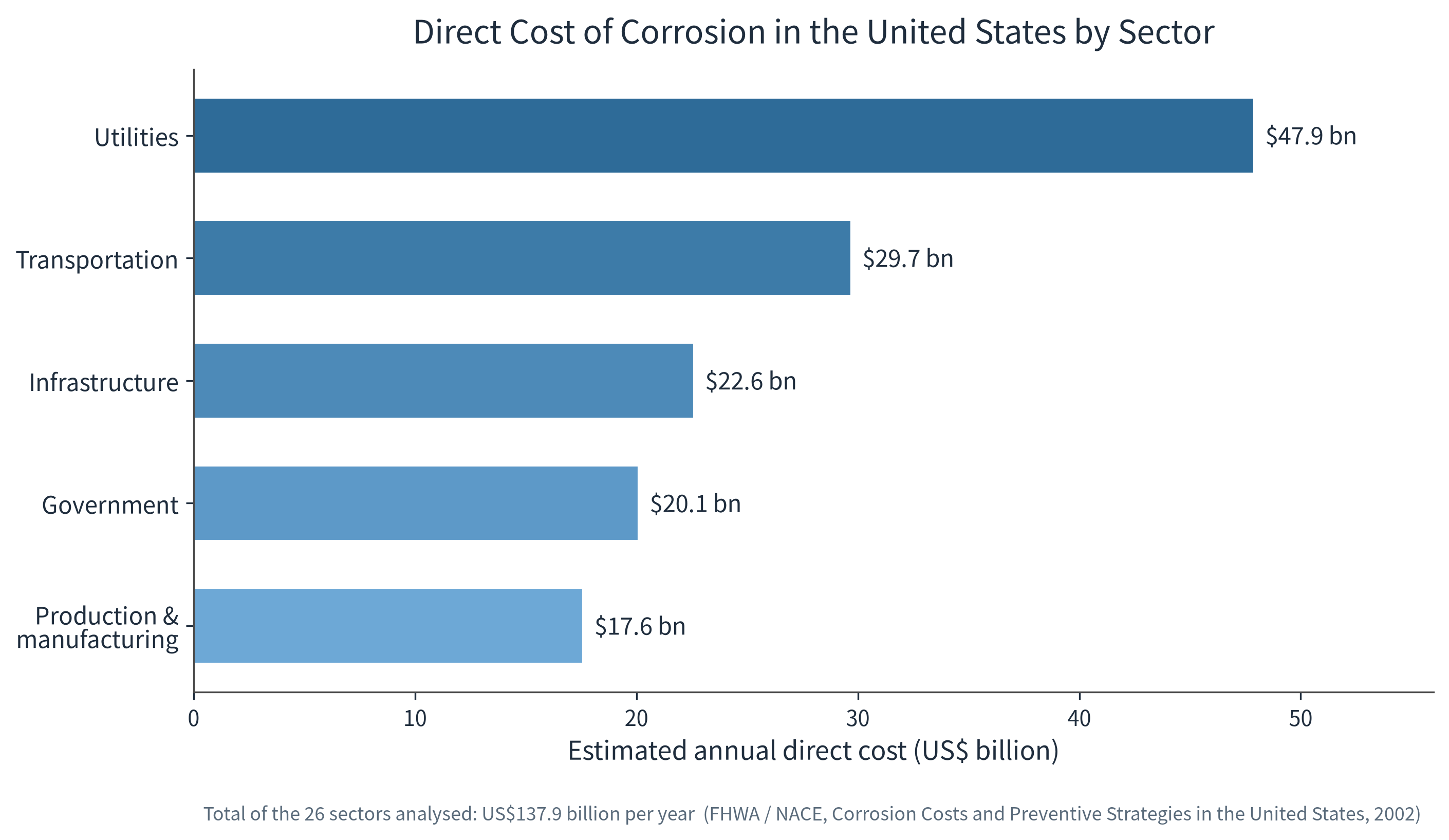
Figure 1. Estimated annual direct cost of corrosion in the United States by sector (FHWA / NACE, Corrosion Costs and Preventive Strategies in the United States, 2002).
The reason these figures matter so much to the operator is that almost none of them is unavoidable, because the same NACE analysis that produced the cost estimates also demonstrated that between 15 and 35 percent of the total cost of corrosion could be saved through the intelligent application of existing corrosion control technologies, and for the oil and gas industry specifically the single most powerful and cost-effective of those technologies, particularly for the internal corrosion of tubing, flowlines and processing facilities, is chemical inhibition. Every dollar spent on an effective inhibitor program buys protection for assets whose replacement value runs into the hundreds of millions, prevents the safety and environmental consequences of a failed pipeline or a parted tubing string, and avoids the enormous expense of an unscheduled shutdown, and it is this arithmetic, in which a relatively modest chemical spend protects an enormous capital base, that makes corrosion management one of the highest-value disciplines in production chemistry and makes the selection of the right inhibitor a decision with direct consequences for the bottom line. The cost story is therefore not simply a story of large numbers but a story of leverage, because the gap between the cost of corrosion and the cost of controlling corrosion is precisely the value that an informed inhibitor program, backed by a supplier with a complete and well-characterised product portfolio, delivers to the operator year after year.
The Principal Corrosion Threats in Oilfield Environments
The first and most widespread threat in modern oil and gas production is sweet corrosion caused by carbon dioxide, which dissolves in the produced water to form carbonic acid and creates a mildly acidic environment in which the steel surface corrodes in a characteristic pattern of shallow pits and grooves, and the severity of this attack depends on the carbon dioxide partial pressure, the temperature, the flow velocity and the water chemistry, which is why carbon dioxide corrosion is typically described as a flow-dependent and temperature-dependent phenomenon that can proceed at rates of several millimetres per year if left untreated. The second major threat is sour corrosion caused by hydrogen sulphide, which in addition to the general corrosion associated with the acidic sulphide environment introduces the far more dangerous possibility of hydrogen ingress into the steel, leading to sulphide stress cracking, hydrogen-induced cracking and the catastrophic brittle failures that have made sour service one of the most tightly regulated areas of materials engineering, and because oil and gas reservoirs frequently contain both carbon dioxide and hydrogen sulphide in varying proportions, the industry must routinely deal with the combined sweet and sour threat that demands inhibitor molecules capable of handling both mechanisms simultaneously. Superimposed on these acid gas threats are two further enemies that are often underestimated, the first being dissolved oxygen, which is introduced chiefly through water injection and surface handling and which produces extremely aggressive pitting at even very low concentrations, and the second being the concentrated mineral acids, hydrochloric and sulphuric, that are deliberately introduced into wells during acidising and into plant during pickling, where the acid attack on steel is so ferocious that without a dedicated acid corrosion inhibitor the metal loss would be measured in millimetres per minute rather than per year.
Each of these threats demands a different protective strategy, and Figure 2 maps the product portfolio of UNPChemicals onto this threat landscape, showing how the CIMET and companion PCMET lines have been deliberately arranged so that eight products address the combined carbon dioxide and hydrogen sulphide sour systems, one product, CIMET 515, addresses sweet carbon dioxide systems specifically, one product each, CIMET Cl-28 and CIMET Cl-31, addresses hydrochloric and sulphuric acidising respectively, and one product, PCMET PE1650, addresses dissolved oxygen, and this one-to-one mapping between chemistry and threat is not an accident but the direct result of understanding that an inhibitor molecule protects against the specific electrochemical mechanism for which it was designed. In addition to these purely chemical threats, the modern operator must also contend with microbially influenced corrosion caused by sulphate-reducing bacteria, with erosion corrosion in high-velocity multiphase flow, with galvanic corrosion at the junctions of dissimilar metals, and with the under-deposit corrosion that hides beneath scale and solids, and while inhibitors are not the complete answer to every one of these mechanisms, a well-chosen and well-applied inhibitor remains the first line of defence in the majority of internal corrosion scenarios encountered in the field.
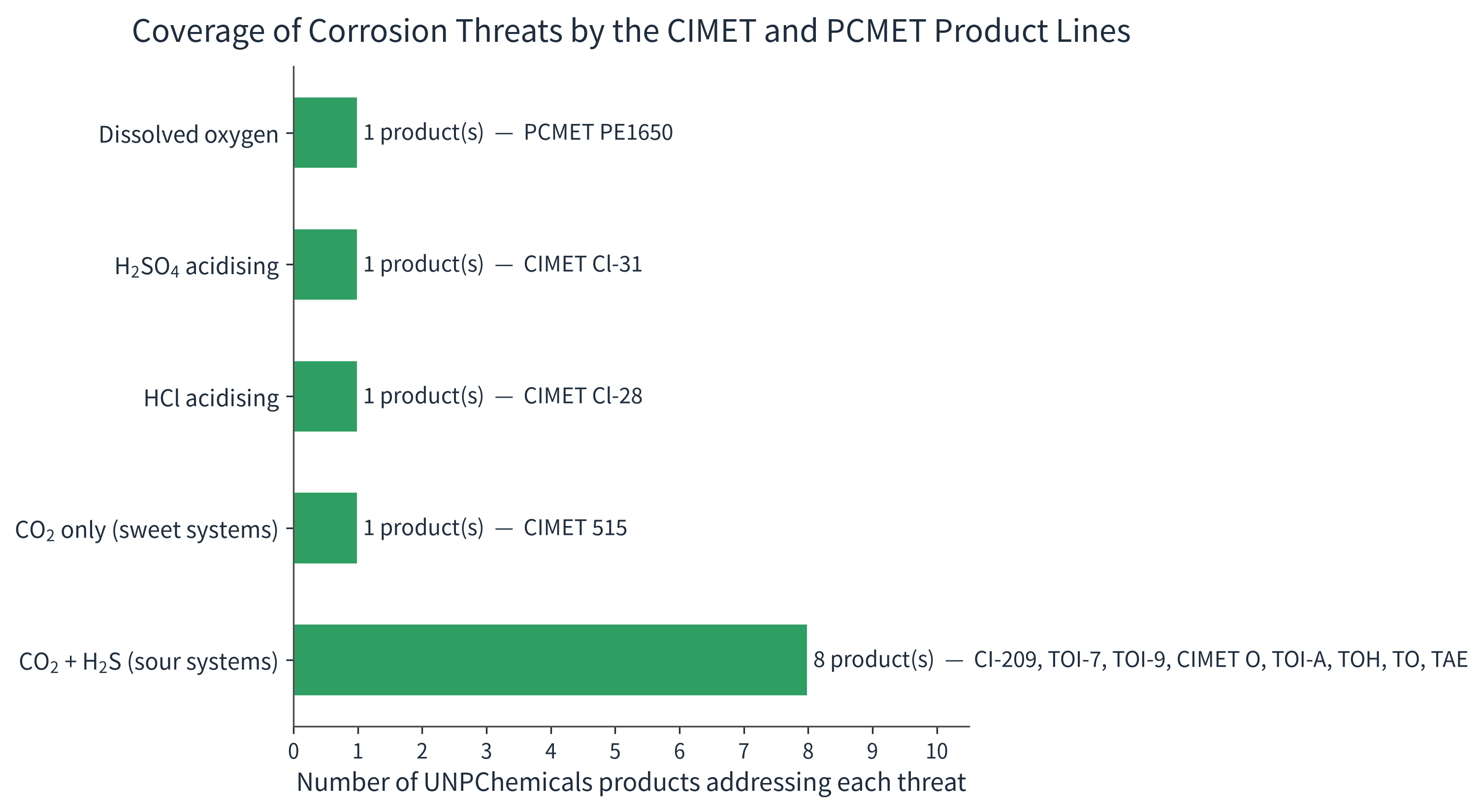
Figure 2. Coverage of corrosion threats by the UNPChemicals CIMET and PCMET product lines.
How Corrosion Inhibitors Are Applied and Evaluated in the Field
The manner in which an inhibitor is delivered to the metal surface is just as important as the chemistry of the inhibitor itself, and the industry has developed three principal application strategies that are selected according to the nature of the asset and the continuity of the threat, the first being continuous injection, in which the inhibitor is pumped at a steady, low rate into the flowing stream through a capillary string, an umbilical or an injection quill, so that a constant protective concentration is maintained at all times, which is the method of choice for pipelines, flowlines and producing wells where the corrosion threat is continuous, while the second strategy is batch treatment, in which a relatively large volume of concentrated inhibitor is introduced periodically into the system, either as a slug that is pushed along by the flowing fluid to lay down a persistent film, or as a squeeze treatment in which the inhibitor is injected into the formation and slowly returns with the produced fluids to protect the well for weeks or months, and the third strategy is the addition of the inhibitor to a process stream such as an acidising fluid, where the chemical is simply blended into the acid before it is pumped downhole and must survive the acid attack for the duration of the job. The dosage of the inhibitor is a carefully optimised quantity, because too little chemistry fails to form a complete film and leaves the metal exposed while excessive dosage wastes money and can cause emulsion or foaming problems, and the optimum concentration is established through a combination of laboratory testing and field monitoring that typically uses corrosion coupons, electrical resistance probes, linear polarisation resistance probes and ultrasonic wall thickness measurements to track the actual corrosion rate of the asset over time.
The evaluation of an inhibitor before it ever reaches the field follows a similarly disciplined path, starting with laboratory screening in which the candidate product is tested against the actual produced brine and the actual corrosive gas composition at the relevant temperature and pressure, using standard methods such as the wheel test, the rotating cylinder electrode test, the bubble test, electrochemical impedance spectroscopy and autoclave testing under full downhole conditions, and the results of these tests are expressed as a protection efficiency, typically the percentage reduction in corrosion rate achieved by the inhibitor compared with the untreated baseline, with values of 90 percent or above being the normal target for acceptance. Once a product has passed laboratory screening it is subjected to compatibility testing with the other chemicals that will share the same stream, and finally to a field trial in which the corrosion rate is measured before, during and after the treatment so that the real protection achieved in the operating environment can be quantified, and throughout this entire process the operator relies on reference standards and recommended practices issued by bodies such as NACE and ISO that define both the test methods and the acceptance criteria, ensuring that the selection of an inhibitor is a technical, evidence-based decision rather than a matter of guesswork.
Formulation, Compatibility and the Economics of Inhibition
No corrosion inhibitor is ever shipped as a pure active molecule, and the finished commercial product is always a formulation in which the active chemistry is dissolved or dispersed in a carefully chosen solvent system, together with surfactants to improve spreading and wetting, sometimes with a small amount of intensifier or synergist to boost performance, and the choice of solvent system, which is why the solubility data examined in the first part of this series matter so much, determines how the product will be handled, injected, winterised and delivered to the metal surface in the field, with polar solvents such as isopropanol providing water compatibility, hydrocarbon solvents such as kerosene and aromatic 150 providing oil-phase delivery, and the balance between them defining where the product will partition in a multiphase system. The physical properties of the formulation are equally practical, because a product that gels or thickens at winter temperatures cannot be injected reliably, which is why the pour point specifications of the CIMET series, mostly below zero degrees Celsius and down to below minus 15 degrees Celsius for the most cold-tolerant grades, are such valuable data for the operator in cold climates, although the phosphate ester PCMET PE1650 with its pour point of 12 degrees Celsius serves as a reminder that some chemistries inherently need heating or solvent dilution in winter service, and the active content of the product, which ranges from 50 percent for CIMET 515 up to 100 percent for the majority of the imidazoline products, governs the dose economics because it determines how much commercial product must be pumped to deliver a given amount of active chemistry.
Compatibility is the silent partner of formulation, because in the real field no chemical is injected alone and the inhibitor must coexist peacefully with the demulsifiers that break the emulsion, the scale inhibitors that prevent mineral deposition, the biocides that control bacteria, the hydrate inhibitors such as methanol and glycol, and the oxygen scavengers that are injected in the same stream, and an incompatible inhibitor can destabilise the emulsion, precipitate the scale inhibitor, poison the demulsifier or simply fail to protect the metal because its film is disrupted by the other chemicals, which is why suppliers such as UNPChemicals routinely perform compatibility and performance testing with the operator's full chemical package before recommending a product. The economics of inhibition are ultimately the argument that closes the case, because the cost of an inhibitor program, measured in a few parts per million of a product at a price per litre, is vanishingly small compared with the cost of the failure it prevents, and when the NACE findings that 15 to 35 percent of the total cost of corrosion can be saved by existing technology are applied to an industry whose corrosion bill runs into billions of dollars, the conclusion is inescapable that a properly designed, properly dosed and properly monitored inhibitor program is one of the highest return investments an operator can make in the integrity and longevity of its assets.
UNPChemicals and the CIMET Series of Corrosion Inhibitors
The CIMET series from UNPChemicals is a complete answer to the threat landscape described above, and Table 1 below organises the product line by application so that the operator can see at a glance which product is designed for which duty, with the eight-member imidazoline family covering the sweet and sour carbon dioxide and hydrogen sulphide systems that represent the overwhelming majority of oilfield corrosion problems, the polyquaternary CIMET 515 providing a water-soluble option for sweet systems, the proprietary CIMET Cl-28 and CIMET Cl-31 standing ready for the extreme duty of hydrochloric and sulphuric acid service, and the phosphate ester PCMET PE1650 extending protection to the oxygen corrosion that threatens water injection and aerated systems. What makes this series genuinely useful in the field is that every grade is characterised not only by its chemistry but by the physical and solubility data that the application engineer needs, including the active content, the pour point, and the solubility and dispersibility in isopropanol, kerosene, water and aromatic 150, so that the selection of a product can be made with confidence for the actual phase behaviour, the actual climate and the actual corrosion mechanism of the asset in question.
Corrosion threat | Recommended products | Chemistry | Key properties | Typical duty |
Sweet CO2 systems | CIMET 515 | Polyquaternary ammonium salt | 50% active, water-soluble, pour point -12 °C | Downhole and topside protection in CO2 wells |
Sour CO2 + H2S systems | CIMET CI-209, TOI-7, TOI-9, CIMET O, TOI-A, TOH, TO, TAE | Tall oil imidazoline family, amine ether | 75–100% active, oil/water variants, low pour points | Continuous and batch treatment of producing wells and pipelines |
HCl acidising | CIMET Cl-28 | Proprietary blend | Added to hydrochloric acid solutions | Well stimulation and acid pickling |
H2SO4 acidising | CIMET Cl-31 | Proprietary blend | Added to sulphuric acid solutions | Acid service and pickling |
Dissolved oxygen | PCMET PE1650 | Phosphate ester | 100% active, oil/water applicable, pour point 12 °C | Water injection and aerobic systems |
Table 1. Application-based selection guide for the UNPChemicals CIMET and PCMET product lines.
For the operator who is establishing or upgrading a corrosion management program, the practical value of the CIMET series lies in the confidence that comes from a single supplier covering the whole range of internal corrosion threats, supported by complete technical data, sensible product differentiation and the flexibility to recommend continuous injection, batch treatment or acid service products as the duty demands. UNPChemicals backs this portfolio with the technical service that turns a product list into a working program, including assistance with product selection, dose optimisation, compatibility testing with the existing chemical package and interpretation of the corrosion monitoring results that confirm performance in the field, and it is this combination of a complete and transparent product line with genuine corrosion engineering support that makes the CIMET series a practical, dependable foundation for protecting the tubing, pipelines, facilities and water systems on which oil and gas production depends.