 WhatsApp
 sales@unpchemicals.com
 +86 16638830202

What Is an Oilfield Corrosion Inhibitor?
The Imidazoline Ring and the Oleic Chain That Anchor the Protective Film
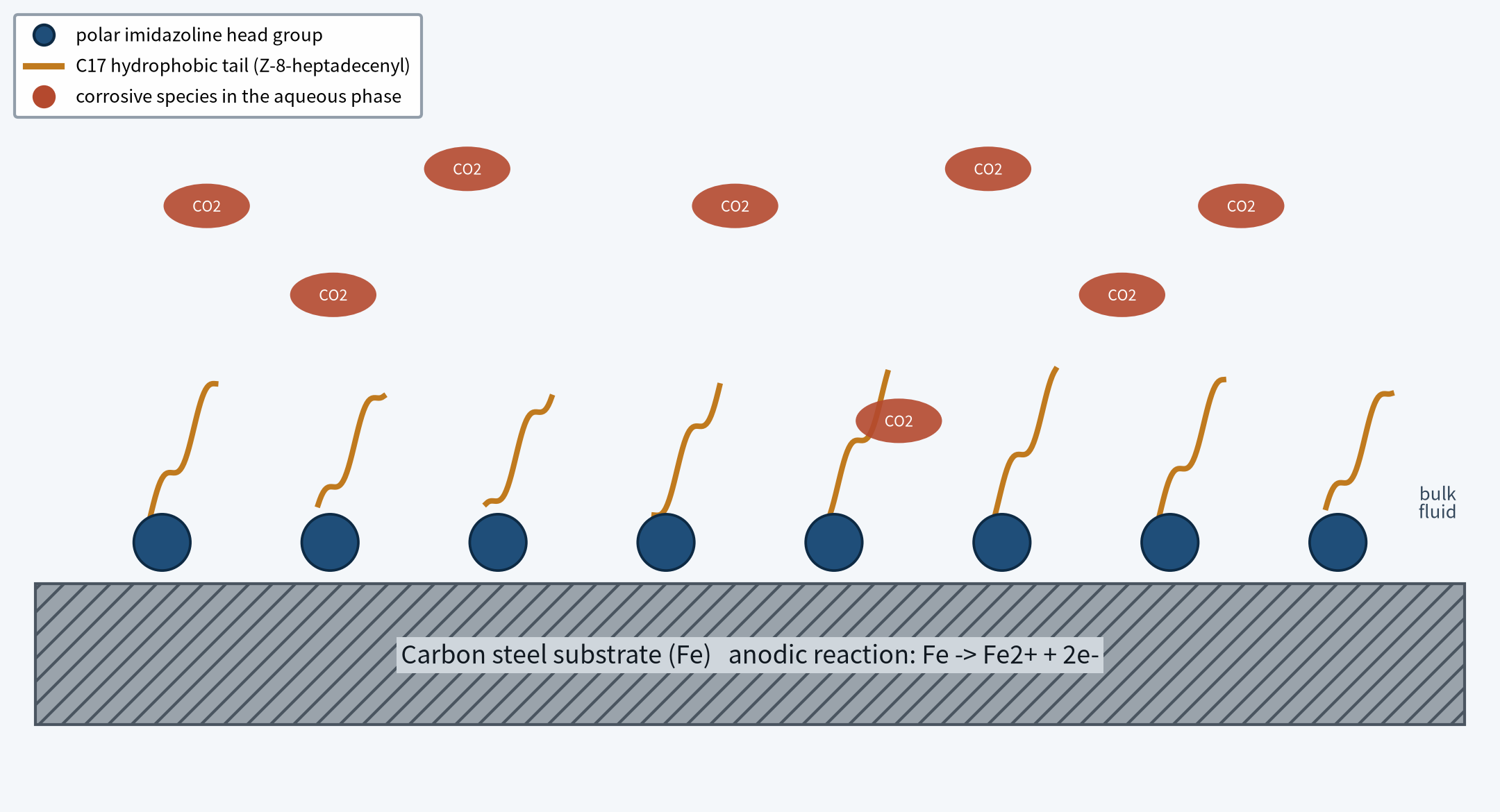
The resulting film is a self-assembled monolayer rather than a coating, with the polar heads in contact with the metal and the alkyl tails presented to the aqueous phase, so that the interface the corrosive fluid encounters is not steel but a hydrocarbon-like surface with a contact angle far removed from the wetting behaviour of bare metal. Water and hydrated ions must cross that hydrophobic layer before they can reach the anodic and cathodic sites on which the corrosion cell depends, and the film therefore suppresses both the anodic dissolution of iron and the cathodic reduction of protons and carbonic acid in a single step, while the same layer physically separates the sulphide or chloride species that would otherwise initiate pitting. Because adsorption is a dynamic equilibrium rather than a permanent bond, the film is continuously desorbed and re-formed at the local inhibitor concentration, which is why a properly dosed system behaves as if it were self-healing and why local depletion of inhibitor, whether caused by an under-dosed injection point, a stagnant section or a sudden influx of condensate, is visible in the field as localised attack long before the average corrosion rate responds.
One Functional Group Two Behaviours Hydroxyethyl versus Aminoethyl Imidazoline
Feature | Hydroxyethyl imidazoline | Aminoethyl imidazoline | Benzyl-quaternised TOFA amide |
CAS number | 95-38-5 | 20565-75-7 | 92797-20-1 |
Substance type | Single substance, defined structure | Single substance, defined structure | UVCB reaction mixture |
Terminal group | Hydroxyl (-CH2CH2OH) | Primary amine (-CH2CH2NH2) | Benzyl-substituted quaternary nitrogen |
Polyamine used | Aminoethylethanolamine (AEEA) | Diethylenetriamine (DETA) | Diethylenetriamine (DETA) |
Dominant anchoring mode | Protonated ring plus hydrogen bonding | Protonated ring plus amine chelation | Permanent cation, no protonation required |
Dependence on pH | Strong, single protonation step | Strong, two protonation steps | Essentially independent of pH |
Water partitioning | Moderate, oil-favoured | Higher, more water-soluble | High, strongly water-dispersible |
Typical field duty | CO2 and H2S production wells, flowlines | Acidising, pickling, aggressive sour service | Brine-dominant and high-shear systems |
Transport classification | UN3267, class 8, PG III | UN3267, class 8, PG III | UN3267, class 8, PG III |
Quaternization with Benzyl Chloride and the Tall Oil Amide Route
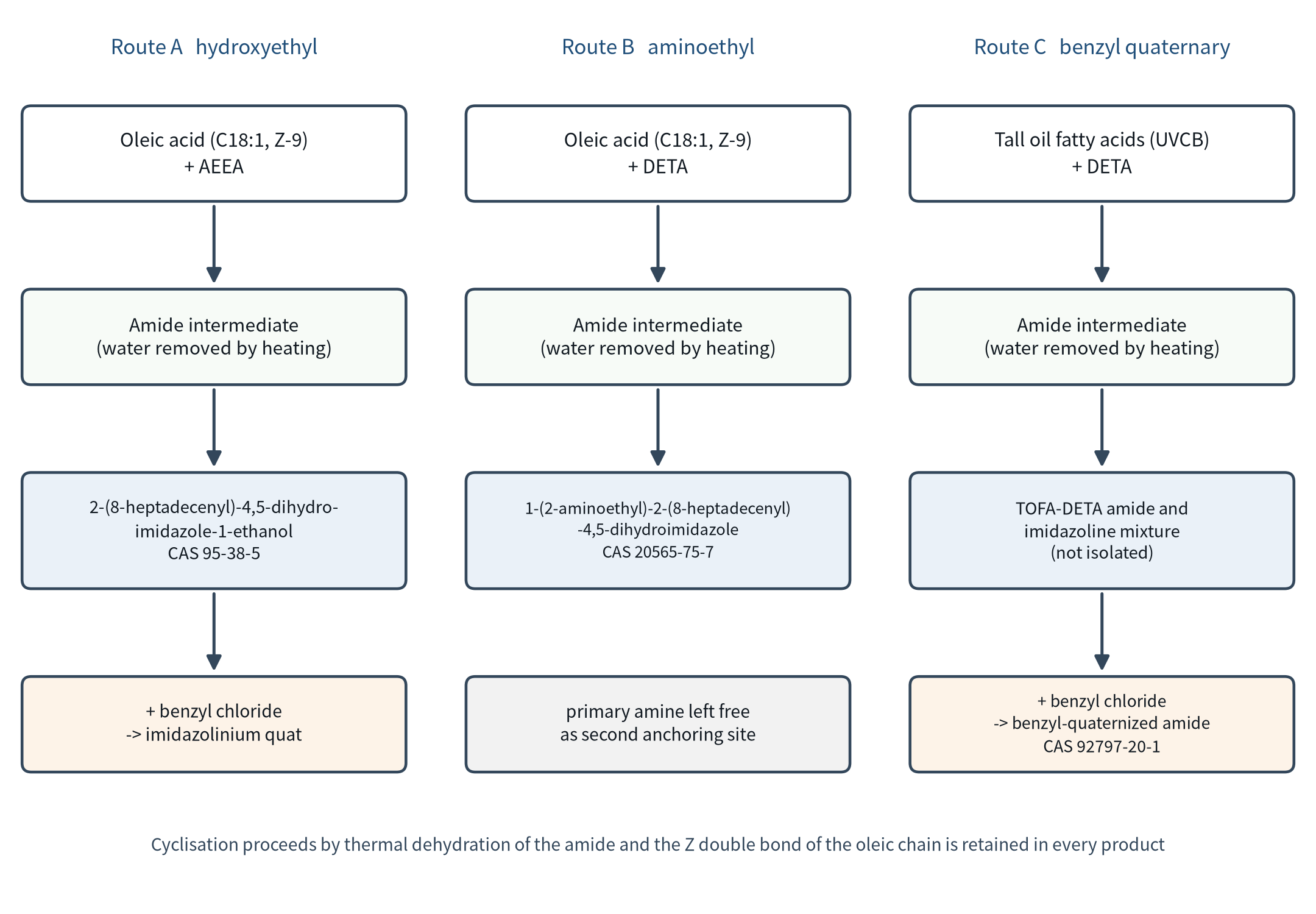
The price of that robustness is a set of side effects that a formulator has to design around, because a permanent cation is a far more aggressive surfactant than an amine that is only partly charged at working pH: it foams more strongly, it interacts more readily with anionic chemistries such as sulphonated scale inhibitors, phosphate esters and friction reducers, and it carries a higher aquatic toxicity, so the quaternised grades are normally the most heavily regulated members of any corrosion portfolio and are always classified as hazardous to the aquatic environment. Benzyl quaternary ammonium compounds also have a finite thermal ceiling, since prolonged exposure to very high bottomhole temperature can drive dequaternisation and loss of the permanent charge, which is why temperature is the first question asked before a quaternised grade is recommended for a deep, hot producer.
How Molecular Structure Translates into Physical Property and Field Dosage
Property | Hydroxyethyl imidazoline 95-38-5 | Aminoethyl imidazoline 20565-75-7 | Benzyl-quaternised TOFA amide 92797-20-1 |
Appearance | Clear to pale amber liquid | Clear to pale amber liquid | Clear to amber liquid |
Relative density at 20 C | 0.93 (estimated) | 0.94 (estimated) | 0.94 (estimated) |
Flash point, closed cup | Above 237 C (estimated) | Above 250 C (estimated) | Above 240 C (estimated) |
Reaction in water | Dispersible, weakly alkaline | Dispersible, alkaline | Dispersible, alkaline |
Solubility behaviour | Oil soluble, alcohol compatible | Partly water soluble, oil dispersible | Water dispersible with co-solvent |
GHS classification of the group | Skin corrosion 1C, aquatic acute and chronic 1 | Skin corrosion 1C, aquatic acute and chronic 1 | Skin corrosion 1C, aquatic acute and chronic 1 |
Transport | UN3267, class 8, PG III, marine pollutant | UN3267, class 8, PG III, marine pollutant | UN3267, class 8, PG III, marine pollutant |