 WhatsApp
 sales@unpchemicals.com
 +86 16638830202
Why Friction Matters: The Problem This Additive Solves
Every machine with moving parts loses energy to friction. In engines, gearboxes, compressors and hydraulic systems, a surprising share of that loss happens under boundary lubrication — the condition where the oil film becomes too thin to fully separate two metal surfaces. Under high load, low speed or rising temperature, asperities touch, friction spikes, heat builds and wear accelerates. Base oils alone are not designed for this regime; their job is to carry load hydrodynamically. When the film breaks down, something else must protect the surface. That job belongs to friction modifiers, and among them, oil-soluble organic molybdenum compounds are widely regarded as the most effective class for cutting friction while adding wear and oxidation protection. Understanding what an organic molybdenum friction modifier actually is — and how it works — is the first step to using it well.
What Is an Organic Molybdenum Friction Modifier?
An organic molybdenum friction modifier is an oil-soluble organometallic additive in which a molybdenum atom is chemically bonded to sulfur- and/or phosphorus-containing organic ligands. The word "organic" is important: unlike solid molybdenum disulfide (MoS2) powder, which must be dispersed as particles in the lubricant, these compounds dissolve molecularly in the base oil. That solubility is what makes them practical — they can be blended uniformly into engine oils, industrial lubricants, metalworking fluids and greases without sedimentation or filter blocking. Once in service, they do not simply coat the surface; they react at the contact zone to build a protective film. Depending on the ligand chemistry, the same molecule can also deliver extreme-pressure (EP), anti-wear and antioxidant performance, which is why organic molybdenum is described as a multifunctional additive rather than a single-purpose one.
How It Works: The MoS₂ Tribofilm Mechanism
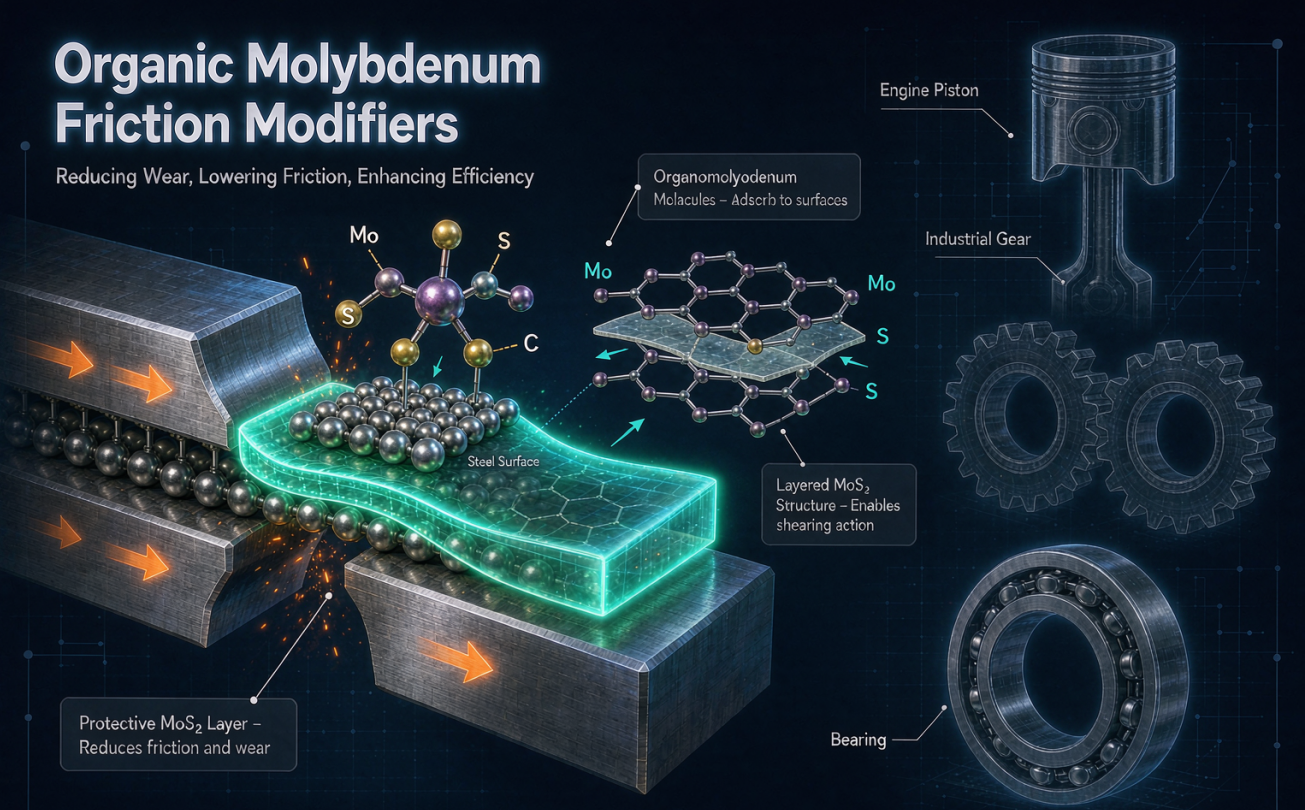
The friction-reducing effect comes from a film formed directly on the metal. When a lubricated contact enters the boundary regime, local temperature and pressure cause the organic molybdenum molecule to adsorb onto the surface and decompose tribochemically. The decomposition product is a thin, patched layer rich in molybdenum disulfide. MoS2 has a layered crystal structure: within each layer, atoms are strongly bonded, but the layers slide over one another with very little resistance. The tribofilm therefore sticks firmly to the substrate yet shears easily — so sliding happens inside the film instead of between metal asperities. The coefficient of friction drops, less heat is generated, and wear is reduced. Sulfur and phosphorus released from MoDTP and MoDTC grades contribute additional EP and anti-wear action by forming protective sulfide and phosphate layers at the hottest contact points, while the molybdenum species suppresses oxidation. This combination — low shear, strong adhesion and chemical protection — is the reason organic molybdenum outperforms many conventional friction modifiers under demanding conditions.
Core Functions and Practical Benefits
Organic molybdenum friction modifiers are valued for a stack of complementary functions, not just one:
- Friction reduction: forms a low-shear MoS2 tribofilm that lowers the coefficient of friction, cutting energy loss and operating temperature.
- Anti-wear protection: the tribofilm and sulfur/phosphorus reaction layers shield surfaces under boundary and mixed lubrication, extending component life.
- Extreme-pressure performance: helps prevent scuffing and seizure in high-load contacts such as gears and cam-follower systems.
- Antioxidant contribution: molybdenum species help inhibit oil oxidation, supporting longer lubricant service life.
- Fuel and energy economy: lower friction translates directly into reduced fuel consumption in vehicles and lower power draw in industrial equipment.
Together these functions make the additive useful wherever efficiency, durability and thermal stability matter.
Main Chemical Types of Organic Molybdenum
Organic molybdenum friction modifiers fall into a few well-defined families, separated mainly by their ligand chemistry and sulfur/phosphorus content:
- Molybdenum dithiophosphate (MoDTP): contains both sulfur and phosphorus. Delivers the broadest multifunctional package — friction reduction plus strong EP, anti-wear and antioxidant behavior.
- Molybdenum dithiocarbamate (MoDTC): phosphorus-free. Provides excellent friction reduction with anti-wear and antioxidant functions, and is preferred where phosphorus must be limited.
- Long-chain MoDTC: a dithiocarbamate with longer alkyl chains, giving improved solubility and handling in a wider range of base oils.
- Sulfur- and phosphorus-free organomolybdenum complexes: environmentally oriented chemistry built for low-S/low-P and low-ash formulations, with strong friction reduction and synergism with other additives.
Commercial Organic Molybdenum Portfolio
UNPChemicals supplies a focused range of organic molybdenum friction modifiers across these chemistry families, so formulators can match the additive to the base oil and the application:
- MSAIL 300L (Molybdenum dithiophosphate, MoDTP; equivalent to SAKURA LUBE 300 / MOLYVAN L; CAS 72030-25-2): a liquid organic molybdenum containing sulfur and phosphorus (Mo 9.1%, S 11.3%, P 3.2%). It greatly reduces the coefficient of friction and provides EP, anti-wear and antioxidant functions.
- MSAIL 300LB (Molybdenum dithiophosphate, MoDTP; equivalent to RC3580; CAS 68958-92-9): a higher-sulfur, higher-phosphorus variant (Mo 8.0%, S 12.0%, P 6.0%) for applications needing stronger boundary and EP protection.
- MSAIL 525A (Molybdenum dithiocarbamate, MoDTC; equivalent to SAKURA LUBE 525; CAS 253873-83-5): a phosphate-free liquid organic molybdenum (Mo 10.0%, S 11.0%) with friction reduction, anti-wear and antioxidant performance.
- MSAIL 525B (Long-chain molybdenum dithiocarbamate, MoDTC; equivalent to MOLYVAN 3000; CAS 71342-89-7): a phosphorus-free long-chain dialkyl dithiocarbamate molybdenum (Mo 10.0%, S 10.7%) offering enhanced solubility and strong friction reduction.
- MSAIL 8550 (Organomolybdenum complex, sulfur- and phosphorus-free; equivalent to MOLYVAN 855; CAS 445409-27-8): a versatile, environmentally friendly additive (Mo 7.9%) with exceptional friction reduction, superior performance when combined with sulfur additives, and antioxidant synergism.
Applications Across Industries
Because they dissolve in oil and act at the surface, organic molybdenum friction modifiers are used across a broad range of lubricants:
- Internal-combustion engine oils: reduce friction and wear, improve fuel economy and protect valvetrain and piston-ring contacts.
- Industrial lubricants: used in gear oils, compressor oils, turbine and hydraulic systems to raise efficiency, lower operating temperature and extend maintenance intervals.
- Neat-oil metalworking fluids: reduce friction and tool wear in cutting, drawing and forming, improving surface finish and tool life.
- Lubricating greases: enhance performance in bearings, gears and other assemblies where boundary contact occurs.
Grade selection follows the application: MoDTP grades suit systems that want maximum multifunction protection; phosphorus-free MoDTC and S/P-free complexes suit formulations constrained by phosphorus, sulfur or ash limits.
What to Check Before Selecting a Grade
An organic molybdenum friction modifier should be chosen by chemistry, not by molybdenum content alone. Confirm compatibility with the base oil and the rest of the additive package, and check that the sulfur and phosphorus levels fit the target specification. Consider the operating envelope — load, temperature and sliding speed — and the materials in contact, since active sulfur can stain yellow metals. Finally, review environmental and regulatory limits on phosphorus, sulfur and sulfated ash. Working through these points avoids the common problems of poor solubility, additive conflict, corrosion and off-spec formulations.
Concluding Remarks
An organic molybdenum friction modifier is an oil-soluble organometallic additive that builds a low-shear MoS2 tribofilm on metal surfaces, reducing friction and wear while adding EP and antioxidant protection. From MoDTP and MoDTC to long-chain and S/P-free complexes, the family offers a grade for almost every lubricant system — engine oils, industrial lubricants, metalworking fluids and greases. Understanding the functions and the tribofilm mechanism makes it possible to select the right chemistry with confidence, turning lower friction into real gains in efficiency, durability and equipment life.
Contact the UNPChemicals technical-sales team for datasheets, formulation recommendations and custom-grade support for your organic molybdenum friction-modifier projects.