 WhatsApp
 sales@unpchemicals.com
 +86 16638830202
Industry-Wide Operational Challenges
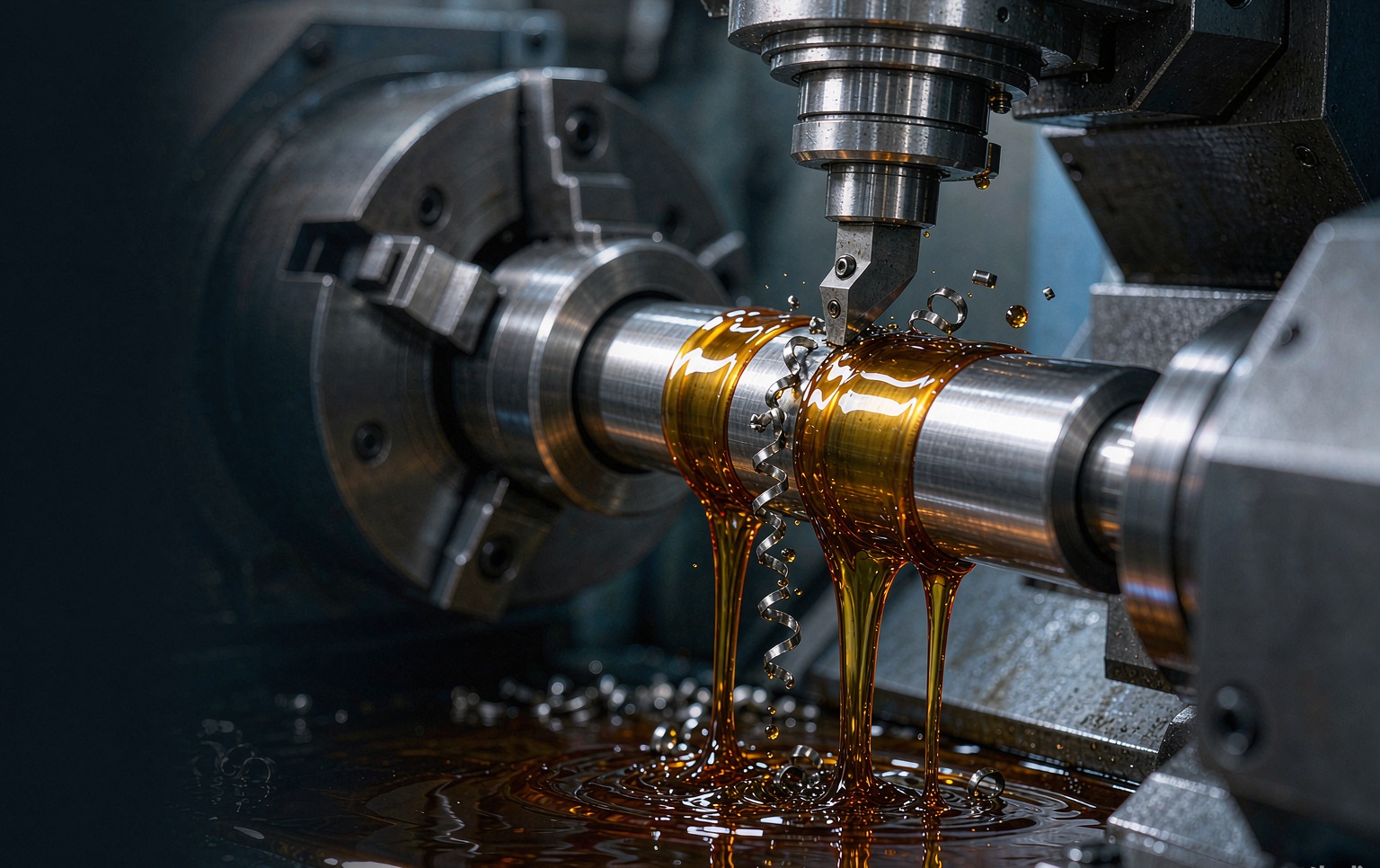
Turning, milling, broaching, gear cutting and cold forming with neat (straight) oils place the entire tribological duty on the fluid itself: with no water to absorb heat, the additive package alone must control friction, boundary contact, oxidation and metallic corrosion inside the chip-forming zone. At high cutting speeds and loads the tool–chip interface reaches flash temperatures at which ordinary fatty esters and base-oil films desorb and break down, producing built-up edge, flank wear, chatter and unacceptable surface finish. Active-sulfur extreme-pressure chemistry, on which heavy-duty cutting still depends, attacks copper alloys in fixtures, guideways and bronze worm gears, staining or pitting them and turning the oil green. Circulating oil held at 60–80 °C, loaded with fine metal fines and entrained air, oxidises quickly; the resulting acids, varnish and resin plug filters, lacquer machine surfaces and force premature sump changes. Oil mist at the spindle raises consumption and workshop air-quality concerns, while disposal of spent oil is increasingly restricted. Base oil plus a simple fat-and-sulfur package cannot cover these combined demands, so formulators must screen individual oil-soluble additives against base-oil type, load severity and the metallurgy of both workpiece and machine tool.
What are Metalworking-Oil Additives?
Metalworking-oil additives are oil-soluble functional chemicals compounded into neat cutting oils, forming and drawing lubricants, rolling oils and related industrial lubricants to upgrade friction control, extreme-pressure and anti-wear protection, oxidation resistance and corrosion protection. They work at interfaces — adsorbing on metal, reacting at hot spots or interrupting radical oxidation chains — rather than by changing the bulk viscosity of the base oil. The main families are friction modifiers, extreme-pressure (EP) and anti-wear (AW) agents, metal deactivators, rust and corrosion inhibitors, antioxidants, and auxiliary components such as antifoam and lubricity esters.
Core Principles & Fundamental Classification
Single-component additives are concentrated, oil-soluble substances used to upgrade defined performance attributes during compounding. They cannot replace the load-carrying capacity of a correctly selected base oil, nor the cooling contribution of circulation and flow. Their action is interfacial and molecular: forming adsorbed or tribochemical films, passivating reactive metal surfaces, or decomposing peroxides before oxidation propagates. According to functional orientation and representative grades, the products in this portfolio fall into three groups:
l Organo-molybdenum friction modifiers: molybdenum dithiophosphate (MoDTP, MSAIL 300L, CAS 72030-25-2) — a liquid friction modifier containing both sulfur and phosphorus that also contributes EP, anti-wear and antioxidant performance.
l Ashless thiadiazole metal deactivators: thiadiazole octyl mercaptan condensate (CSAIL DMTD-8, CAS 13539-13-4) — a liquid, ashless copper-corrosion inhibitor with EP and auxiliary antioxidant effects.
l Dialkyl phosphite multifunctional additives: dioleyl hydrogen phosphite (PSAIL 3018, CAS 64051-29-2) — an oleyl-structured phosphite combining antioxidant, anti-wear and stabilizing properties.
Performance-Driven Working Mechanisms
l Molybdenum dithiophosphate (MSAIL 300L): the molecule carries molybdenum together with sulfur and phosphorus in one oil-soluble structure. Under boundary contact it decomposes at asperity hot spots and deposits a mixed film — lamellar MoS₂ of low shear strength together with an iron/molybdenum phosphate glass — on the rubbed surface. This dual film lowers the friction coefficient under mixed and boundary lubrication, which reduces contact temperature, suppresses built-up edge and improves finish; the same chemistry supplies extreme-pressure and anti-wear protection and decomposes hydroperoxides, so friction, wear and oxidation are addressed by a single component.
l Thiadiazole octyl mercaptan condensate (CSAIL DMTD-8): a dimercaptothiadiazole derivative, ashless, containing both sulfur and nitrogen. It chemisorbs on copper and copper-alloy surfaces, forming a thin organometallic film that passivates the metal against active sulfur, hydrogen sulfide and acidic degradation products, preventing staining, pitting and selective corrosion of brass fixtures, bronze bearings and copper guideways. Because the film is a molecular layer, protection is obtained at very low treat rates without impairing EP performance, and the thiadiazole ring also scavenges peroxides, giving a secondary antioxidant effect. Being ashless, it leaves no metal-containing ash and suits formulations in which zinc or barium are restricted.
l Dioleyl hydrogen phosphite (PSAIL 3018): the oleyl chains provide high oil solubility and strong adsorption on steel, while the phosphite group decomposes peroxides as a primary antioxidant and, under severe contact, converts into an iron phosphate film that supports anti-wear and EP performance. The result is improved oxidation stability, less sludge and varnish, and better retention of lubricity in service. Its ashless, metal-free character makes it a practical building block where a low-ash anti-wear and antioxidant component is required.
Consequences of Improper Additive Selection
Inadequate or mismatched selection brings operational risk rather than a simple performance shortfall. Too little friction modifier, or one that is incompatible with the base oil, leaves friction and contact temperature high: built-up edge returns, surface finish degrades and power draw rises. Overdosing MoDTP, or using it in a base oil where it is only partly soluble, produces haze, sediment and molybdenum-containing deposits on workpieces and in filters. Omitting the copper deactivator while relying on active-sulfur EP chemistry allows brass fixtures, bronze bearings and copper guideways to stain and pit, and the corrosion products then circulate as abrasive contamination. Insufficient antioxidant or phosphite leaves the oil oxidising at sump temperature, with rising acid number, varnish, filter plugging and smoke. Excessive or poorly balanced EP chemistry attacks machine paint and seals, can leach cobalt from carbide tooling and raises operator skin-irritation concerns. A package that is not balanced overall foams, entrains air, mists heavily and lets chips settle into sludge.
Commercial Additive Portfolio Overview
l MSAIL 300L (molybdenum dithiophosphate, CAS 72030-25-2): liquid organic-molybdenum friction modifier containing sulfur and phosphorus; markedly reduces the friction coefficient and adds extreme-pressure, anti-wear and anti-oxidation functions; used in engine oils, industrial lubricants, neat metalworking fluids and greases.
l CSAIL DMTD-8 (thiadiazole octyl mercaptan condensate, CAS 13539-13-4): liquid ashless metal deactivator with EP and auxiliary antioxidant effects; at very low concentration prevents active-sulfur corrosion of copper and copper alloys and inhibits hydrogen-sulfide corrosion; used in automotive and industrial lubricating oils and in metalworking fluids.
l PSAIL 3018 (dioleyl hydrogen phosphite, CAS 64051-29-2): multifunctional dialkyl phosphite with an oleyl-alcohol structure; combines antioxidant, anti-wear and stabilizing performance, with good oil solubility and processing behaviour from the oleyl chain and effective EP and anti-wear protection from the phosphorus content.
Critical Performance Metrics for Qualified Single-Component Additives
l High efficiency at low treat rates: measurable friction reduction, copper passivation or oxidation control at economical dosage, without requiring excessive loading.
l Broad formulation compatibility: miscible and chemically stable in mineral, PAO and ester base oils, with seal, paint and contamination tolerance in service; no precipitation, haze or deposit formation.
l Robust service stability: functions retained under high-shear circulation, temperature cycling, fine-metal contamination and air entrainment in sump operation.
l Practical industrial processability: liquid state, low viscosity and clean metering for blending plants, with straightforward quality-control verification of molybdenum, nitrogen, phosphorus or sulfur content as applicable.
Application Domains & Formulation Selection Guidelines
Neat cutting oils: broaching, gear hobbing, gun drilling, deep-hole drilling and heavy turning of carbon, alloy and stainless steels, where boundary friction and tool life dominate.
Forming and rolling lubricants: cold-rolling oils, drawing and stamping fluids and tube-bending lubricants requiring combined lubricity and EP protection.
Associated systems: industrial gear oils, hydraulic oils and greases that share the same oil-soluble additive platform.
Selection guidance:
l Use MSAIL 300L as the friction-reduction and finish-improvement component where contact temperature, built-up edge and surface quality are the limiting factors, and take advantage of its combined EP and antioxidant contribution to simplify the package.
l Add CSAIL DMTD-8 whenever active sulfur is present in the formulation or copper, brass and bronze parts contact the oil, and where an ashless liquid alternative to solid benzotriazole-type deactivators is preferred.
l Adopt PSAIL 3018 as the ashless anti-wear and antioxidant building block, particularly in formulations that must avoid metal-containing additives or need additional sludge and varnish control at elevated sump temperature.
l Balance total sulfur, phosphorus and molybdenum levels against workpiece metallurgy, machine-tool materials, mist and disposal requirements, then confirm the package by bench screening before plant trials.
Concluding Remarks
Dependable neat metalworking-oil performance rests on base-oil quality and on rational screening of oil-soluble single-component additives during compounding. Organo-molybdenum friction modifiers, ashless thiadiazole metal deactivators and dialkyl phosphite antioxidants and anti-wear agents together deliver low friction, reliable extreme-pressure protection, yellow-metal passivation and oxidation stability — the combination that extends tool life, protects machine components and keeps sump life predictable in heavy machining.
Contact the UNPChemicals technical-sales team for datasheets, formulation recommendations and custom-grade support for your metalworking-oil projects.