 WhatsApp
 sales@unpchemicals.com
 +86 16638830202
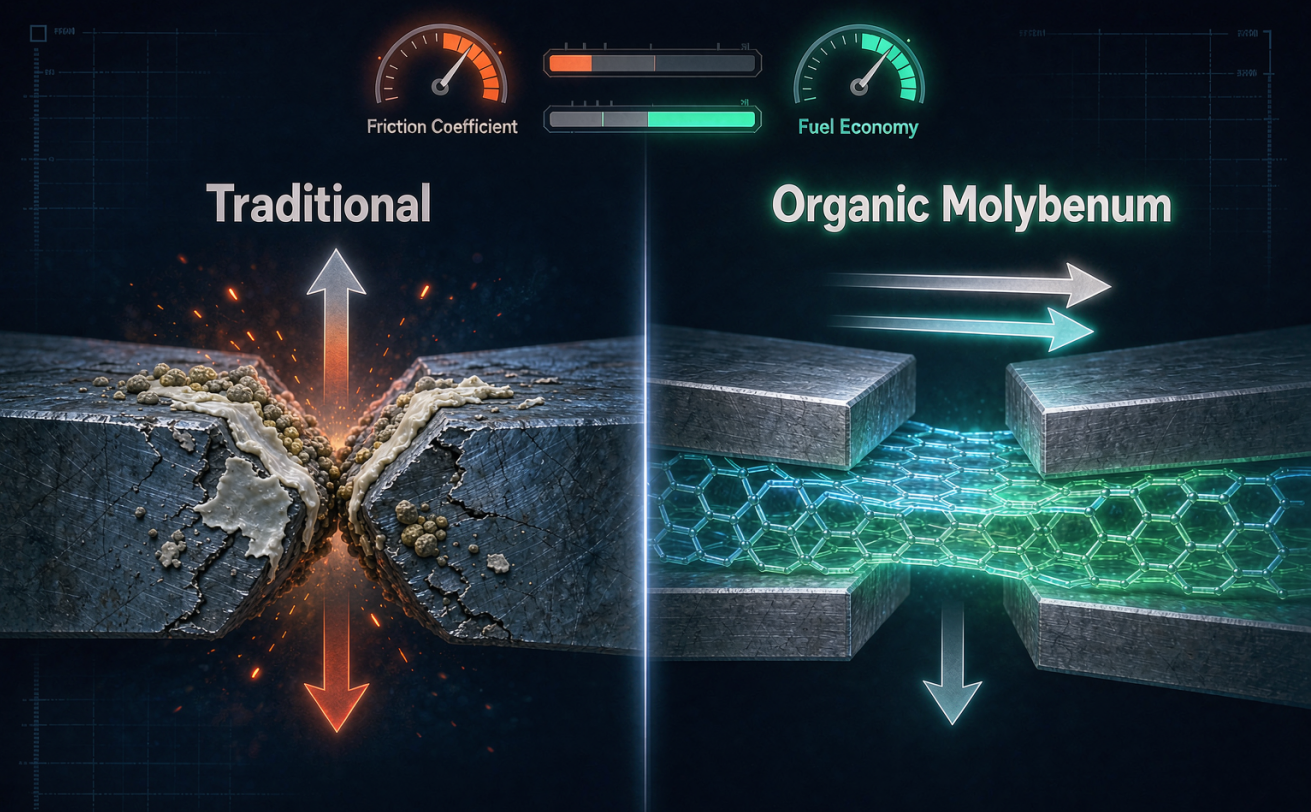
Why Friction Coefficient and Fuel Economy Belong Together
In any lubricated machine, energy lost to friction is energy that never reaches the output shaft. Under hydrodynamic lubrication the oil film separates the surfaces and friction is governed mainly by viscosity. The real challenge begins under boundary and mixed lubrication — at startup and shutdown, under high load, low speed or elevated temperature — where the film thins and metal asperities make contact. This is the regime where friction modifiers matter most, and where the difference between one chemistry and another shows up directly in both the coefficient of friction and fuel consumption. Two broad approaches compete in modern formulations: traditional friction modifiers such as fatty acids, esters, polymers, solid particles and ZDDP-type compounds, and oil-soluble organic molybdenum compounds. This article compares them head-to-head on the two metrics that formulators and end users care about most.
Traditional Friction Modifiers: How They Work and Where They Fall Short
Traditional friction modifiers come in several families, each reducing friction by a different mechanism. Organic compounds such as fatty acids, amides and esters (for example stearic and oleic acid, or glycerol monostearate) adsorb on metal surfaces and form a thin, low-shear layer. Polymers such as PAG, PTFE and PAO build a brush-like boundary layer that lowers shear forces. Solid particles such as graphite, molybdenum disulfide and tungsten disulfide act as a cushion that prevents direct metal-to-metal contact. Inorganic compounds such as ZDDP form protective reaction films under pressure. Each approach helps, but each carries limits: adsorbed organic films can desorb at high temperature, solid particles can settle or filter out and may be inconsistent at thin films, and ZDDP is constrained by phosphorus and ash limits in modern specifications. These limitations are what drive the search for a more robust boundary-lubrication additive.
Organic Molybdenum Friction Modifiers: Oil-Soluble and Film-Forming
Organic molybdenum friction modifiers are oil-soluble organometallic compounds in which molybdenum is chemically bonded to sulfur- and/or phosphorus-containing ligands. Unlike solid MoS2 powder, they dissolve molecularly in the base oil and generate a protective film in situ. At the contact zone, heat and pressure drive tribochemical decomposition: the molecule adsorbs on the metal surface and converts into a thin, patched layer rich in molybdenum disulfide. MoS2 is strongly bonded within each crystal layer but shears easily between layers, so sliding occurs inside the film rather than between metal asperities. The result is a low and stable coefficient of friction under exactly the conditions where conventional films weaken. Depending on the ligand, the same molecule also contributes anti-wear, extreme-pressure and antioxidant performance.
Head-to-Head: Friction Coefficient
The decisive difference is in the boundary regime. Adsorbed fatty-acid and ester films reduce friction at moderate temperature but lose effectiveness as heat rises and the film desorbs. Solid-particle modifiers can lower friction but depend on particles reaching and staying at the contact, which is difficult in thin films and fine-filtration systems. Organic molybdenum does not rely on a physisorbed layer or on suspended particles: it chemically builds a MoS2-rich tribofilm that is tenacious under load and self-renewing as the additive continuously reacts at the interface. The MoS2 layers have very low shear strength, which keeps the coefficient of friction low and, importantly, stable as speed, load and temperature change. This is why organic molybdenum typically delivers the lowest and most consistent boundary friction coefficient of the approaches compared here.
Head-to-Head: Fuel Economy and Energy Efficiency
Fuel economy follows friction directly: less energy lost at the contact means less fuel burned for the same work. Organic molybdenum lowers friction across a broader range of operating conditions than traditional modifiers, so the fuel-economy benefit persists beyond a narrow steady-state window — through cold starts, urban stop-and-go driving and high-load operation. In engines this translates into measurable reductions in fuel consumption and CO2 output; in industrial systems it appears as lower power draw, reduced operating temperature and longer oil and equipment life. Traditional modifiers can improve efficiency in a favorable window, but their benefit tends to fade when the Lubrication regime or temperature moves outside that window. For formulators targeting fuel-economy specifications, organic molybdenum offers the more durable lever.
Beyond the Two Metrics: Durability, Compatibility and Selection
Organic molybdenum also scores on ancillary performance. The tribofilm and the sulfur/ phosphorus reaction layers provide anti-wear and extreme-pressure protection, while molybdenum species contribute oxidation control — benefits that extend component and oil life. Selection still depends on the application: MoDTP grades such as MSAIL 300L and MSAIL 300LB offer the broadest multifunctional protection; phosphorus-free MoDTC grades MSAIL 525A and MSAIL 525B suit low-phosphorus formulations; and the sulfur/phosphorus-free complex MSAIL 8550 fits low-ash and environmentally sensitive systems. In all cases, confirm solubility in the base oil, compatibility with the additive package, and compliance with phosphorus, sulfur and ash limits before fixing a treat rate.
UNPChemicals Organic Molybdenum Product Portfolio
- MSAIL 300L (Molybdenum dithiophosphate, MoDTP; CAS 72030-25-2): liquid organic molybdenum containing sulfur and phosphorus (Mo 9.1%, S 11.3%, P 3.2%); greatly reduces the coefficient of friction with EP, anti-wear and antioxidant functions.
- MSAIL 300LB (MoDTP; CAS 68958-92-9): higher-sulfur, higher-phosphorus variant (Mo 8.0%, S 12.0%, P 6.0%) for demanding boundary and EP conditions.
- MSAIL 525A (Molybdenum dithiocarbamate, MoDTC; CAS 253873-83-5): phosphate-free liquid organic molybdenum (Mo 10.0%, S 11.0%) with friction reduction, anti-wear and antioxidant performance.
- MSAIL 525B (Long-chain MoDTC; CAS 71342-89-7): phosphorus-free long-chain dialkyl dithiocarbamate molybdenum (Mo 10.0%, S 10.7%) with enhanced solubility and strong friction reduction.
- MSAIL 8550 (Organomolybdenum complex, S/P-free; CAS 445409-27-8): versatile, environmentally friendly additive (Mo 7.9%) with exceptional friction reduction, superior performance with sulfur additives and antioxidant synergism.
Organic Molybdenum Friction Modifier Manufacturer
UNPChemicals is a professional and trusted friction modifier manufacturer, producing a high-quality range of lubricant additives tailored to customers' workflows and products. Its dedicated organic molybdenum portfolio covers every major chemistry — molybdenum dithiophosphate (MoDTP), molybdenum dithiocarbamate (MoDTC), long-chain MoDTC and sulfur/phosphorus-free organomolybdenum complexes — supporting formulators in engine oils, industrial lubricants, metalworking fluids and greases. Every grade referenced in this comparison comes from UNPChemicals' own friction-modifier range, so the performance discussion above reflects real, commercially available products rather than generic chemistry.
Looking for a reliable organic molybdenum friction modifier manufacturer? UNPChemicals combines that focused product range with practical formulation support. Whether you need the multifunctional protection of MoDTP, the low-phosphorus profile of MoDTC, or the low-ash chemistry of an S/P-free organomolybdenum complex, our technical-sales team can recommend a grade, supply detailed datasheets and develop custom solutions around your base oil, additive package and performance targets. Contact UNPChemicals today for samples, specifications and formulation recommendations for your friction-modifier projects.