 WhatsApp
 sales@unpchemicals.com
 +86 16638830202
Industry-Wide Operational Challenges
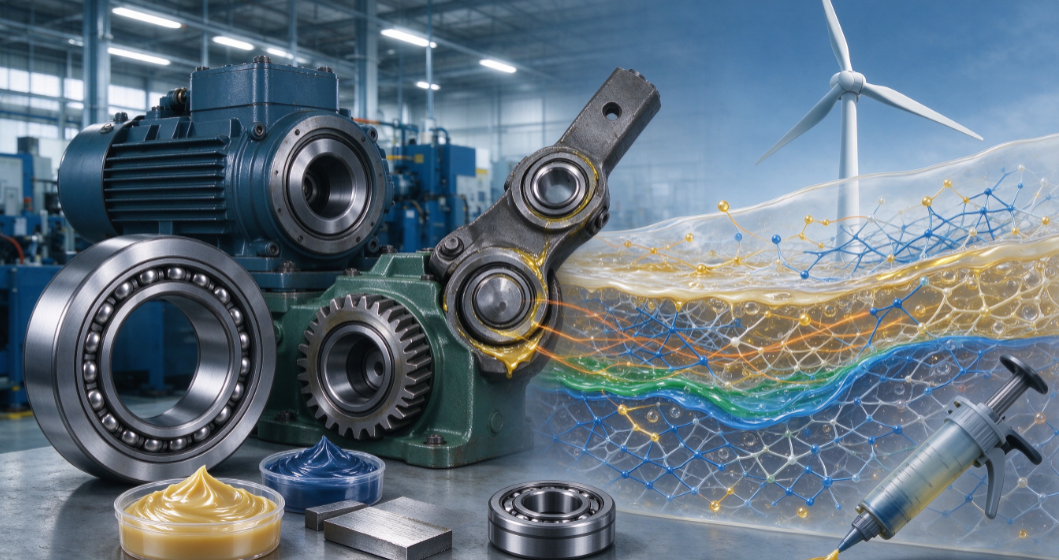
Automotive, industrial, aerospace and marine machinery frequently operate under combined harsh conditions including heavy load, vibration, salt-water corrosion, wide temperature fluctuation and continuous mechanical shear. Base grease composed merely of base oil plus thickener cannot independently satisfy comprehensive service requirements. Without properly compounded grease additive-package solutions, facilities suffer multiple failure risks: accelerated oxidative hardening of grease, insufficient extreme-pressure protection for friction pairs, metal rusting under humid-saline surroundings, grease loss caused by vibration displacement and shortened re-greasing service intervals. Formulators rely on pre-blended multi-functional grease additive packages to simplify formulation development and deliver balanced comprehensive performance for diversified semi-solid lubricant end-products.
What is Lubricating Grease?
Lubricating grease is a semi-solid to solid lubricant composed of a thickening agent dispersed in a liquid lubricant. The thickening agent gives grease its characteristic consistency, allowing it to adhere to surfaces and stay in place, providing long-lasting lubrication. It is widely used in various industrial and mechanical applications where a more viscous and adherent lubricant is required compared to oils. Grease offers excellent protection against wear, corrosion, and contamination, especially in situations where there is a risk of the lubricant being displaced or washed away. It can withstand moderate to high loads and is suitable for applications with slow to moderate speeds. Common base oils used in grease formulation include mineral oils, synthetic oils, or vegetable oils, each offering different performance characteristics.
Core Principles & Fundamental Classification
Grease additive packages are pre-formulated multi-component chemical blends for performance upgrading of base-grease matrices. Analogous to paraffin inhibitors modifying wax-crystal morphology without removing paraffin from crude oil: grease additive packages do not alter the intrinsic semi-solid structural characteristics built by grease thickener-base-oil networks. Instead, multiple functional ingredients work synergistically at molecular and interfacial levels to realize anti-oxidation, extreme-pressure anti-wear, corrosion-resistance and surface-adhesion improvement.
According to application-oriented positioning, they are sorted into multiple major product families: - General-purpose grease additive packages: Universal compound blends for conventional multi-scene grease manufacturing. - Mine-special high-EP grease additive packages: Low-odor formulations adapted for heavy-duty mining working conditions. - Automotive chassis-wheel-hub dedicated packages: Light-colored long-life additive systems for vehicle wheel-hub and chassis greases. - Polyurea-grease-specific additive packages: Component combinations matched to polyurea thickener semi-solid matrices. - Low-friction special-purpose packages: Formulations for universal joints, wind-power equipment and other low-friction-demand scenarios.
Typical functional components contained inside these packages include antioxidants, anti-wear / extreme-pressure agents, corrosion inhibitors and tackifiers.
Performance-Driven Working Mechanisms
Different functional components within blended grease additive packages realize performance improvement through distinct molecular pathways: - Anti-wear & Extreme-Pressure Components: Build composite physical-chemical protective films on metal contact surfaces. Under normal-load conditions, physical barrier layers mitigate direct metal-to-metal contact; when load rises sharply, active ingredients chemically react with metal substrates to form durable tribochemical layers, preventing scoring and seizure under heavy-load impact. - Antioxidant Components: Scavenge free radicals generated by heat, oxygen and mechanical shear, interrupting grease oxidative chain-reactions. They restrain grease hardening, acid generation and performance degradation, extending the service life of semi-solid grease matrices. - Corrosion Inhibitors: Adsorb onto metal surfaces and form dense barrier films, isolating metal substrates from moisture, salt spray and other corrosive media to suppress rust and electrochemical corrosion. - Tackifier Components: Interact with base-grease systems and metal surfaces to enhance grease surface adhesion. They effectively resist grease displacement caused by vibration, shock and washing-off, ensuring lasting lubricant coverage for friction pairs.
Consequences of Improper Additive-Package Selection
Inadequate or mismatched additive-package selection brings multiple operational risks. Chemical incompatibility between additive-package and base-grease thickener systems triggers consistency drift, phase separation and performance decay. Insufficient extreme-pressure capacity leads to rapid wear or seizure of bearings and joint friction pairs. Inadequate antioxidant capability causes grease oxidative hardening and failure in high-temperature service environments. Packages lacking corrosion-inhibiting components cannot resist salt-water and humid-atmosphere corrosion in marine-outdoor scenarios. Unmatched tackifier performance results in grease throwing-off under heavy vibration. All above-mentioned failures shorten re-lubrication cycles, raise maintenance frequency and increase comprehensive operating costs for end-user equipment.
Commercial Additive Portfolio Overview
- UNP G8001: General-purpose lubricating-grease additive package. Possesses balanced lubricity, anti-corrosion, anti-wear and anti-oxidation properties for diversified conventional grease-formulation projects. - UNP G8002: Low-odor, high-extreme-pressure grease additive package specially developed for mining industry. Tailored for harsh heavy-load mining-site lubricating-grease manufacturing. - UNP G8003: Light-colored long-life grease additive package dedicated to automotive wheel-hub and chassis grease, oriented for vehicle-related grease-formulation requirements. - UNP G8004: Special additive package for polyurea-based lubricating greases. Formulated with components compatible with polyurea thickener matrices; delivers outstanding lubricity, anti-corrosion, anti-wear and long-term stability performance. - UNP G8005: Low-friction grease additive package for automotive universal joints, wind-power equipment and analogous low-friction-demand mechanical systems.
Critical Performance Metrics for Qualified Grease Additive Packages
Following the unified evaluation framework across UNPChemicals technical review series, high-quality grease additive packages shall meet four core performance metrics:
1. High efficiency at low treat rates: Achieve target anti-oxidation, anti-wear, EP-protection and anti-corrosion performance under economical addition dosage without destroying the original thickener network structure of base grease.
2. Broad formulation compatibility: Good mutual compatibility among internal components; stable dispersion within lithium-, calcium-, polyurea-type and other base-grease matrices; avoid consistency mutation or phase separation.
3. Robust environmental stability: Retain integrated functional performance under wide-range temperature variation, mechanical vibration, shear and humid-saline corrosive surroundings.
4. Practical industrial processability: Adapt to grease-manufacturing batching workflows; finished greases shall satisfy corresponding industry standards and certification requirements such as API, SAE, NSF and MIL-specifications.
Application Domains & Formulation Selection Guidelines
These grease additive-package systems serve multiple industrial and transportation segments:
1. Automotive sector: Wheel-hub bearings, chassis components, universal joints and vehicle accessory lubricating-grease formulation.
2. General industrial machinery: Conveyor equipment, motors, pumps and various bearing-oriented grease-manufacturing tasks.
3. Aerospace industry: Landing-gear, actuator and engine-accessory greases complying with strict high-reliability specifications.
4. Marine and offshore facilities: Deck machinery, shaft equipment and offshore production-site greases resisting salt-spray corrosion.
5. Mining & wind-power industries: Heavy-load mining machinery and wind-power-equipment-specific grease-formulation projects.
Formulators need to comprehensively evaluate operating temperature range, load magnitude, vibration intensity, environmental corrosiveness, base-grease thickener type and relevant industry-certification requirements before final grade selection: - Choose UNP G8001 for conventional general-purpose lubricating-grease compounding. - Adopt UNP G8002 for mining-oriented heavy-load grease-formulation with low-odor requirements. - Select UNP G8003 when producing light-colored long-life greases for automotive wheel-hub and chassis applications. - Deploy UNP G8004 exclusively for polyurea-thickened grease formulation projects. - Use UNP G8005 for scenarios requiring low-friction performance such as automotive universal joints and wind-power equipment.
Concluding Remarks
Reliable semi-solid grease lubrication performance relies not only on base-oil and thickener-network performance but also on rationally-matched multi-functional additive-package design. Pre-blended grease additive-packages integrate antioxidant, anti-wear-EP, corrosion-inhibitor and tackifier functions. Proper grade selection simplifies grease-formulation workflows, improves grease anti-oxidation life, heavy-load protection and anti-displacement capability, and satisfies performance requirements for automotive, industrial, aerospace and marine-mining equipment, lowering overall equipment-maintenance expenditures for end-users.
Contact UNPChemicals technical-sales team for datasheets, formulation recommendations and custom-grade support for your specific lubricating-grease-formulation projects.