 WhatsApp
 sales@unpchemicals.com
 +86 16638830202
What is a Demulsifier?
Why Desalting and Dehydration Matter in Crude Oil Processing
Objective | Consequence in refining |
Removal of chlorides | Reduces hydrogen chloride formation; mitigates corrosion in atmospheric and vacuum column overhead systems |
Removal of solid impurities | Reduces fouling of furnace tubes and heat exchangers; improves heat transfer; reduces tube wear |
Removal of metals (As, Ni, Na) | Extends catalyst life and lowers catalyst consumption in reforming and cracking units |
Reduction of ash in heavy fractions | Improves the quality of the products derived from the heavy oil |
Removal of water | Cuts transport energy and furnace heat load; prevents column-flooding accidents |
The Electrostatic Desalting Process and Its Governing Parameters
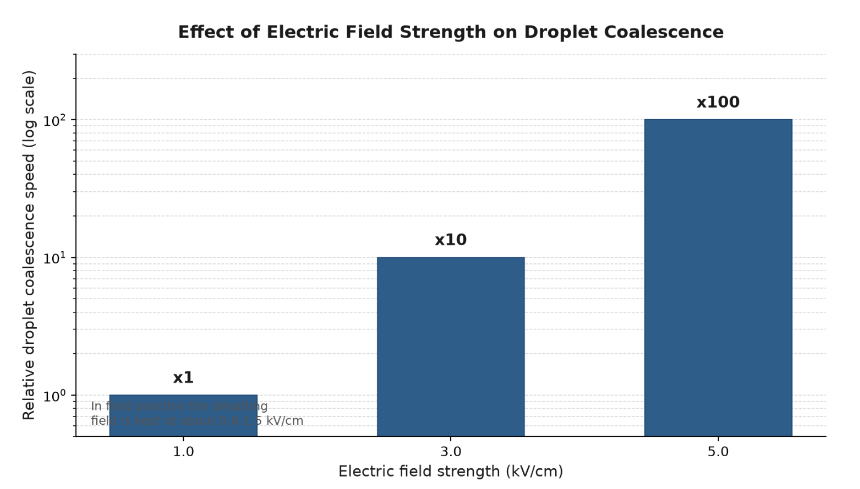
The degree of salt removal depends to a large extent upon the intimacy of the contact between the crude, the wash water, and the demulsifier, for deep desalting requires the crude to be thoroughly mixed with the wash water so that fresh droplets come into full contact with the saline droplets, yet over-vigorous mixing can generate an emulsion that is itself difficult to break; for this reason a controllable oil-water mixer, typically a mixing valve whose mixing capacity is regulated by the pressure drop across it, is required so that the optimum degree of mixing can be maintained in every situation, with the pressure drop serving as an indicator of how finely the wash water has been dispersed in the crude and the appropriate mixing intensity being that which achieves the desired degree of mixing without causing serious emulsification of the two phases. The electric field acts chiefly to coalesce the polar water droplets and to break the water-in-oil emulsion, for droplets placed in the field are agitated by the field, undergo rapid disordered movement, and, together with Brownian motion, collide much more frequently, so that when the velocity of collision is high enough the droplets coalesce and settle under gravity. The breaking of an oil-water emulsion is an extremely complex process whose efficiency depends upon the nature of the emulsion, the strength of the electric field, and the whole set of process conditions, and it has been reported that the rate of droplet coalescence rises steeply with field strength, being roughly ten times higher at 3 kV/cm than at 1 kV/cm and again roughly ten times higher at 5 kV/cm than at 3 kV/cm; over many years of experiments with different fields it has been found that the field strength on site can be controlled within the range of about 0.8 to 1.5 kV/cm. This steep dependence of the coalescence speed on field strength is illustrated in Figure 1.
Parameter | Typical setting | Principal effect |
Temperature | About 110-135 degrees Celsius | Lowers viscosity and increases density difference; too high a temperature raises conductivity and current |
Strong-field residence time | At least 2-4 minutes | Ensures droplet coalescence in the strong field |
Weak-field residence time | At least 4-6 minutes | Ensures settling in the weak field |
Demulsifier dosage | About 15-40 ppm | Sets the breaking and coalescence performance |
Wash-water rate | About 3-8 percent per stage, with two or more stages | Provides the vehicle of desalting and dilutes the saline droplets |
Mixing intensity | Controlled by the pressure drop across the mixing valve | Balances thorough contact against over-emulsification |
Field strength | About 0.8-1.5 kV/cm on site | Drives droplet coalescence; the speed rises about tenfold for each 2 kV/cm step |
Comparison of Oil-Water Separation Methods
Method | Primary mechanism | Typical application | Key advantages | Principal limitations |
Heating | Lowers viscosity and density difference; accelerates flocculation | Treaters, heaters, upstream of separators | Simple and widely applicable; boosts demulsifier performance | High energy cost; risk of light-end loss and corrosion |
Centrifugation | Applies centrifugal force to separate by density | Oily-water treatment; laboratory bottle testing | Very fast separation; compact equipment | High capital and operating costs; limited scale-up |
Time and gravity settling | Allows gravity to act over a long residence time | Long flowlines, storage tanks, settling vessels | No energy input; passive and reliable | Large footprint; slow; ineffective for stable emulsions |
Electric field (AC) | Induces dipolar charges; increases collision and coalescence | Electrostatic treaters; crude desalting | Very low residual water and salt; high throughput | Requires conductive continuous oil phase; less effective for heavy crude |
Chemical demulsifiers | Displaces natural emulsifiers; disrupts the film; promotes coalescence | Downhole, wellhead, flowline, separator inlet | Versatile, cost-effective, flexible injection points, tunable chemistry | Requires optimization; risk of over-treatment; possible water carry-over |