 WhatsApp
 sales@unpchemicals.com
 +86 16638830202

What is a Demulsifier?
The Formation and Stabilization of Crude Oil Emulsions
Category | Nature and typical examples | Characteristic size or MW | Stabilization mechanism |
Solids dispersed in oil | Clay, rock dust, crystalline paraffin wax | Diameters generally < 2 um | Adsorbed at the interface with resins and asphaltenes, forming a surface film |
Resins and asphaltenes | High-molecular-weight O-, N-, and S-bearing hydrocarbons | Resins about 570-1,000; asphaltenes about 900-3,500 | Form a mechanically strong protective film |
Substances dissolved in oil | Naphthenic acids and related surface-active compounds | - | Molecular adsorption; surface activity |
Substances dissolved in water | Certain salts and highly polar surface-active materials | - | Interface-active stabilization of droplets |
Demulsification Mechanisms and the Behaviour of Demulsifiers in Solution
Classification of Demulsifiers by Ionic Type and Solubility
Class | Behaviour of the hydrophilic group in water | Typical examples |
Anionic | Shows anionic character when dispersed in water | Soaps (fatty-acid sodium salts), sulfate esters, sulfonates, phosphate esters |
Cationic | Shows cationic character | Amine salts, quaternary ammonium salts |
Amphoteric | Carries both positive and negative charges at the hydrophilic end | Amino-acid-type sodium dodecylaminopropionate; betaine-type alkyl dimethyl betaines |
Nonionic | Does not dissociate into ions | Polyethylene-glycol type (e.g. alkylphenol polyoxyethylene ethers); grades AE-1910, BP-2040, FC-961, FC-9300, GT-922 |
Selection Criteria for an Ideal Demulsifier
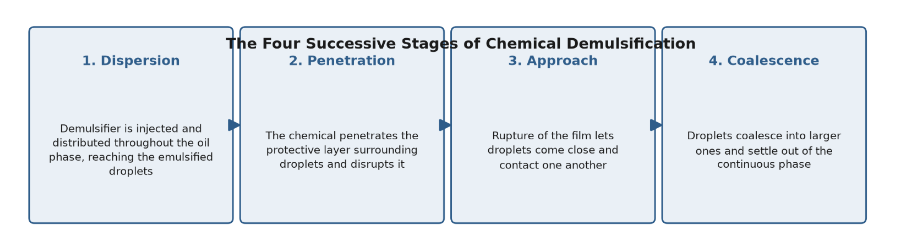
In accordance with the action history of a demulsifier and the fundamental model of emulsion breakdown, the chemical breaking process itself is generally considered to take place in four stages. In the first stage the demulsifier is added to the crude oil and distributed throughout the entire oil phase so that it reaches the emulsified water droplets; in the second stage the chemical enters the protective layer surrounding the emulsified droplets and destroys it; in the third stage, once the protective layer has been broken, the emulsified droplets approach one another and come into contact; and in the fourth and final stage the droplets coalesce and the emulsified water separates from the continuous phase. This four-stage picture, which is represented schematically in Figure 1, provides a convenient framework for understanding what an effective demulsifier must be able to accomplish.
Requirement | What it ensures in the breaking process |
Strong surface activity | Preferential adsorption at the oil-water interface; lowers droplet surface tension and film strength |
Good wetting properties | Diffusion to the droplets, penetration of the protective layer, and reduction of inter-particle cohesion |
Sufficient flocculation capacity | Brings the droplets close together, increasing collision and coalescence opportunities |
High coalescence capacity | Small droplets merge into large drops that settle by gravity |