 WhatsApp
 sales@unpchemicals.com
 +86 16638830202
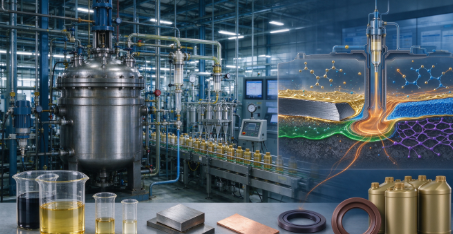
Industry-Wide Operational Challenges
Modern lubricant manufacturing faces multi-dimensional pressures including tightening environmental regulations, growing demand for energy-saving performance, rising market share of synthetic and bio-based base stocks, and the digital transformation brought by Industry 4.0. Simply mixing base oil cannot meet diversified end-use requirements. Without rationally-selected single-component specialty additives, finished lubricants will suffer high friction loss, metal corrosion, seal-material incompatibility, copper-alloy corrosive attack and insufficient anti-oxidation performance. Formulators must pick suitable individual additives, match base-oil properties and manufacturing process parameters to resolve these formulation and production bottlenecks.
What is a lubricant?
A lubricant is a substance, such as oil or grease, used to reduce friction, wear, and heat between interacting surfaces and protect machinery and components. It provides a layer between the surfaces in relative motion, minimizing metal-to-metal contact, thereby preventing wear and damage. Lubricants also have additional functions, such as cooling, cleaning, corrosion prevention, and sealing.
Core Principles & Fundamental Classification
Special-function single-component lubricant additives are pure or concentrated individual chemical substances for performance upgrading during lubricant blending. Analogous to paraffin inhibitors modifying wax-crystal morphology without removing paraffin from crude oil: single-component additives cannot replace the fundamental hydrodynamic-lubrication capability of base oils. Instead, individual molecules act at molecular and interfacial levels to deliver friction-reduction, metal-deactivation, seal-compatibility, extreme-pressure anti-wear and anti-oxidation effects.
According to functional orientation, these single-component additives are divided into five primary groups: - Organic-molybdenum friction-modifying additives: Liquid / solid Mo-based substances for friction reduction, anti-wear and antioxidation. - Seal-swell additives: Special components for rubber-seal compatibility adjustment. - Ash-less thiadiazole-series metal deactivators: Copper-alloy corrosion-suppressing additives with auxiliary EP-antioxidant performance. - Molybdenum-dithiophosphate extreme-pressure anti-wear ingredients: Sulfur-phosphorus-containing molybdenum additives with comprehensive tribological properties. - Amine-neutralized phosphate-ester multifunctional additives: Ash-less load-bearing anti-wear components for lubricants and metal-working fluids.
Performance-Driven Working Mechanisms
Different single-component additives realize performance improvement through distinct molecular pathways: - Organic-molybdenum friction modifiers: Under boundary-lubrication conditions, molybdenum-containing molecules decompose and form low-friction tribochemical films on metal friction surfaces, lowering friction coefficient while delivering supplementary anti-wear and antioxidation effects for engine oils, industrial lubricants, greases and metal-working fluids. - Seal-swell additives: Interact with rubber-seal polymer networks to produce controlled moderate swelling. They prevent seal hardening-shrinking-leakage and maintain long-term sealing integrity for lubrication systems. - Thiadiazole-type metal deactivators: Adsorb onto copper-and-copper-alloy surfaces to form dense protective barrier films, isolating base-fluid-dissolved active-sulfur species and inhibiting copper corrosion; partial grades also suppress hydrogen-sulfide-triggered corrosion and provide auxiliary extreme-pressure and antioxidant functions. - Amine-neutralized mixed-phosphate-ester additives: Form high-strength boundary-lubrication films on metal surfaces under high-temperature working conditions, offering excellent load-bearing and anti-corrosion performance; capable of partially reducing dosage demands for other rust-inhibitor and anti-emulsifier components.
Consequences of Improper Additive Selection
Inadequate or mismatched single-component additive selection brings multiple operational risks. Incompatibility between additive and base-oil / other co-additives triggers precipitation, phase separation and loss-of-function inside blended lubricants. Unsuitable friction-modifier grades fail to reduce friction coefficient and cannot achieve energy-saving targets. Missing seal-swell additives will cause rubber-seal shrinkage-hardening and system fluid leakage. Insufficient metal-deactivator dosage leads to severe corrosion of copper-alloy parts induced by active sulfur. Improper additive matching also makes finished products fail environmental-protection and OEM-specification requirements. All these defects increase production reject rates and shorten service life of end-user mechanical equipment.
Commercial Additive Portfolio Overview
- MSAIL 525A (MoDTC, Molybdenum dithiocarbamate): Phosphate-free liquid organic-molybdenum friction modifier; delivers friction-reduction, anti-wear and antioxidation; applicable for engine oils, industrial lubricants, neat metalworking fluids and greases, CAS 253873-83-5.
- MSAIL 8550 (S/P-free organomolybdenum complex): Eco-friendly versatile organomolybdenum complex; exhibits synergistic performance with sulfur-containing additives; for engine oils, industrial oils, neat metalworking fluids and greases, CAS 445409-27-8.
- DMET 7300 (Sulfolane-type seal swell agent): Low-dosage hydrolysis-resistant seal-expansion additive; improves compatibility between base oil and various rubber-seal materials, CAS 18760-44-6.
- CSAIL T561 (Thiadiazole tert-dodecyl-mercaptan condensate): Liquid ash-less metal deactivator with EP-antioxidant auxiliary effect; suppresses active-sulfur-caused copper-alloy corrosion at low dosage; for automotive-industrial lubricants and metalworking fluids, CAS 59656-20-1.
- MSAIL 300L (MoDTP, Molybdenum dithiophosphate): Sulfur-phosphorus-containing liquid organomolybdenum additive; integrates extreme-pressure, anti-wear, friction-reduction and antioxidation; suitable for engine oils, industrial lubricants, neat metal-working fluids and greases, CAS 72030-25-2.
- DMTD-8 (Thiadiazole octyl-mercaptan condensate): Liquid ash-less metal deactivator with auxiliary EP-antioxidant performance; resists copper corrosion from active sulfur and inhibits hydrogen-sulfide-induced corrosion, CAS 13539-13-4.
- DMTD-9 (Thiadiazole tert-nonyl-mercaptan condensate): Organosulfur multi-purpose additive, deployed in lubricants, fuels and metal-working-fluid formulations, CAS 91648-65-6.
- EPSAIL T351 (Molybdenum dibutyl dithiocarbamate / Power-type MoDTC): Solid organomolybdenum EP-anti-wear agent; good antioxidation and anti-wear; can partially or fully replace molybdenum disulfide in lubricants and greases, CAS 68412-26-0.
- PSAIL 2280 (Amine-neutralized mixed-phosphate esters): Ash-less multifunctional phosphate-ester-amine-salt additive; high load-bearing and anti-corrosion capacity; forms thick boundary-lubrication films under high-temperature conditions, widely applied in metal-working-fluid formulations together with sulfur carriers, CAS 68603-55-4.
Critical Performance Metrics for Qualified Single-Component Additives
Following the unified evaluation framework across UNPChemicals technical review series, high-quality single-component lubricant additives shall meet four core performance metrics:
1. High efficiency at low treat rates: Realize target friction-modification, metal-deactivation, seal-adjustment or extreme-pressure performance under economical additive dosage.
2. Broad formulation compatibility: Chemically compatible with diverse base-oil stocks and other co-existing additives; avoid precipitation, sediment or antagonistic side-reactions.
3. Robust environmental stability: Retain core functional performance under high-temperature, shear, and complex service-fluid conditions; satisfy relevant environmental-toxicity constraints.
4. Practical industrial processability: Possess suitable physical state (liquid / solid) for metering, feeding and blending in lubricant-manufacturing vessels; convenient for quality-control testing during production.
Application Domains & Formulation Selection Guidelines
These single-component additive systems serve multiple lubricant-manufacturing segments:
1. Automotive lubricants: Engine oils, gear oils, transmission fluids and hydraulic fluids for passenger and commercial vehicles.
2. Industrial lubricants: Gearboxes, compressors, turbines, hydraulic systems for manufacturing, power-generation and mining machinery.
3. Marine lubricants: Special-formulation oils protecting ship engines and transmission equipment.
4. Aerospace lubricants: High-reliability lubricant products for aircraft engine and system components.
5. Grease & metal-working-fluid production: Functional ingredients for greases and neat-oil-type metal-working-fluid formulations.
Formulators need to evaluate base-oil type, target operating-condition parameters, sealing-material types, alloy-component characteristics and environmental-regulatory requirements before grade selection: - Select organomolybdenum series (MSAIL 525A / MSAIL 8550 / MSAIL 300L / EPSAIL T351) when friction-reduction, anti-wear and antioxidation performance are required. - Adopt DMET 7300 when rubber-seal-swell compatibility improvement is required for lubricant formulations. - Deploy thiadiazole-series metal-deactivators (CSAIL T561, DMTD-8, DMTD-9) for systems containing copper-alloy parts exposed to active-sulfur corrosion risk. - Use PSAIL 2280 for high-temperature load-bearing scenarios, especially for metal-working-fluid compounding together with sulfur-based extreme-pressure components.
Concluding Remarks
High-quality finished lubricants rely not only on base-oil quality but also on rational screening and matching of single-component specialty additives during the lubricant-manufacturing blending workflow. Various organomolybdenum friction modifiers, seal-swell agents, thiadiazole-based metal-deactivators and phosphate-ester-type multi-functional additives deliver friction-reduction, tribo-film-forming, metal-corrosion-suppression and seal-compatibility-adjustment functions. Correct single-component additive selection helps manufacturers cope with modern-industry challenges including environmental-protection constraints, energy-saving demands and synthetic-base-oil popularization, supporting stable production of qualified automotive, industrial, marine and aerospace-grade lubricant products.
Contact UNPChemicals technical-sales team for datasheets, formulation recommendations and custom-grade support for your specific lubricant-manufacturing projects.