 WhatsApp
 sales@unpchemicals.com
 +86 16638830202

What is a Demulsifier?
Seen from the chemist's point of view, a demulsifier is a surface-active molecule engineered to out-compete the natural emulsifiers of crude oil for positions at the oil-water interface. It is chosen not for the strength of its surface activity alone but for the way it combines that activity with the right balance of oil solubility and water solubility, so that it can travel through the bulk oil to reach a droplet, adsorb onto the interfacial film more strongly than the asphaltenes already there, displace them, and leave behind a film that is weak enough for colliding droplets to rupture and merge. In this sense the demulsifier is a deliberate, molecularly tailored competitor to the asphaltenes and resins that the crude itself brings to the interface, and the selection of the right competitor, by way of the HLB and the relative solubility number and by way of blending, is the subject of the following sections.
Asphaltenes Resins and the Rigid Interfacial Film
The stabilizing film of a crude oil emulsion is built chiefly by the heavy, polar fraction of the oil, and the most important single contributor is the asphaltene fraction, the high-molecular-weight, poly-aromatic fraction that carries nitrogen, oxygen, and sulfur in its structure and that is held in solution in the oil by the surrounding resins. When an oil-water interface is created, these asphaltene molecules, together with the resins, naphthenic acids, and finely divided solids such as clay and wax crystals, adsorb onto that interface and arrange themselves so that their polar ends face the water and their aromatic, oil-soluble ends face the oil. Over time this adsorbed layer thickens and cross-links into a viscoelastic, mechanically strong film that behaves almost like a solid skin around each droplet. It is this skin, rather than the mere presence of surface-active material, that resists coalescence: when two droplets collide, the film on each must first bend and rupture, and a rigid, highly elastic film absorbs the energy of the collision and keeps the droplets apart. The mechanical strength of the film, measured as interfacial rheology, correlates closely with how difficult a crude is to break, and the chemist who understands this film understands the enemy that the demulsifier must attack.
Table 1. Natural interfacial components and the character of the film they form
Component | Nature | Contribution to film stability |
Asphaltenes | High-MW poly-aromatic fraction with N, O, S | Builds a rigid, viscoelastic, cross-linked film; the principal stabilizer |
Resins | Lower-MW polar hydrocarbons solubilizing asphaltenes | Plasticize and reinforce the film; bridge asphaltenes at the interface |
Naphthenic acids | Low-MW, strongly surface-active acids | Adsorb readily; contribute a weaker but fast-forming interfacial layer |
Fine solids | Clay, rock dust, paraffin wax crystals below 2 micrometres | Form a steric, particle barrier; stabilize the emulsion by mechanical scaffolding |
How Demulsifiers Displace Natural Emulsifiers at the Oil-Water Interface
A demulsifier attacks the rigid film through competitive adsorption, a process that is best understood as a contest for a limited number of seats at the interface. When the demulsifier is injected it must first dissolve in the continuous oil phase, because a product that does not travel through the oil can never reach the droplets; it then diffuses toward the interface and, because its molecular structure is chosen to be highly surface-active, it adsorbs more rapidly and more strongly than the asphaltenes that are already there, displacing them from the interfacial seats and pushing them back into the bulk oil. As the demulsifier takes over the film, it does not form a rigid, cross-linked layer of its own; rather, it forms a loosely arranged, mechanically weak layer that offers little resistance to coalescence, and at the same time it lowers the interfacial tension and alters the wetting of any fine particles trapped in the film, so that those particles release from the interface and move back into the oil. The net result is that the skin around a droplet, which was strong enough to survive a collision, is now weak enough to rupture when two droplets touch, and the droplets merge into larger drops that settle. Figure 1 illustrates this displacement schematically, comparing the intact asphaltene-resin film before treatment with the weakened, partially displaced film after the demulsifier has adsorbed.
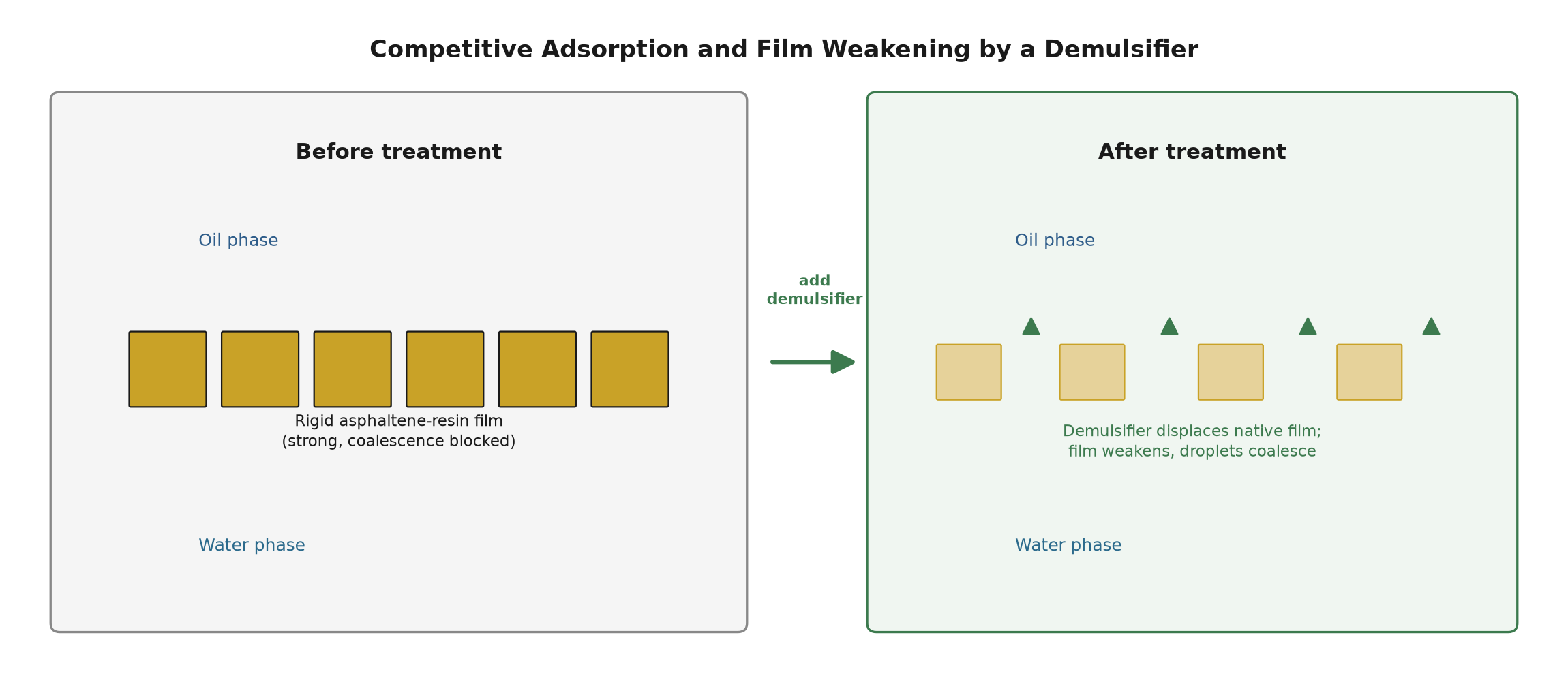
Figure 1. Competitive adsorption and film weakening by a demulsifier at the oil-water interface.
Two further behaviors complete the demulsifier's work. The first is flocculation, in which the demulsifier molecules bridge between neighboring droplets or alter the electrostatic character of their surfaces so that the droplets cluster together, increasing the frequency and force of collisions; the second is coalescence proper, in which the weakened film finally ruptures and the droplets merge. A good demulsifier must do both, and a product that only brings droplets together without weakening the film, or that weakens the film without encouraging collision, leaves the job half done. This is why the molecular architecture of the demulsifier, and not simply its surface activity, is the object of formulation.
HLB RSN and the Molecular Matching of Demulsifier to Crude
The first quantitative scale used to characterize a demulsifier is the hydrophilic-lipophilic balance, or HLB, which places a surface-active molecule on a scale from very oil-soluble, lipophilic products at the low end to very water-soluble, hydrophilic products at the high end. The natural emulsifiers of crude oil, the asphaltenes and resins, are comparatively lipophilic, and an effective demulsifier must be of a compatible and complementary HLB: if the demulsifier is too water-soluble it will partition into the water and never reach the droplet; if it is too oil-soluble it will stay in the bulk oil and adsorb only weakly at the interface. The practical, field-friendly successor to HLB is the relative solubility number, or RSN, a measured value obtained by titrating the product in a water-organic solvent mixture; lower RSN values denote more oil-soluble products and higher RSN values more water-soluble products, and the RSN of a candidate is matched to the API gravity, asphaltene content, and temperature of the crude being treated.
The matching follows a consistent pattern. Heavy, viscous, high-asphaltene crudes generally need the more oil-soluble, lower-RSN demulsifiers, because these products dissolve readily in the heavy oil, travel to the interface, and displace the lipophilic asphaltene film; lighter, lower-viscosity crudes, and emulsions with a high water cut, often respond to the more water-soluble, higher-RSN products, which wet the droplet surface and promote the rapid water dropout. The optimal RSN also shifts with temperature, because heating changes both the viscosity of the oil and the solubility of the demulsifier, and this is why a product that performs well at one treater temperature may be suboptimal at another. The art of selection is therefore to screen a range of RSN values against the actual crude, at the actual temperature, rather than to assume that a single product will suit every field, and it is this RSN-matched range that a modern demulsifier supplier is expected to offer.
Table 2. DEMET demulsifier families and their relative solubility characteristics
Product family | Representative RSN | Best-suited crude or duty |
Resin oxyalkylates | Intermediate to high | General dehydration and desalting; sharp interface control |
Polymerized polyols | Low to intermediate | Heavy, high-asphaltene crudes; deep drying and slow dehydration |
Esterified phenolic polymers | Intermediate | Rapid water dropping; emulsions with strong interfacial films |
Alkoxyamines | Intermediate | Wetting and oil-in-water demulsification; complex crude slates |
Polyoxyalkylene glycols | Wide range | Tunable base for customized field formulations |
Blending and Synergistic Formulation of Multi-Component Demulsifiers
Because no single molecule can be optimal at every stage of demulsification, the commercial demulsifiers that perform best in the field are almost never pure single compounds but carefully optimized blends of two or more chemistries whose roles complement one another. A fast water-dropping chemistry, often a resin oxyalkylate or an esterified phenolic polymer, is chosen to do the early work of breaking the bulk water and creating the first large drops; a slower, deeper polymerized polyol is added to drive the residual water down to the very low levels required for export; and a wetting or interface-control component is added to keep the oil-water boundary sharp and to prevent the formation of a rag layer. The blend is not a random mixture, because the proportions are tuned so that one component's weakness is covered by another's strength, and the resulting synergy gives a performance that neither component can reach alone.
The formulation logic also takes account of the production chemicals already present in the crude, because corrosion inhibitors, scale inhibitors, and paraffin inhibitors are themselves surface-active and can either reinforce the emulsion or be antagonistic to the demulsifier. A blended demulsifier can be designed to tolerate, or even to counter, the effect of these co-chemicals, and the ability to fine-tune a blend against a specific field sample is what distinguishes a supplier's technical service from the off-the-shelf sale of a generic product. Table 3 sets out the roles of the components in a typical synergistic blend, and it is this component logic that the DEMET range of UNPChemicals is built to deliver.
Table 3. Component roles in a synergistic multi-component demulsifier blend
Component role | Representative chemistry | Function in the blend |
Fast water dropper | Resin oxyalkylate or esterified phenolic polymer | Breaks bulk water early; high initial dropout rate |
Deep dryer | Polymerized polyol, low RSN | Drives residual water to low export BS&W over time |
Interface controller | Wetting agent or alkoxyamine | Keeps the oil-water boundary sharp; suppresses rag layer |
Solubilizer / base | Polyoxyalkylene glycol or solvent | Tune solubility and RSN; improve handling and low-temperature flow |
UNPChemicals Demulsifier Products
UNPChemicals, whose registered English name is Luoyang Pacific United Petrochemical Co., Ltd., builds the DEMET demulsifier range on exactly this interface-chemical principle, offering chemistries across the full RSN range so that a product can be matched to the crude rather than forced on it. The portfolio is organized by function as well as by chemistry: a dryer type that drives the residual water content down, a dropper type that gives rapid and voluminous water separation at the first stage, and a desalter type engineered for electric desalting duty, and the individual products within these families span resin oxyalkylates, polymerized polyols, esterified phenolic polymers, alkoxyamines, polyoxyalkylene glycols, and proprietary blends.
Concrete examples make the interface-chemical matching visible. DEMET I-9037 is a polymerized polyol with an RSN of about 7.0 to 9.5, deliberately very oil-soluble, and it is the deep dryer of the family, chosen for heavy, high-asphaltene crudes where the rigid film resists rapid breakage. DEMET C-168 is a resin oxyalkylate with an RSN of about 19.5 to 22.0, acting as both a water dropper and an interface-control agent across a broad range of API crudes, and it supplies the fast, sharp separation that the heavy-polyol alone would be too slow to deliver. DEMET A-21 sits in the middle of the range with an RSN of about 13.5 to 16.0 and is used where both dehydration and desalting are required, while DEMET M-9510 is a proprietary concentrate that already combines water dropping, desalting, and oil brightening in a single optimized blend, with an RSN of about 7.6 to 8.8, and it can be used as supplied or reformulated with other bases to suit a particular crude. Because the catalog spans RSN values from roughly 5.0 to 23.4, UNPChemicals can offer a RSN-matched chemistry, and a supporting multi-component blend, for virtually any crude the operator brings to the bottle test.